The Bengal Acts Like a Dog, Climbs Like a Monkey, and Talks Back
The cat on top of the refrigerator is not stuck. It climbed up there on purpose, it is watching you, and it has opinions about the fact that you have not played with it yet today. That is a Bengal: it will fetch a toy, walk on a leash, splash in the sink, and talk to you in chirps and trills.
That is the whole deal, and the whole warning: a Bengal is not a difficult cat that happens to be beautiful, but a beautiful cat that costs time — two play sessions a day, every day, climbing space, and a home that can take the chaos. This guide explains bengal cat personality as the registries describe it, and what varies cat to cat.
What a Bengal actually is
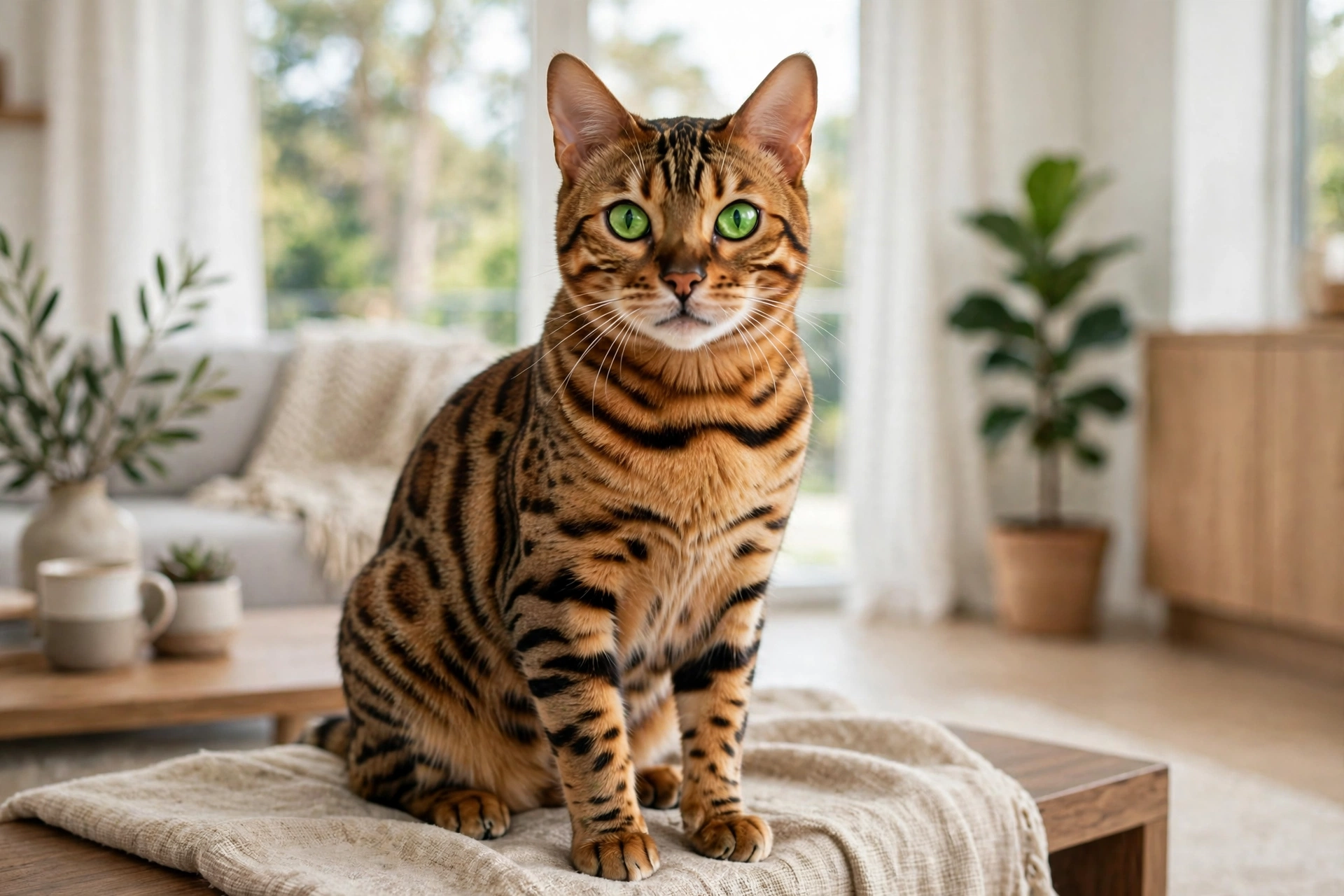
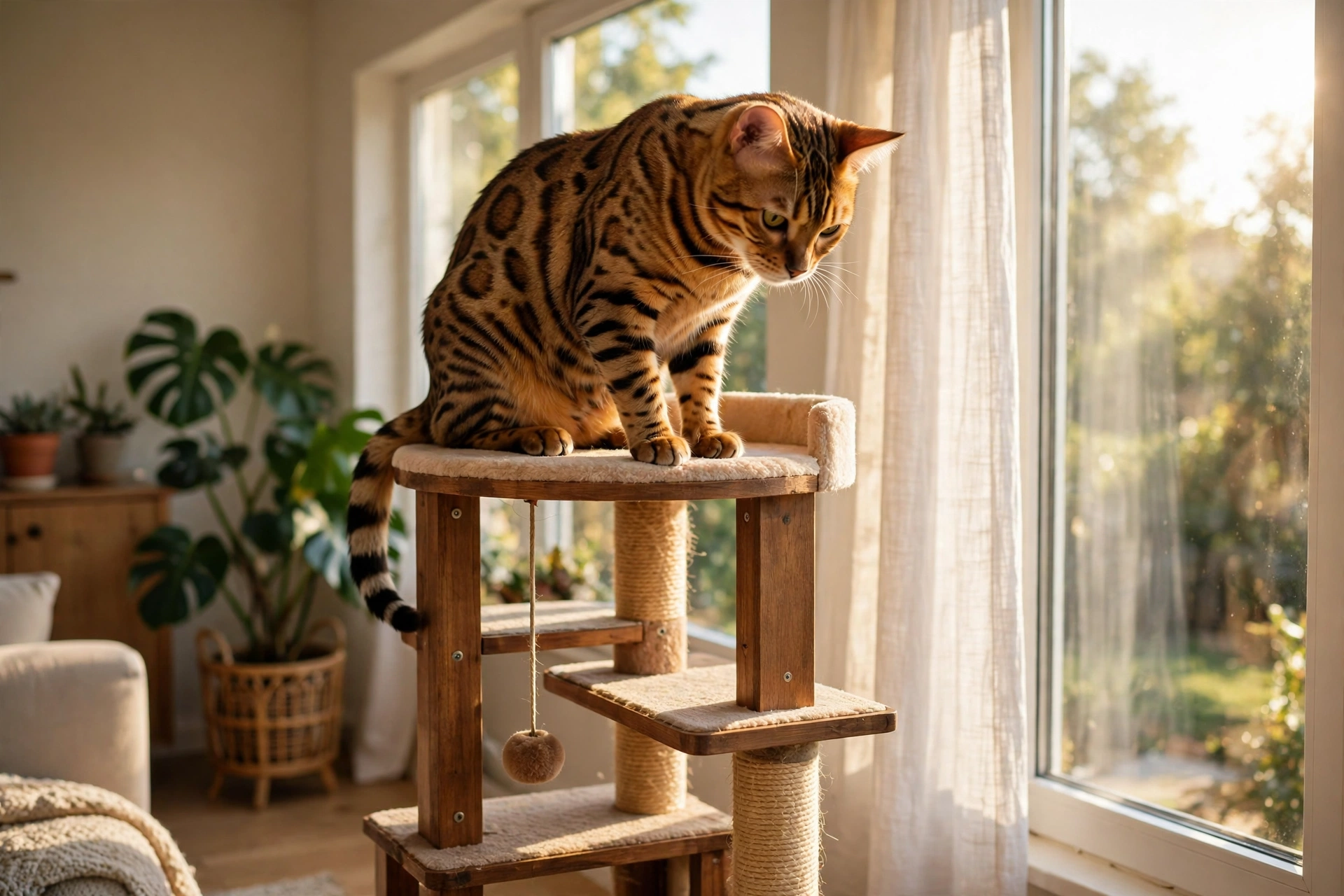
The Bengal is a medium-to-large cat built like an athlete. The Cat Fanciers’ Association describes a sleek, muscular build, hindquarters slightly higher than the shoulders — a body made for jumping. TICA gives the weight as 6 to 15 pounds, males larger than females. The coat is short, close-lying, soft, and luxurious, and it may be glittered — a dusting of gold that catches the light.
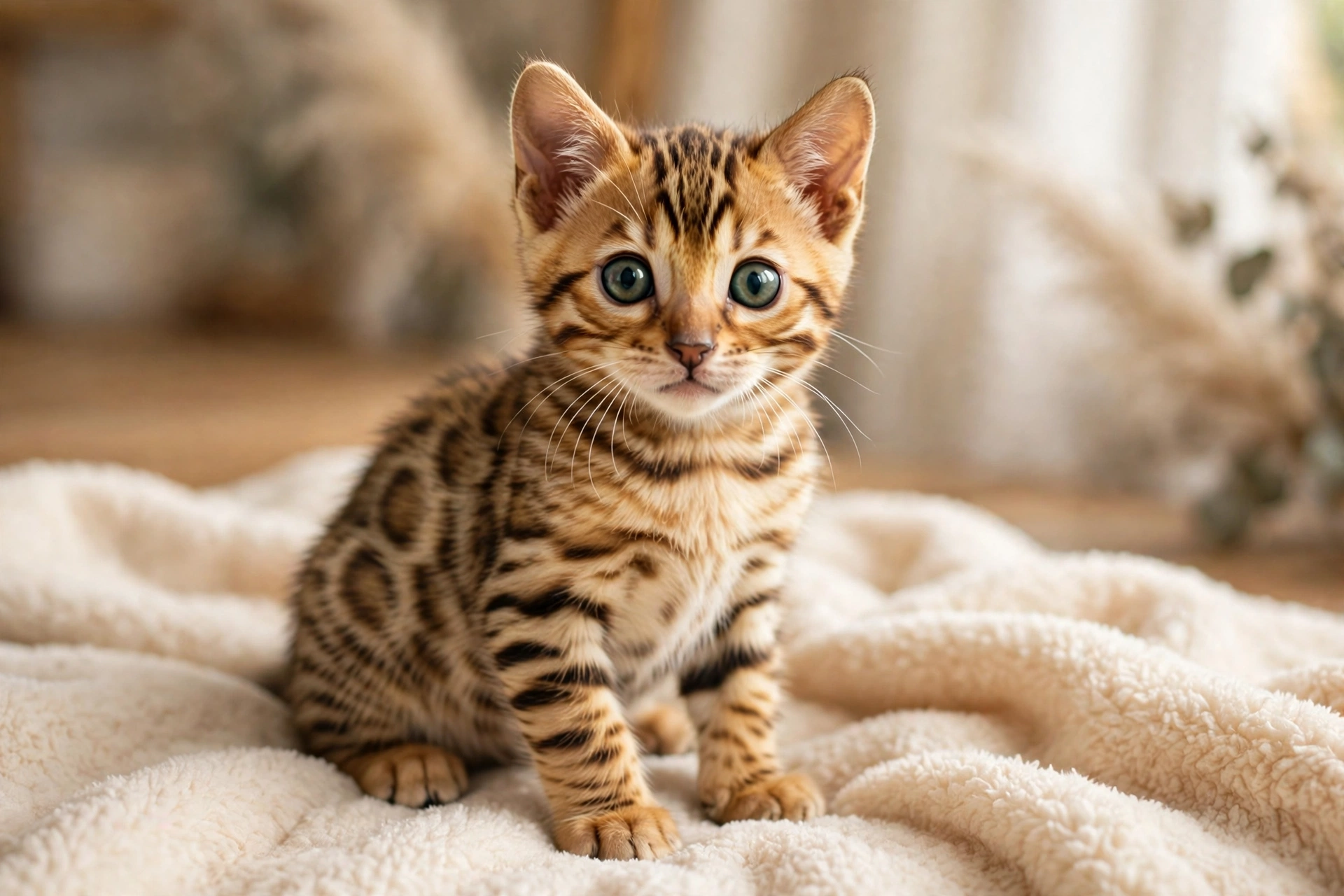
What makes a Bengal unmistakable is the pattern: TICA calls it the only domestic cat that can have rosettes like the leopard, the jaguar, and the ocelot — rings and doughnut shapes, scattered across the flanks. The other pattern is marble, a swirling flow of colour. The most popular colour is the brown or black tabby, from cool grey through golden, bronze, copper, and mahogany. Snow Bengals, from Siamese and Burmese ancestry, have blue to aqua eyes; silver Bengals have a pale coat with dark markings.
One thing a Bengal is not is a cat that sits still — the CFA calls the breed “alert and active, with inquisitive, dependable dispositions” and “curious and athletic.” So the home needs to work in three dimensions: a tall cat tree, shelves to climb, and a window with a view.
The wild ancestor in the family tree
Every Bengal has a wild ancestor, and it is worth understanding what that means, because sellers exaggerate it. In 1963, breeder Jean S. Mill crossed a domestic cat with an Asian leopard cat, a small wild cat of Asia; the modern breed traces to her work in the early 1980s. TICA recognised the Bengal as a new breed in 1986, with championship status in 1991; the CFA accepted it in 2016, for cats six or more generations from the wild ancestor.
The generations are counted precisely. An F1 Bengal is 50 percent wild — the direct offspring of a leopard cat and a domestic cat. An F2 is 25 percent, an F3 is 12.5 percent, and an F4 is 6.25 percent. From F4 onward, TICA calls the cats Stud Book Tradition (SBT) — fully domestic, bred Bengal to Bengal. The early generations, F1 to F3, are Foundation Bengals — not eligible for show, and only the females are used for breeding, because the early-generation males are usually sterile.
In practice, the Bengal you buy from a reputable breeder is an F4 or later, a fully domestic cat. It looks like a leopard because it was bred to look like one, not because it is one. Anyone selling an F1 or F2 as a pet is selling a very different animal, and a very different commitment.
The personality, as the registries describe it
What the registries say about bengal cat personality is consistent. TICA describes Bengals as “generally confident, curious and devoted companions” that “get along well with other pets when properly introduced.” The CFA calls them alert and active, inquisitive and dependable — always awake, always interested, always involved in whatever you are doing.
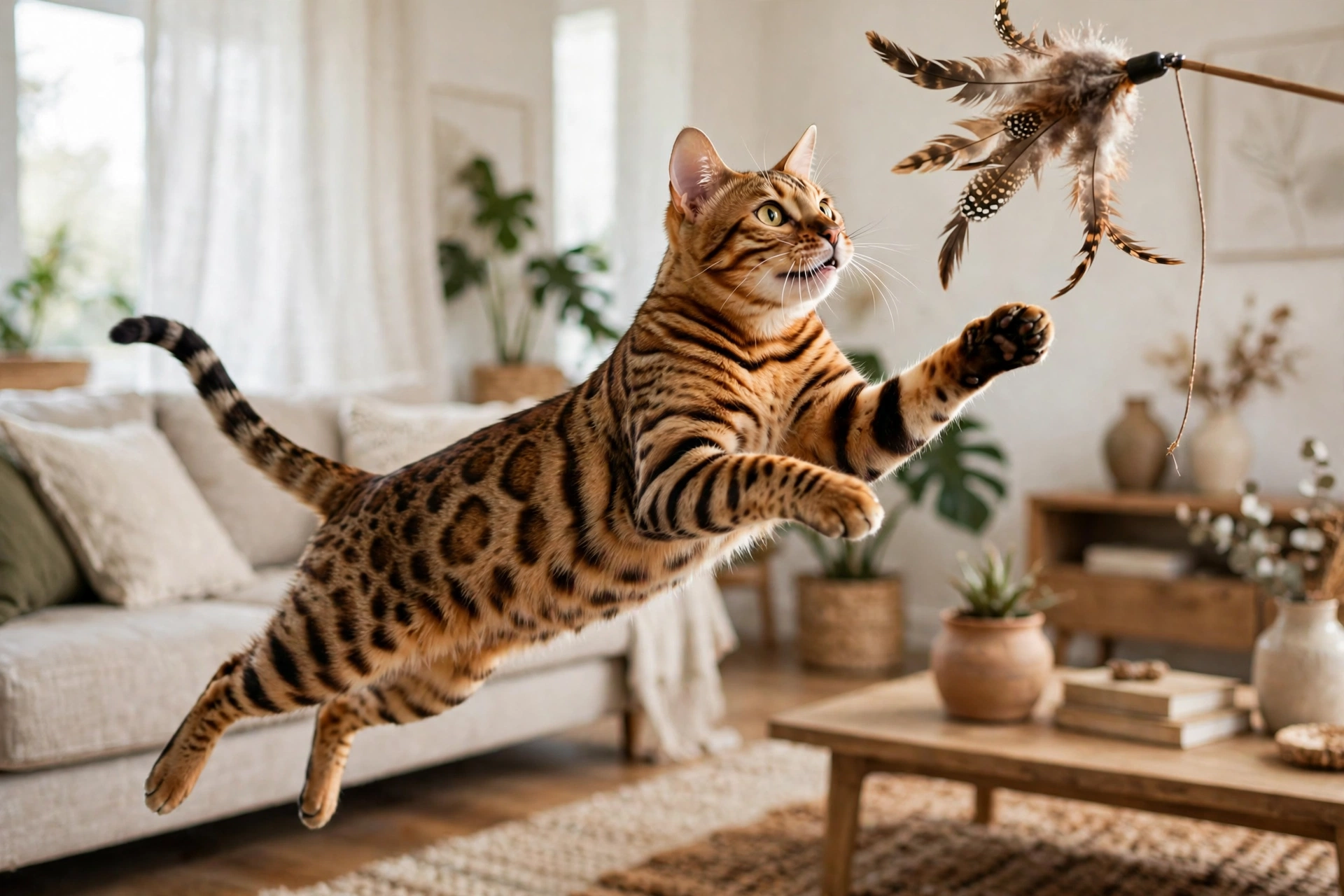
The word that comes up most often is active. A Bengal is not a cat that naps for sixteen hours and stretches for four. It plays in long, intense bursts — chasing, leaping, climbing, fetching — and keeps its kitten energy into its senior years. Many learn to fetch or walk on a leash, and some learn to open doors, drawers, and cupboards — charming the first time, less charming the fiftieth.
The second word is vocal. A Bengal does not just meow. It chirps, it trills, it chatters at birds through the window, and it holds conversations — a running commentary, directed at you, in a voice that expects an answer. Owners who love the breed love the talking; owners who want a quiet house do not.
The third word is dog-like. A Bengal follows its owner from room to room, greets people at the door, and forms a strong bond with its family. It wants to be where you are, and it will supervise.
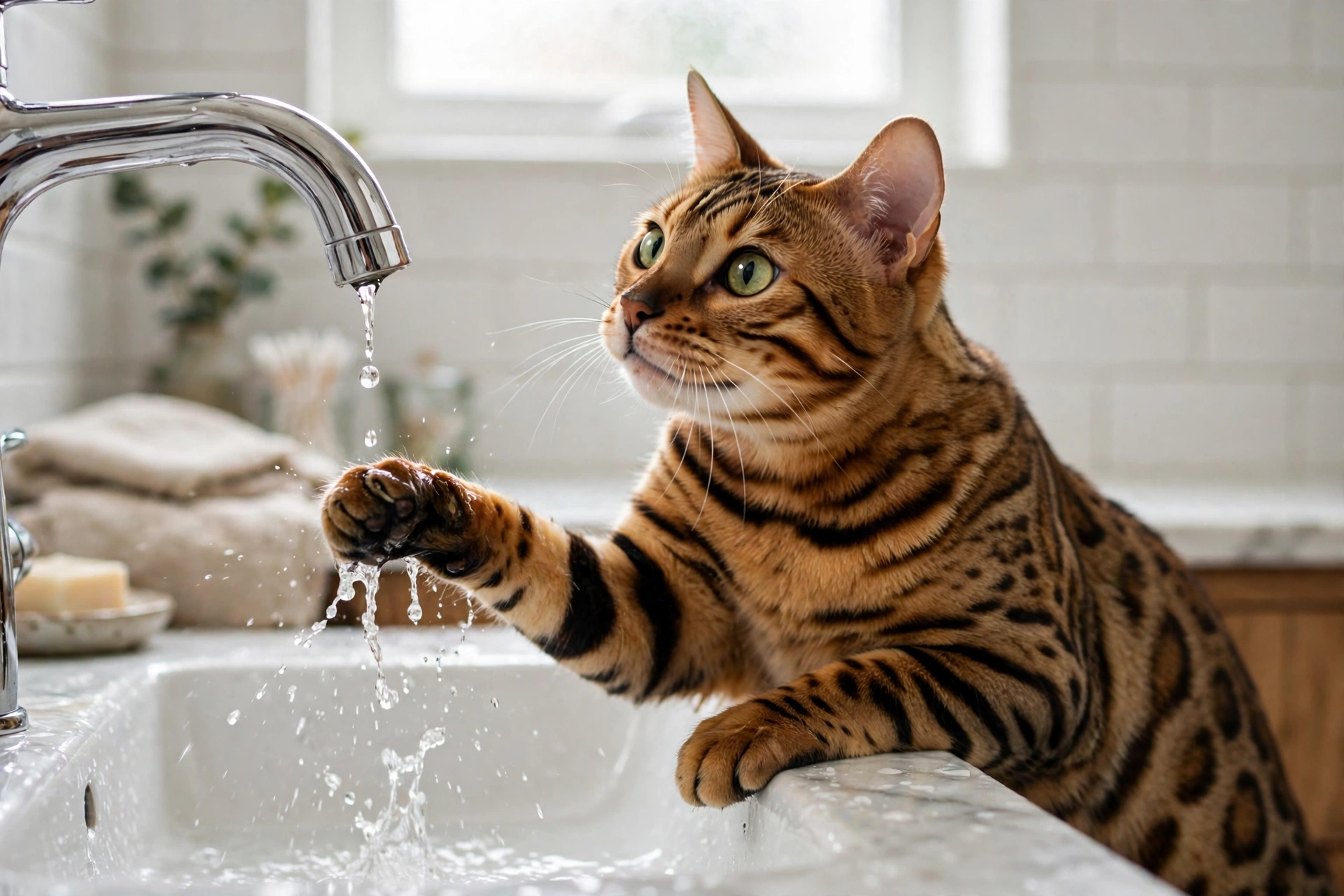
And then there is the water. Many Bengals drink from the tap, paw at the bath, and sit in the sink — some will join you in the shower. Not every Bengal does this, but enough do that it is part of the breed’s reputation.
What varies cat to cat
No breed is a guarantee. Most Bengals are active, but some are calmer — one from a quiet line, or an older one, may be content with one good play session and a long nap.
Cuddliness varies too. Many Bengals bond deeply without ever becoming lap cats: they want to be near you, on the arm of your chair or the top of the sofa, but not held. Some dislike being picked up altogether. A kitten handled gently and often before twelve weeks of age is usually the more tolerant adult, but no Bengal is a stuffed toy, and the ones held against their will are the ones that learn to scratch. Coat colour makes no difference to personality — what matters is the individual cat, the home, and how the kitten was raised.
Daily care: play and stimulation
Here is the honest part. A Bengal needs two or more interactive play sessions a day — not most days, every day. A feather wand, a laser pointer, a ball to fetch: ten to fifteen minutes, twice a day, with you involved. A Bengal that is not played with does not simply get bored — it gets creative, and its creativity looks like shredded curtains and a 3 a.m. sprint across your bed.
Climbing space is not optional: a tall cat tree, wall shelves, or a cleared wardrobe top gives a Bengal the height it wants and keeps it off the kitchen counters. Puzzle feeders make a Bengal work for its food, which uses the brain as well as the body, and a tired Bengal is a well-behaved Bengal. Rotate the toys, and play before bed — a good evening session is the difference between a cat that sleeps and one that opens cupboards.
Grooming and feeding
The good news is the coat. The Bengal’s short coat needs very little: a weekly brush with a soft brush or grooming glove removes loose hair, and most Bengals shed less than a longhaired breed. Baths are rarely needed. The nails need trimming every few weeks, and the ears and teeth need the usual weekly check.
Feeding is straightforward, with one warning. Bengals burn a lot of energy, but an inactive Bengal with free access to food gains weight easily, and a heavy Bengal loses the athleticism that defines it. Measured meals of a complete and balanced food, rather than free-feeding, keep the weight in check — ask your vet about portions. Some Bengals have sensitive stomachs, so if a food does not agree with your cat, ask the vet rather than switching foods on your own.
Living with one
A Bengal does best in a home prepared for it: high perches and a tall cat tree, a window with a view, and a house cat-proofed like you would for a toddler — cupboards latched, breakables off open shelves, plants checked for toxicity. A Bengal will investigate everything, and it will reach the top shelf.
With other pets, TICA’s line holds: Bengals “get along well with other pets when properly introduced.” A slow, scent-first introduction works best. With small pets, caution is needed: the prey drive is real, and a Bengal should never be left unsupervised with birds, hamsters, or other small animals.
Health to discuss with your vet or breeder
A breed guide is not a health article, and this section is not a diagnosis — these are the conditions the breed’s own sources report, and the questions to ask a vet or breeder before you commit.
Hypertrophic cardiomyopathy (HCM) is the best-known Bengal predisposition: the heart muscle thickens over time, and breed-health guides describe it as a leading cause of premature death in the breed. There is no fully predictive DNA test for HCM in Bengals, so screening is done by echocardiogram, an ultrasound of the heart. Ask the breeder whether their breeding cats are screened.
Progressive retinal atrophy, variant b (PRA-b) is an inherited eye condition in which the retina gradually degenerates. It is autosomal recessive — a kitten needs two copies of the gene to be affected — and it starts early, with blindness often by one to two years. A DNA test exists — ask the breeder whether their lines carry it.
Pyruvate kinase deficiency (PK deficiency) is an inherited blood condition in which red blood cells break down too quickly, causing anaemia. It is also autosomal recessive, and a DNA test exists — ask the breeder for the results.
Also reported: flat chested kitten syndrome, luxating patella (a kneecap that slips out of place), hip dysplasia, gastrointestinal sensitivity, and a higher reported risk of intestinal lymphoma. None of these is a prediction about any individual cat: most Bengals live long, active lives, with most breed guides giving a lifespan of 12 to 16 years. The point of the list is the questions — does the breeder test for PRA-b and PK deficiency, and are the breeding cats screened for HCM? Once the cat is home, the point is the routine: regular vet visits, attention to weight, and prompt care when anything changes.
Generations and the law
Before you buy, check the law where you live — Bengals are the one breed where the answer changes by postcode. Hawaii bans Bengals of every generation. New York City and Seattle have their own municipal bans. Connecticut bans the breed with a narrow exception for cats already registered there. Massachusetts and Alaska draw the line by generation: Alaska requires F4 or later, Massachusetts requires registration showing three or more generations from the wild ancestor.
The reason is the early generations: an F1 to F3 Bengal is closer to a wild animal than a pet, and some places have decided not to allow them at all. An F4 or later Bengal is a fully domestic cat, and it is legal in most places — but “most” is not “everywhere,” and the rules change. Before you commit, check your state agriculture or wildlife agency and your city animal control, and ask the breeder which generation the kitten is.
Who a Bengal suits — and who it doesn’t
A Bengal suits an active home, a patient owner, and a routine that includes play. It suits someone who works from home and wants a cat on their desk, a family with older children who will play with a wand toy, or a person who wants a cat that acts like a dog.
A Bengal does not suit a quiet household, a home empty all day, or a first-time owner who wants a cat that looks after itself. It does not suit someone who wants a lap cat — many Bengals never become one — or anyone who cannot commit to daily play. And it does not suit a home with small pets that roam free, or a place where the breed is restricted.
Consider rescue as well as breeders: an adult rescue Bengal comes with a known energy level, temperament, and voice — and a rescue can tell you whether the cat you are meeting is the one you can live with.
Frequently asked questions
Are Bengal cats good with children?
Generally yes, for older children. Bengals are active, playful, and tolerant of noise — a good match for children old enough to play with a wand toy and to understand that a cat is not a toy. Young children should always be supervised with any cat, and a Bengal that is grabbed or cornered will defend itself.
Do Bengal cats like water?
Many do. Bengals are famous for playing with water — drinking from the tap, pawing at the bath, sitting in the sink — unlike most cats. Not every Bengal likes water, but if yours does, a bathroom door that does not latch is a bathroom your Bengal will visit.
Are Bengal cats hypoallergenic?
No. No cat breed is truly hypoallergenic, and the Bengal is no exception. Some people report fewer reactions, but that is anecdotal, not proven, and a Bengal still sheds and still produces the proteins that trigger allergies. If allergies are a concern, spend time with the breed before committing.
How much exercise does a Bengal need?
Two or more interactive play sessions a day, ten to fifteen minutes each, plus climbing space and puzzle feeders. A Bengal that is not played with does not simply get bored — it gets destructive.
Are Bengal cats legal where I live?
It depends on the generation and the place. Hawaii bans Bengals of every generation, New York City and Seattle have municipal bans, and Connecticut, Massachusetts, and Alaska restrict them by generation or registration. Most places allow F4 and later, but check your state and city rules before you buy, and ask the breeder which generation the kitten is.
A Bengal is not the cat for everyone. It is the cat for the person who wants a companion that fetches, climbs, talks, and plays in the sink — and who can give it two play sessions a day and a home that can take the chaos. If you can keep up, it will keep you entertained for fifteen years.