Blog

  • The Tiny Whiskers on Your Cat’s Front Legs Are Doing a Job You Can’t See

    The Tiny Whiskers on Your Cat’s Front Legs Are Doing a Job You Can’t See

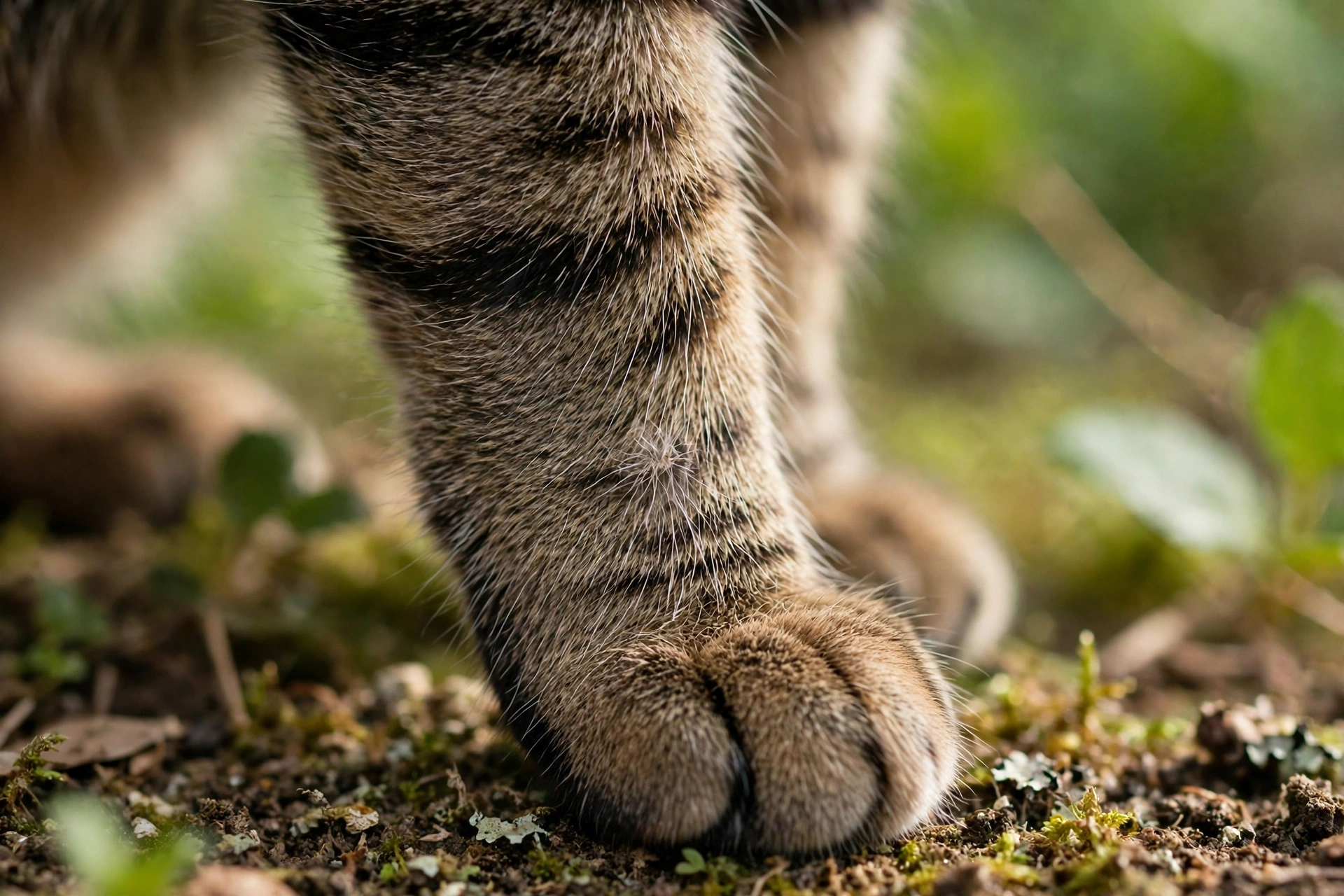
    Next time your cat is stretched out asleep, look at its front legs — not the paws, a little higher. On the back of each wrist, just above the paw, sits a small tuft of fine, stiff hairs, sticking out at an angle from the rest of the fur. Most owners have never noticed it, and plenty who have assumed it was just stray hairs.

    They are not stray hairs. They are whiskers — the same kind of sensory equipment as the long ones fanning out from your cat’s muzzle — and they sit in one of the most useful places on the whole animal. They are called carpal whiskers, and once you know where to look, you will never unsee them.

    Meet the wrist whiskers

    Carpal whiskers sit on the front legs only. The name comes from the carpus, the wrist joint, and the tuft grows on the back — or, as Litter-Robot puts it, the inner side — of each wrist, just above the paw. International Cat Care lists them with the better-known sets: about 24 on the cheeks, more above the eyes, and a set on the back of the forelegs.

    Every cat has them. Catster answers the question directly: yes, all cats have carpal whiskers on their front legs — if you have not seen them on your cat, you have not looked hard enough. They are usually longer and thicker than the whiskers above the eyebrows, according to Catster, but still short beside the muzzle whiskers, and on a long-haired cat they can vanish into the surrounding fur.

    There is nothing on the back legs to match them. The front paws do the close work — catching, holding, testing surfaces — and the wrist whiskers sit exactly where that work happens. Think of them as feelers for the paws, the way the muzzle whiskers are feelers for the face.

    What a whisker actually is

    A whisker is not a thicker ordinary hair. It is a different structure altogether, called a vibrissa, and it works more like a sensor than like fur.

    International Cat Care puts the difference in plain numbers: a cat’s whiskers are twice as thick as the normal hairs on its body and sit three times as deep within the skin. Live Science adds why that depth matters — at the root of each whisker is a follicle loaded with nerves. Catster goes further: whiskers are sensory organs, rooted in follicles filled with nerves and blood vessels, and those nerves connect to the brain’s sensory areas. Touch the tip of a whisker, and the signal travels straight into the part of the brain that maps touch.

    That wiring is why whiskers can do things ordinary fur cannot. The base of each whisker is packed with nerve endings, giving the cat what International Cat Care calls a highly sensitive navigational system. Whiskers detect slight changes in air currents, letting a cat sense an object it cannot see, and they report where objects sit relative to the head and legs — the muzzle whiskers are about the same width as the cat’s body, according to WebMD, so they work as a rough measuring device for gaps. The whiskers above the eyes trigger an automatic blink when something approaches the face.

    The full set is larger than most people realise: 24 muzzle whiskers, 12 on each cheek, per International Cat Care and Litter-Robot, plus smaller sets above the eyes, on the chin, and on the wrists. The carpal whiskers are the least famous of the set, but they are built from exactly the same hardware.
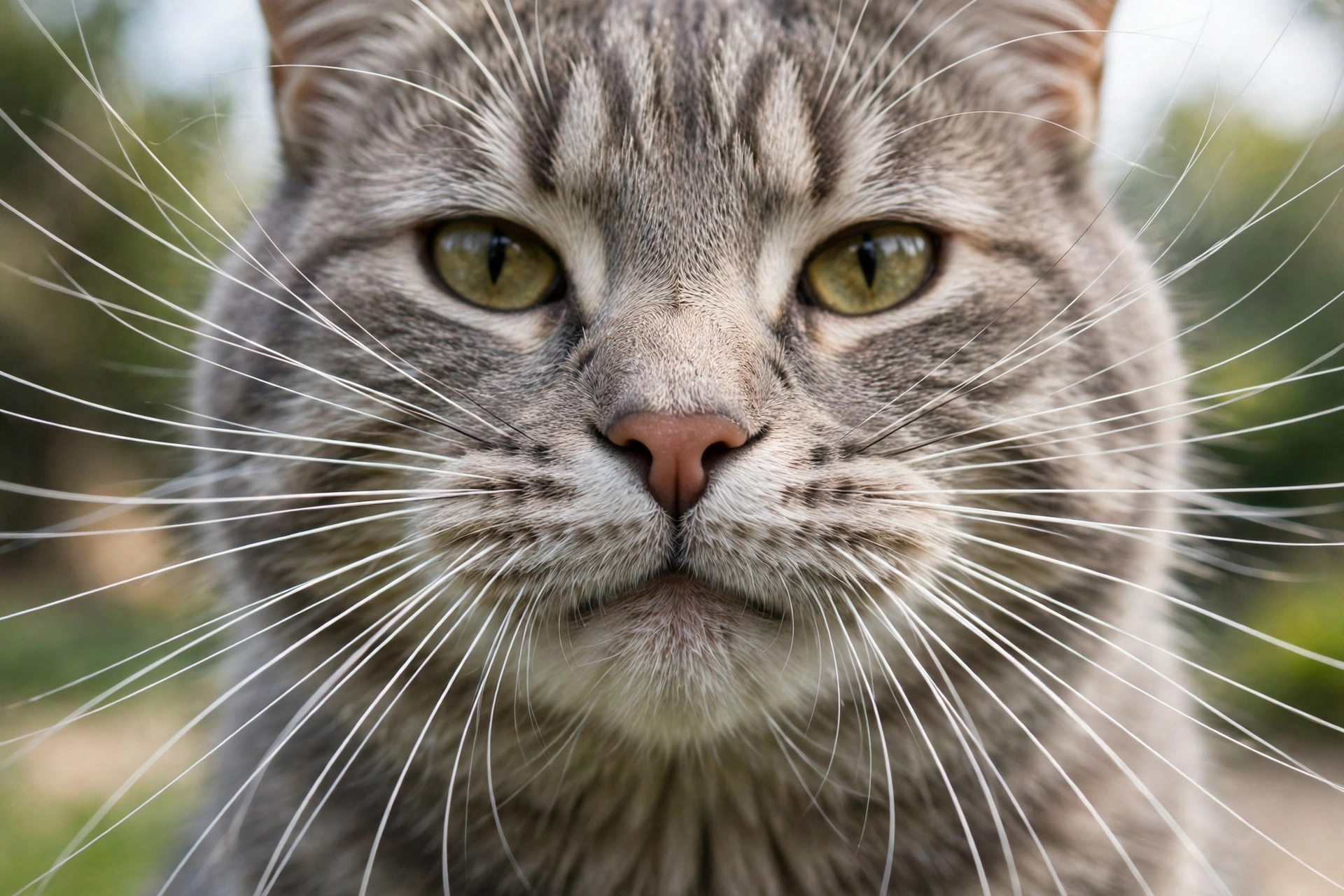
    Close-up of a grey tabby cat's face with long white muzzle whiskers fanned out on both sides
    The muzzle whiskers are the famous set — the wrist whiskers are built from the same hardware.

    The blind spot your cat lives with

    To understand why a cat would need whiskers on its legs, start with a surprise about cat eyes: they are terrible at close range.

    Most cats cannot form a clear, sharp image of anything closer than approximately 25–30 centimetres, according to CatAbroad — and Catster puts the same limit at about 10 inches, or 25 centimetres. Anything inside that range is blurry and indistinct. On top of that, cats have a specific blind spot directly below and in front of the nose, a cone-shaped zone extending roughly 10–15 centimetres from the face, again according to CatAbroad. Put a treat directly under your cat’s chin and it may sniff around in confused circles while standing on top of it — it genuinely cannot see it.

    This is not a defect. A cat’s eyes are built for hunting at a distance — spotting movement, judging the leap, tracking prey across a room. The trade-off is that fine detail up close was never the priority: most studies place feline visual acuity between 20/100 and 20/200, according to CatAbroad. What cats gain in return is a wide field of view — around 200 degrees, against about 180 in humans, per both Catster and CatAbroad — and superb motion detection in low light.

    So why do cats have whiskers on their front legs? Because there is a gap in the system, exactly where a hunt ends: the last few centimetres, when the prey is caught and under the paws. Vision has gone blurry by then, and smell is slow. Something else has to take over, and that something is touch — the whiskers, and the nerve endings packed into the paw pads. Catster puts it directly: between a cat’s whiskers and its paws, it does just fine when “seeing” its prey up close.

    What the wrist whiskers are believed to do

    So why do cats have whiskers on their front legs? Here is where honesty matters more than confidence. The jobs below are the leading explanations offered by veterinarians and cat-care writers — not findings proven by experiments designed specifically around carpal whiskers in cats. The anatomy is settled. The exact job list is not. With that said, here is what researchers believe these whiskers do.

    Feeling prey that is already caught. This is the explanation given most often, and it makes the most sense from the blind-spot problem. Litter-Robot describes it plainly: because cats cannot see fine detail at close range, the carpal whiskers help the cat situate its prey so it can position it for the fatal blow. The whiskers are sensitive enough to detect the slightest movement, so a mouse twitching between the paws is felt instantly, even though it cannot be seen. Watch a cat with a toy mouse and you can see the logic — the paws hold, the head dips, and the whiskers on the muzzle and the wrists are both in contact with the same small, moving object.
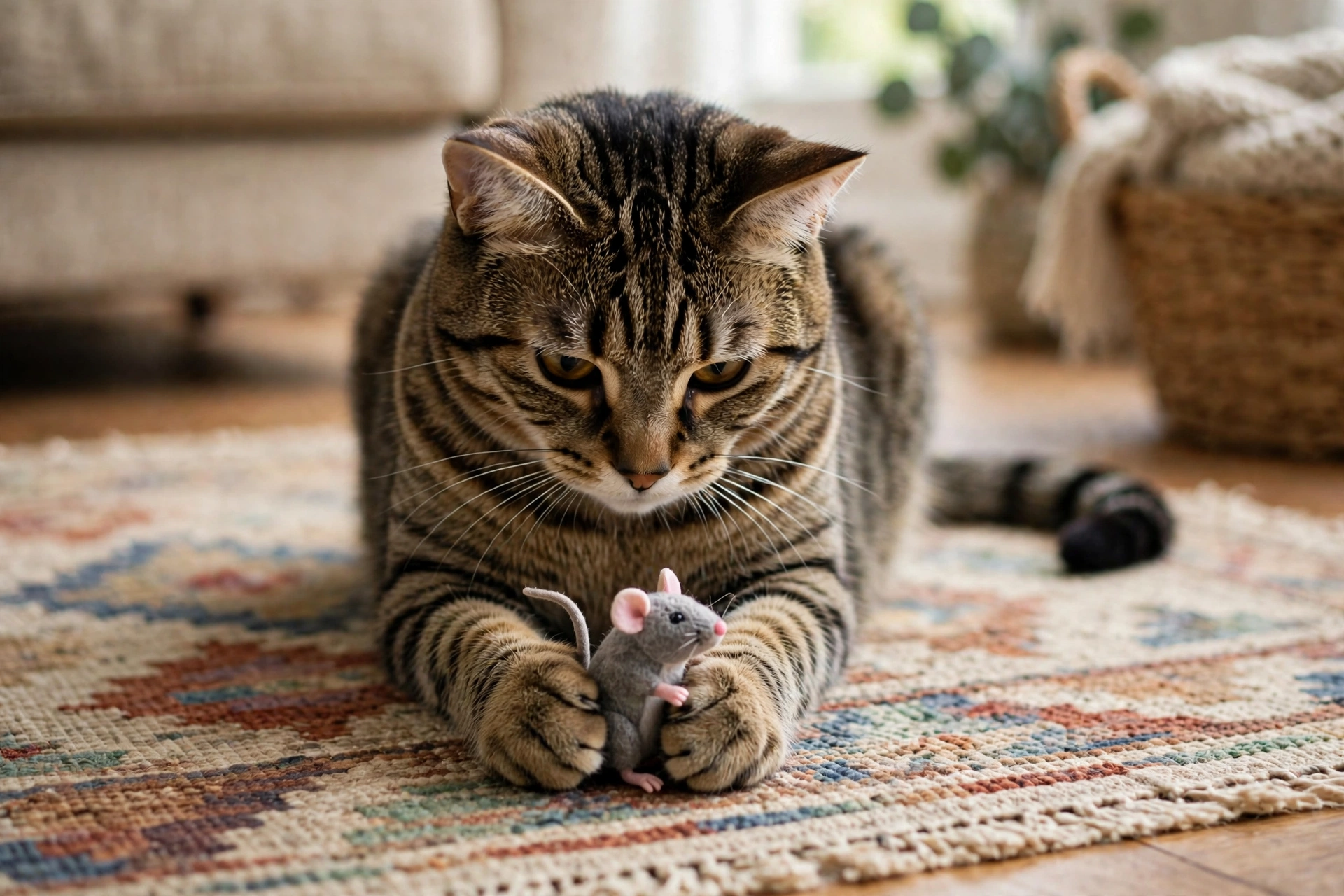
    Tabby cat holding a small grey toy mouse between its front paws on a living-room rug
    The paws hold, the head dips — and the wrist whiskers are in contact with the same small, moving object.

    Sensing the ground and the air. Catster says carpal whiskers help a cat get a better sense of the ground it is walking on, and that they can detect minute changes in air pressure and temperature, which helps the cat identify threats or prey nearby. International Cat Care says the same about whiskers in general: they detect air pressure and currents, which lets a cat locate objects even after losing sight of them.

    Climbing. WebMD states it simply: “Whiskers on the back of the legs help your cat climb trees.” The reasoning is that a climbing cat needs to know exactly where a branch or a trunk surface is relative to its paws, and the wrist whiskers report on contact and texture a fraction of a second before the paw commits its weight. It fits the placement — but WebMD states it in a single sentence without citing a study, and no carpal-specific climbing experiment is cited by any source used for this article.
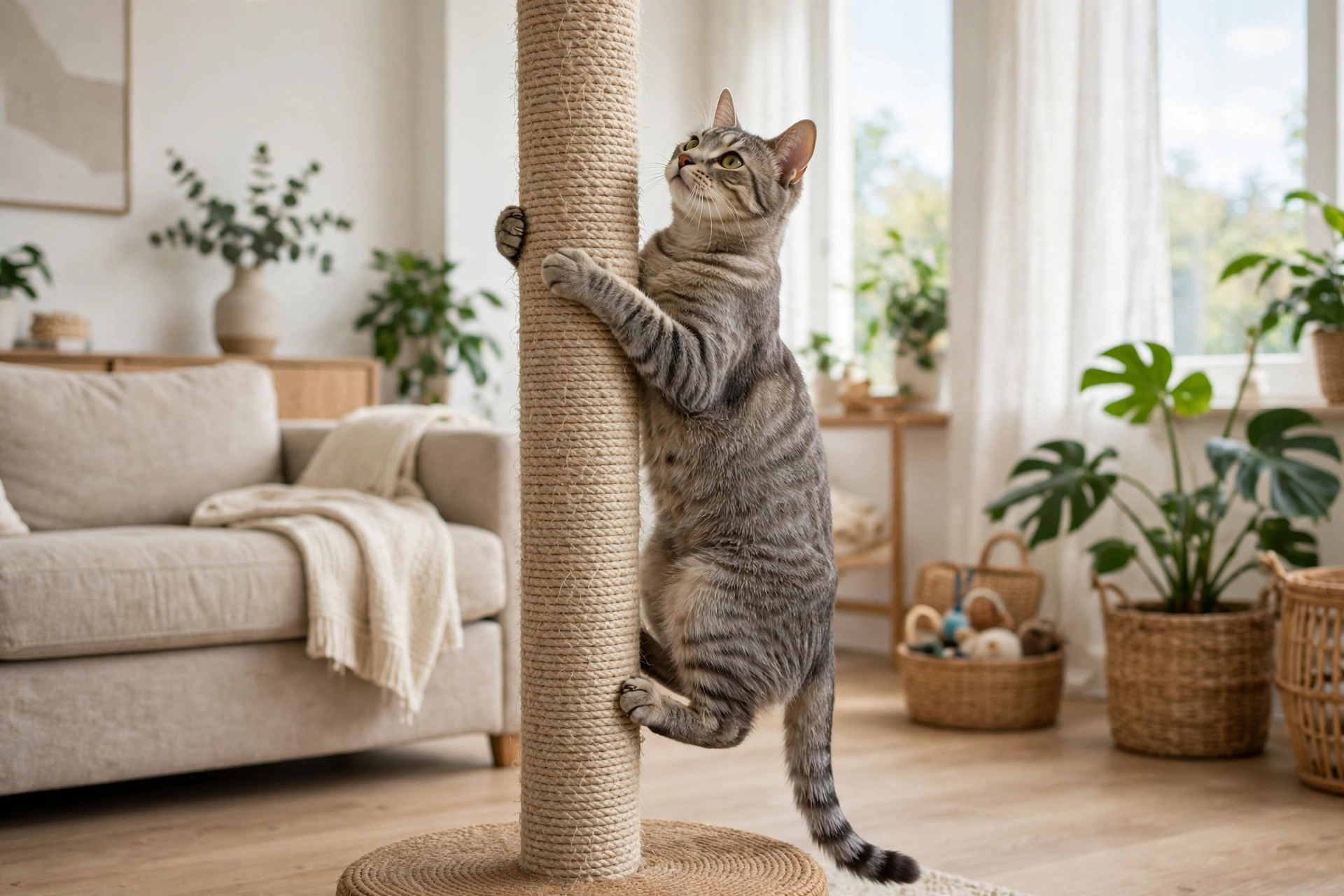
    Grey tabby cat climbing a tall sisal scratching post with its front paws gripping the post
    A climbing cat needs to feel where a surface is before committing its weight — the leading explanation for the wrist whiskers’ role.

    Working in the dark. Cats hunt most at dawn and dusk, and their whiskers are part of why they can do it. Catster lists night hunting among the main functions of whiskers generally: the whiskers help a cat sense its prey and adjust its strike when light is too poor for vision to do the job alone. In a dark hallway, the muzzle whiskers map what is ahead of the face while the carpal whiskers map what is under the paws.
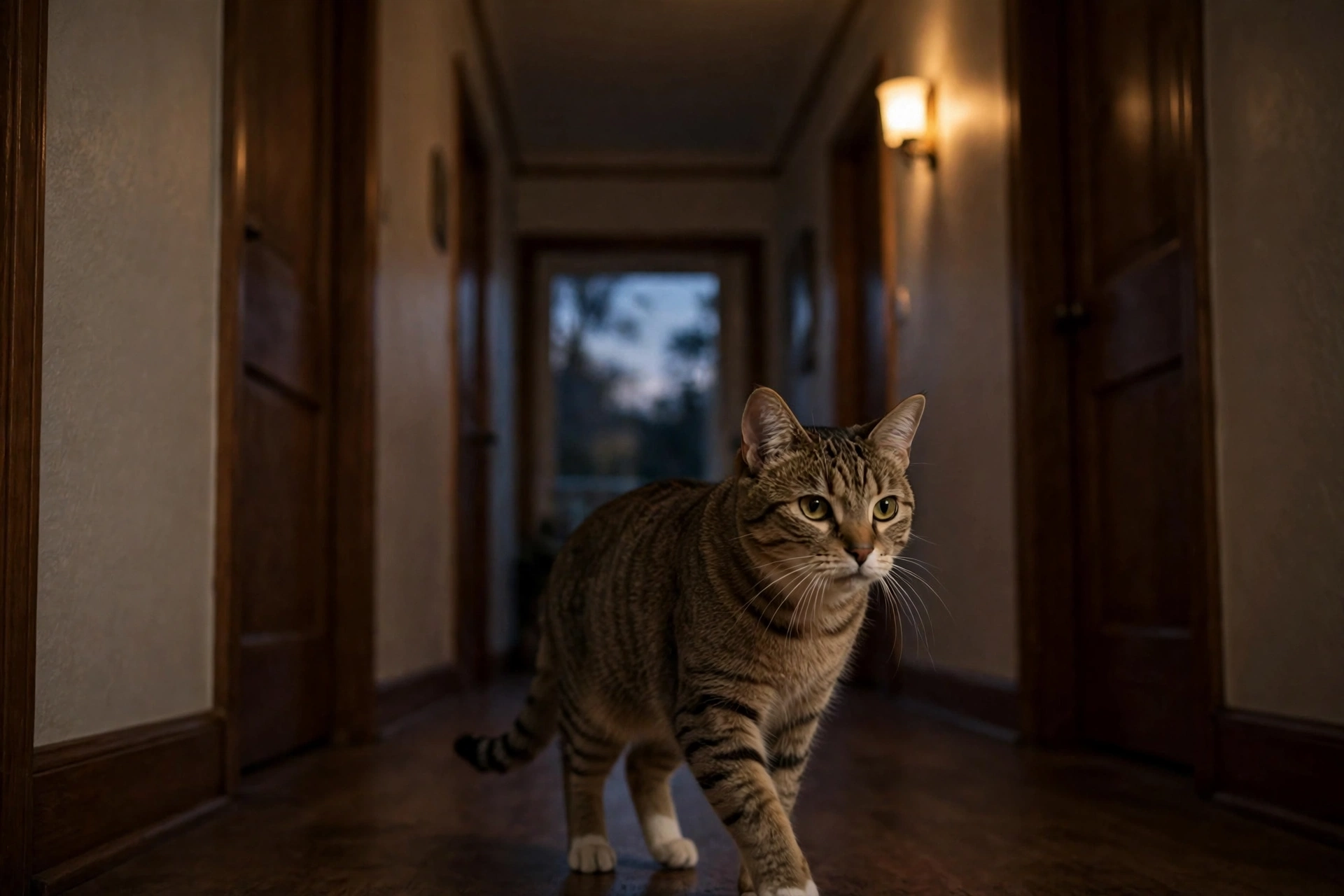
    Tabby cat walking down a dim hallway at dusk with its whiskers pushed forward
    In low light, the muzzle whiskers map what is ahead of the face while the wrist whiskers map what is under the paws.

    Reading mood — a side job worth knowing. Whiskers also signal how a cat is feeling, and the wrist whiskers are no exception to the general rule, though it is the face whiskers that owners can actually read. When a cat is curious or hunting, it pushes its whiskers slightly forward; when it is nervous or upset, it pins them back toward the face, according to both WebMD and Catster.

    What scientists still don’t know

    Most of what is written in answer to why do cats have whiskers on their front legs is inferred, not measured. That is the honest position, and it is the reason this article hedges its claims instead of repeating them as facts.

    First, most whisker research has focused on the face — and much of it on rodents, not cats. The muzzle whiskers have been studied in detail because they are large, obvious, and easy to test. The small tuft on the wrist has received far less direct attention, and none of the sources used for this article cites an experiment that isolated carpal whiskers in cats to test one function at a time.

    Second, the functions overlap. When a cat catches a toy, the muzzle whiskers, the carpal whiskers, the paw pads, and the sense of smell are all reporting at once. Saying which sensor did which part would need an experiment that switches one of them off — and nobody has published that experiment for carpal whiskers in cats.

    Third, some claims travel from source to source without getting stronger. A single sentence in a general whisker article gets repeated until it reads like settled science, even though the original carries no study behind it. That does not make the claim wrong. It makes it unproven.

    So the fair summary is this: carpal whiskers are real, wired like every other whisker, and the leading explanations — feeling caught prey, sensing the ground and the air, helping with climbing and movement in the dark — all fit the anatomy and the blind-spot problem. What is missing is cat-specific experimental proof that separates one job from the others. Until that work exists, “researchers believe” is the right phrase.

    How to find them on your cat — and how to look after them

    Finding carpal whiskers takes thirty seconds and a relaxed cat. Wait until your cat is resting, pick up one front paw gently, and look at the back of the wrist, just above the paw. Part the fur lightly with a fingertip: the tuft is a small cluster of fine, stiff hairs sticking out at a different angle from the surrounding coat. They are easiest to see on short-haired cats in good side light; on a long-haired cat, you may need to look twice. Check both front legs — and do not expect anything dramatic. The whole point of these whiskers is that they are small.

    Once you have found them, the care advice is simple: leave them alone. Never trim whiskers. WebMD is blunt — a cat with cut whiskers becomes disoriented and scared — and veterinarian Jane Brunt puts it memorably: cutting whiskers is “like blindfolding someone”. Catster warns that clipping whiskers can heavily compromise a cat’s abilities. If whiskers are accidentally cut, they do grow back, but slowly: Catster says several weeks to a few months, and Litter-Robot, citing PetMD, puts it at 6 weeks to 3 months.

    A whisker found on the floor is nothing to worry about — International Cat Care notes that shedding a whisker is a perfectly regular body process. Be careful when trimming the fur around the legs, though: Catster warns owners to avoid cutting or damaging the carpal whiskers during grooming.

    One exception is worth knowing: many hairless breeds have short, broken whiskers or none at all, according to Litter-Robot. Every other cat has the complete kit, including the small tuft on the wrists.

    Frequently asked questions

    Do all cats have whiskers on their front legs?

    Yes. According to Catster, all cats have carpal whiskers on their front legs. The main exception is some hairless breeds, which may have short, broken whiskers or none at all, according to Litter-Robot.

    Do cats have whiskers on their back legs?

    No. Carpal whiskers grow only on the forelegs, on the back of the wrists. There is no matching set on the hind legs — the front paws do the catching, holding, and close-range feeling, so that is where the extra sensors sit.

    Can I trim my cat’s carpal whiskers?

    No — never trim any whiskers, including the carpal ones. WebMD warns that a cat with cut whiskers becomes disoriented and scared, and veterinarian Jane Brunt describes cutting whiskers as “like blindfolding someone”. If they are accidentally damaged, they grow back in several weeks to a few months, but the cat is without that sense in the meantime.

    Do carpal whiskers help cats climb?

    That is the leading explanation, but it is not proven by a dedicated experiment. WebMD states that “whiskers on the back of the legs help your cat climb trees”, and the reasoning fits: a climbing cat needs to feel where a surface is relative to its paws before committing its weight. Treat it as a plausible, widely repeated explanation rather than a settled scientific finding.

    Why can’t my cat see a treat right under its nose?

    Because of the close-range blind spot. Most cats cannot form a clear image of anything closer than approximately 25–30 centimetres, according to CatAbroad, and they have a specific blind spot directly below the nose. A treat under the chin sits inside that zone, so the cat genuinely cannot see it and must find it by smell and touch — the range where the whiskers take over.

    Next time your cat is batting a toy mouse between its front paws, look at its wrists. The small tuft of hairs there is doing quiet work in a zone the eyes cannot reach — feeling what the paws are holding, in the dark, where vision has already given up. It is a small piece of anatomy, easy to miss for years. Now you know it is there.
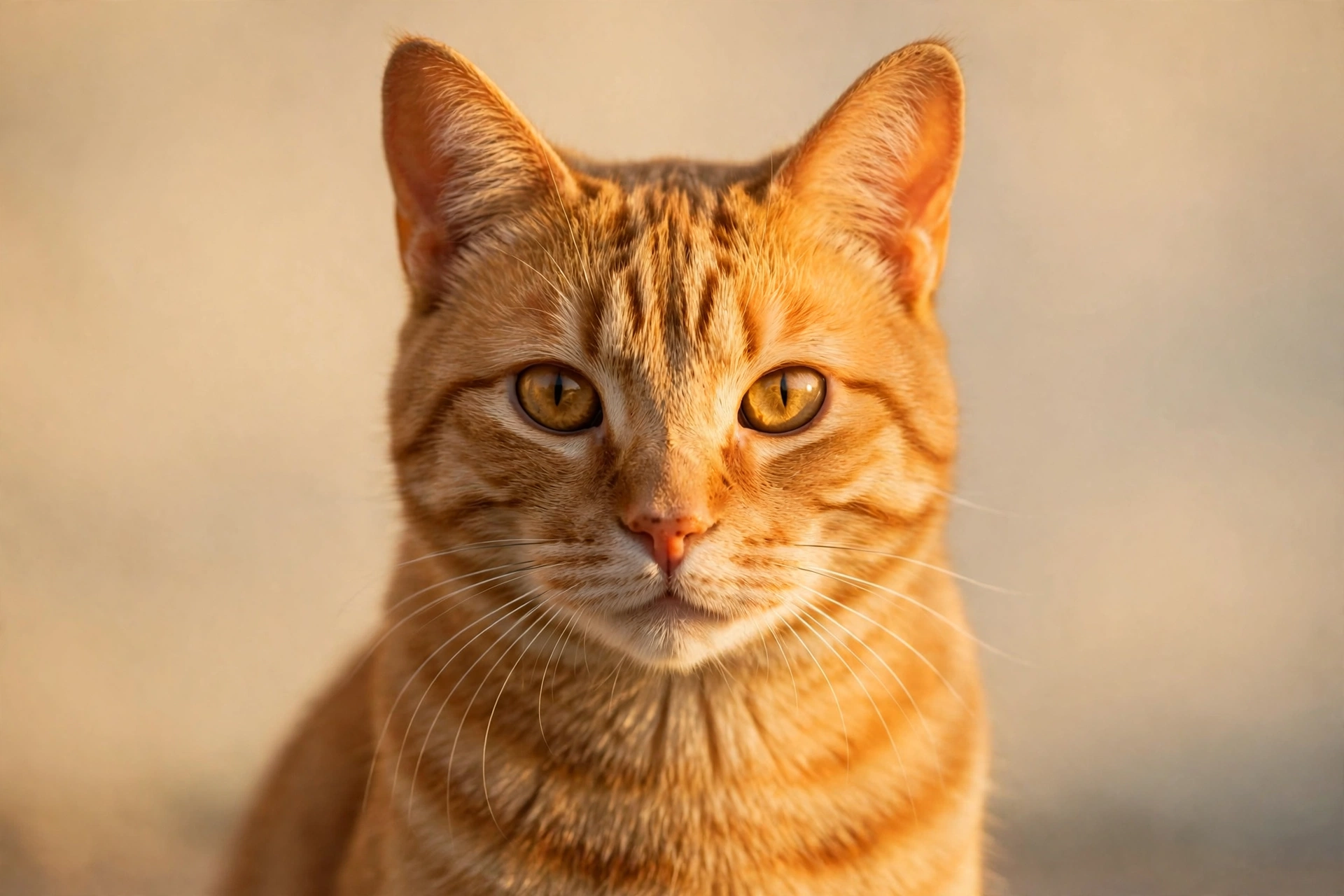
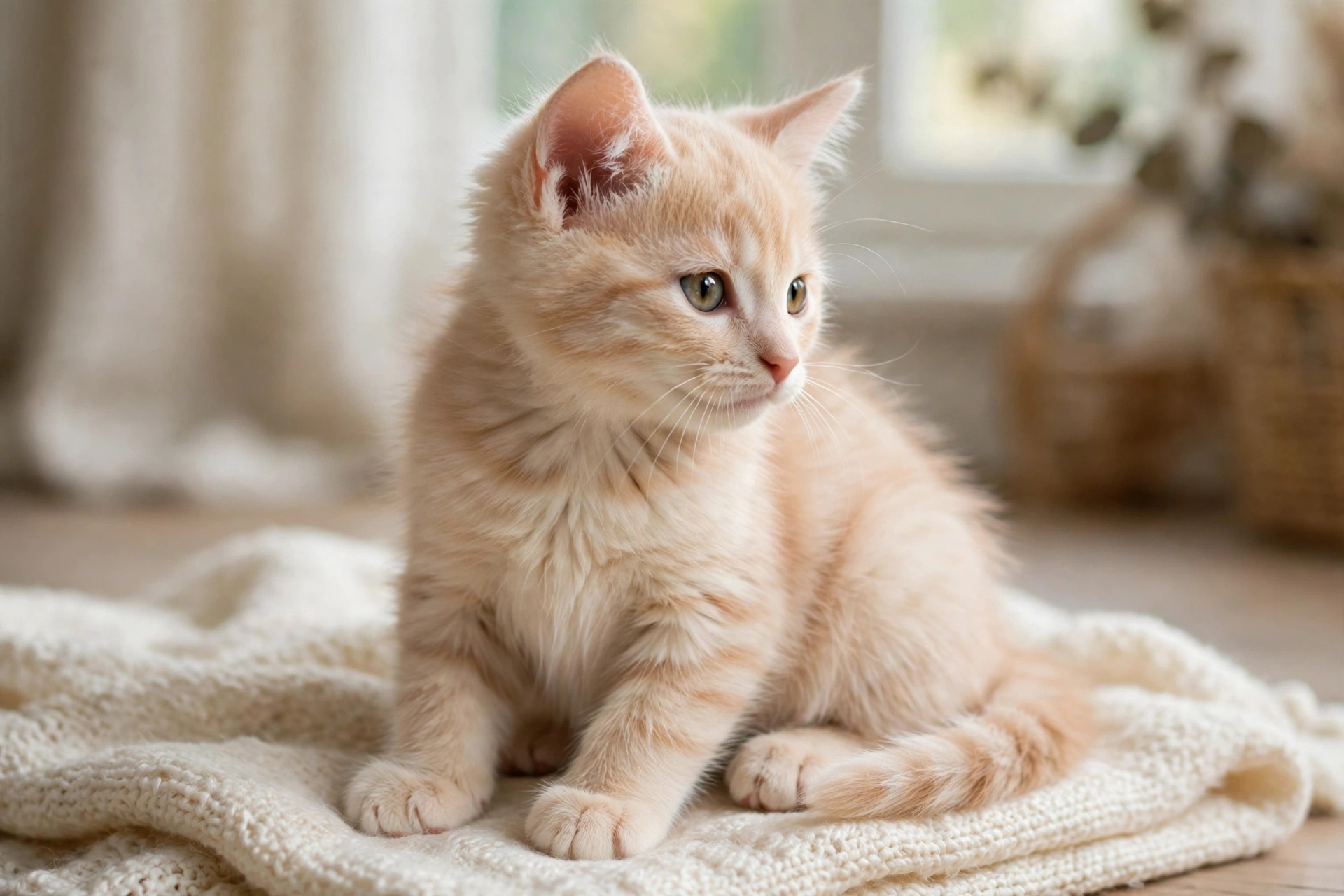
  • 64 Orange Cat Names Sorted by Shade and Personality

    64 Orange Cat Names Sorted by Shade and Personality

    Picture a vet waiting room on a Saturday morning. The receptionist calls a name, and three orange cats look up at once — because all three are called Ginger. It happens more often than anyone admits. Orange cats are so recognisable, and their names are so often chosen in a hurry, that the same handful gets used over and over. This list is built to stop that happening. The 64 names below are sorted the way an orange cat actually looks and behaves — by coat shade first, then by personality — with a separate shelf for the rarer orange girls and the famous gingers of film and comics. Pick the section that matches your cat.

    Why orange cats are special — and why it matters for a name

    Orange is a colour, not a breed. An orange tabby can be a Maine Coon, a Persian, or a shelter kitten with no paperwork, and the orange is the same either way (Chewy). The colour is unusual because its gene sits on the X chromosome: a male cat (XY) needs only one copy to be orange, while a female (XX) needs two. That is why about 75 to 80 percent of orange cats are male and only about 20 percent are female (Britannica; Cats.com). In May 2025, two teams — Stanford’s, led by Christopher Kaelin, and Kyushu University’s, led by Hiroyuki Sasaki — published in Current Biology and traced the colour to a deletion affecting ARHGAP36, which switches pigment production from black-brown eumelanin to reddish-yellow pheomelanin (Fisher Science Education; Petful).

    Two more facts matter before choosing a name. First, every orange cat is a tabby: orange pigment cannot be masked the way black can, so there is no truly solid orange cat, and the patterns have names — mackerel, classic, spotted, ticked, and patched (Chewy; Cats.com; Petful). Second, a pale cream cat is still an orange cat: two copies of the dilution gene soften orange to cream (Petful; Zoetis).

    One thing the colour does not do is decide the personality. There is no peer-reviewed evidence that coat colour drives personality, and the “friendly ginger” reputation is anecdotal — partly because most orange cats are male, so orange-cat behaviour overlaps heavily with male-cat behaviour (Petful). The “one orange braincell” joke is folklore, not science; no study shows orange cats are less intelligent. Judge the cat in front of you, not the coat.

    Names by shade: pale apricot and cream

    The palest orange cats have the softest palette of all — apricot, cream, buff, and the faintest gold. These names suit kittens whose stripes you have to look for in bright sunlight.

    • Apricot — the pale orange fruit; for a kitten with a soft, washed-out coat.
    • Cream — the colour itself; a cream cat is genetically still an orange cat, just diluted.
    • Honey — golden, warm, and sweet; for a pale kitten with amber eyes.
    • Butter — soft yellow, the pale end of the orange range.
    • Vanilla — pale, sweet, and calm-sounding; for a quiet cream kitten.
    • Biscuit — the colour of a baked biscuit; warm and homely.
    • Peaches — the fruit, blush-pale and soft; for a kitten with a pink nose.
    • Meringue — pale, sweet, cloud-like; a light name for a light cat.
    Pale apricot cream orange kitten sitting on a soft cream blanket in soft daylight
    A cream cat is still an orange cat — just diluted.

    Names by shade: golden

    Golden orange cats glow in sunlight, and their names should sound like they do — for the classic mid-orange tabby with clear stripes and a bright coat.

    • Aurelia — from Latin aureus, “golden”; the feminine form of the Roman family name Aurelius (Behind the Name; Wikipedia).
    • Aurelius — the masculine form, from Latin aureus, “golden, gilded”; the name of the emperor Marcus Aurelius (Behind the Name).
    • Leo — from Latin leo, “lion”; short, strong, and one of the most popular names for orange cats (Behind the Name).
    • Leon — from Greek leon, “lion”; the same root as Leo, with a softer sound (Behind the Name; Wikipedia).
    • Nala — Simba’s lioness in The Lion King; a soft two-syllable name for a golden girl. (The “gift” meaning often quoted for Nala is not supported by name scholars — Behind the Name notes the word does not appear to carry that meaning in Swahili.)
    • Sol — from Latin sol, “sun”; one syllable, bright, and hard to mishear (Behind the Name).
    • Amber — the gemstone, or the orange-yellow colour; warm and familiar (Behind the Name).
    • Goldie — golden, plain and simple; for a cat who follows the sun.

    Names by shade: deep copper and red

    The darkest orange cats look almost red in autumn light, with bold stripes and a rich coat. These names lean into the copper and the fire.

    • Rusty — the colour of rust; the classic name for a deep orange tabby.
    • Copper — the metal itself; solid and warm, for a rich reddish coat.
    • Sienna — the English word for “orange-red”, from the clay of Siena in Italy (Behind the Name).
    • Scarlett — originally a surname for a maker or seller of scarlet cloth; dramatic, for a dramatic coat (Behind the Name).
    • Rory — from Irish Ruaidhrí, “red king”, from rúad “red” and rí “king” (Behind the Name; Wikipedia).
    • Flannery — from an Irish surname, from Flannghal, “red valour” (Behind the Name).
    • Garnet — the deep-red gemstone; a jewel-toned name for a dark copper cat.
    • Cinnamon — the warm spice; for a coat that looks dusted with it.
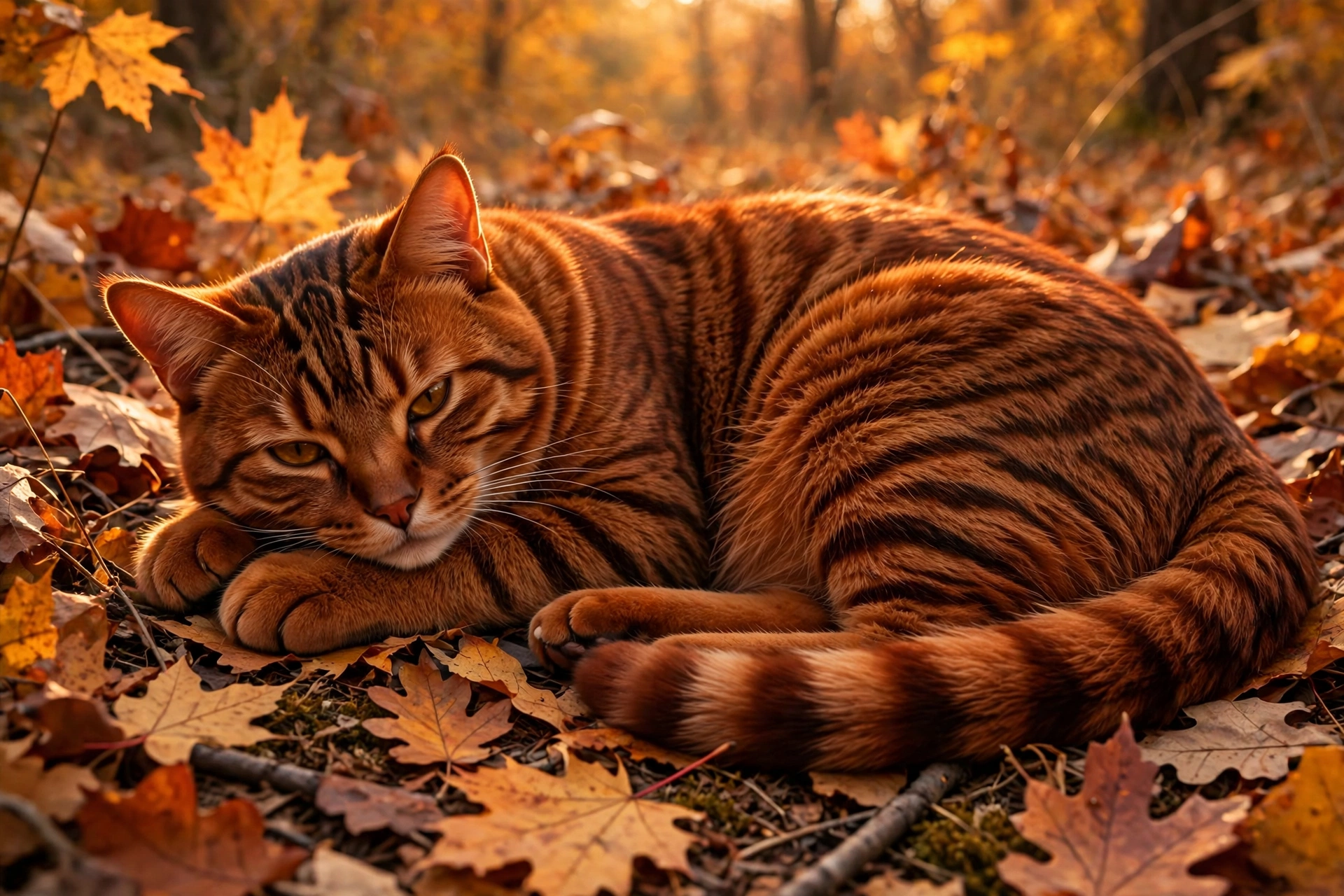
    Deep copper-red tabby cat with bold stripes resting among autumn leaves in warm light
    The darkest orange cats look almost red in autumn light.

    Names by personality: calm and cuddly

    Some orange cats are professional lap warmers: one warm spot, settled in until dinner. These names are soft, short, and easy to say in a sleepy voice.

    • Milo — a soft two-syllable name; its roots are disputed, but the Slavic reading is “gracious, dear” (Behind the Name; Wikipedia).
    • Teddy — a teddy-bear name, for a cat that likes to be held like one.
    • Ollie — a diminutive of Oliver, from Latin oliva, “olive tree”; friendly and unhurried (Behind the Name).
    • Mochi — the soft Japanese rice cake; for a soft, squishy cat.
    • Pudding — a soft dessert name for a cat that flops into a puddle.
    • Waffles — warm breakfast food; for a cat that is always where the warmth is.
    • Snuggles — does what it says; best for a cat that actually snuggles, or it becomes a joke.
    • Maple — the tree whose leaves turn orange-red in autumn; steady and warm.

    Names by personality: playful and chaotic

    Then there are the orange cats who treat the house like a racetrack at 3 a.m. These names are food, jokes, and energy, for a cat that earns them daily.

    • Cheeto — the snack; orange, crunchy, impossible to take seriously.
    • Nacho — the snack; for a cat that steals food with confidence.
    • Cheddar — the cheese; sharp and orange, a favourite for a reason.
    • Mango — the fruit; sweet, bright, a little messy, like the cat.
    • Marmalade — the orange preserve; also the classic nickname for orange tabbies (Cats.com).
    • Ginger — the spice; the other classic nickname for orange tabbies (Cats.com).
    • Pumpkin — the autumn vegetable; round and orange, a natural fall fit.
    • Tigger — the bouncy tiger from Winnie-the-Pooh; for the cat that never walks when it can bounce.

    Names by personality: dignified and regal

    Some orange cats carry themselves like they own the house — because, in their view, they do. These names have history behind them, for a cat with presence.

    • Aslan — from Turkic arslan, “lion”; the great lion of The Chronicles of Narnia (Behind the Name).
    • Simba — from Swahili, “lion”; the hero of Disney’s The Lion King (Behind the Name).
    • Archie — a diminutive of Archibald, from Germanic erkan “genuine” and bald “bold” (Behind the Name; Wikipedia).
    • Cleo — from Greek kleos, “glory”; the short form of Cleopatra, “glory of the father” (Behind the Name; Wikipedia).
    • Jasper — from Persian, “treasurer”; also the gemstone, in warm orange-brown shades (Behind the Name; Wikipedia).
    • Felix — from Latin felix, “lucky, successful”; cheerful, with Roman history behind it (Behind the Name; Wikipedia).
    • Oscar — possibly from Old Irish oss “deer” and carae “friend”, “deer friend” — the “possibly” matters, as the origin is not settled (Behind the Name).
    • Maximus — the Roman cognomen for “greatest”; a big name — save it for a cat with the ego to match (Behind the Name).

    Names for orange girl cats — the rarer ones

    About one orange cat in five is female, which makes an orange girl a rarer find — and a good reason not to default to a boy’s name before the kitten’s sex is known (Britannica; Chewy). These ten suit a female orange cat, from the soft and floral to the bold and red.

    • Leona — from Latin leo, “lion”; the feminine form, literally “lioness” (Wikipedia; Behind the Name).
    • Clementine — the small, sweet orange; bright, with a song built in.
    • Ruby — the deep-red gemstone; a classic that matches a dark copper coat.
    • Poppy — the bright red-orange flower; cheerful and unmistakable.
    • Saffron — the spice, and its yellow-orange colour; rare and precious (Behind the Name).
    • Hazel — the tree, and its warm brown-green colour; for a pale gold or cream girl.
    • Maisie — a Scottish diminutive of Mairead, the form of Margaret, “pearl” (Behind the Name).
    • Sadie — a diminutive of Sarah, from Hebrew, “princess”.
    • Penny — the copper coin; small, bright, exactly the colour of a ginger coat.
    • Autumn — the season when orange takes over; from Latin autumnus (Behind the Name).
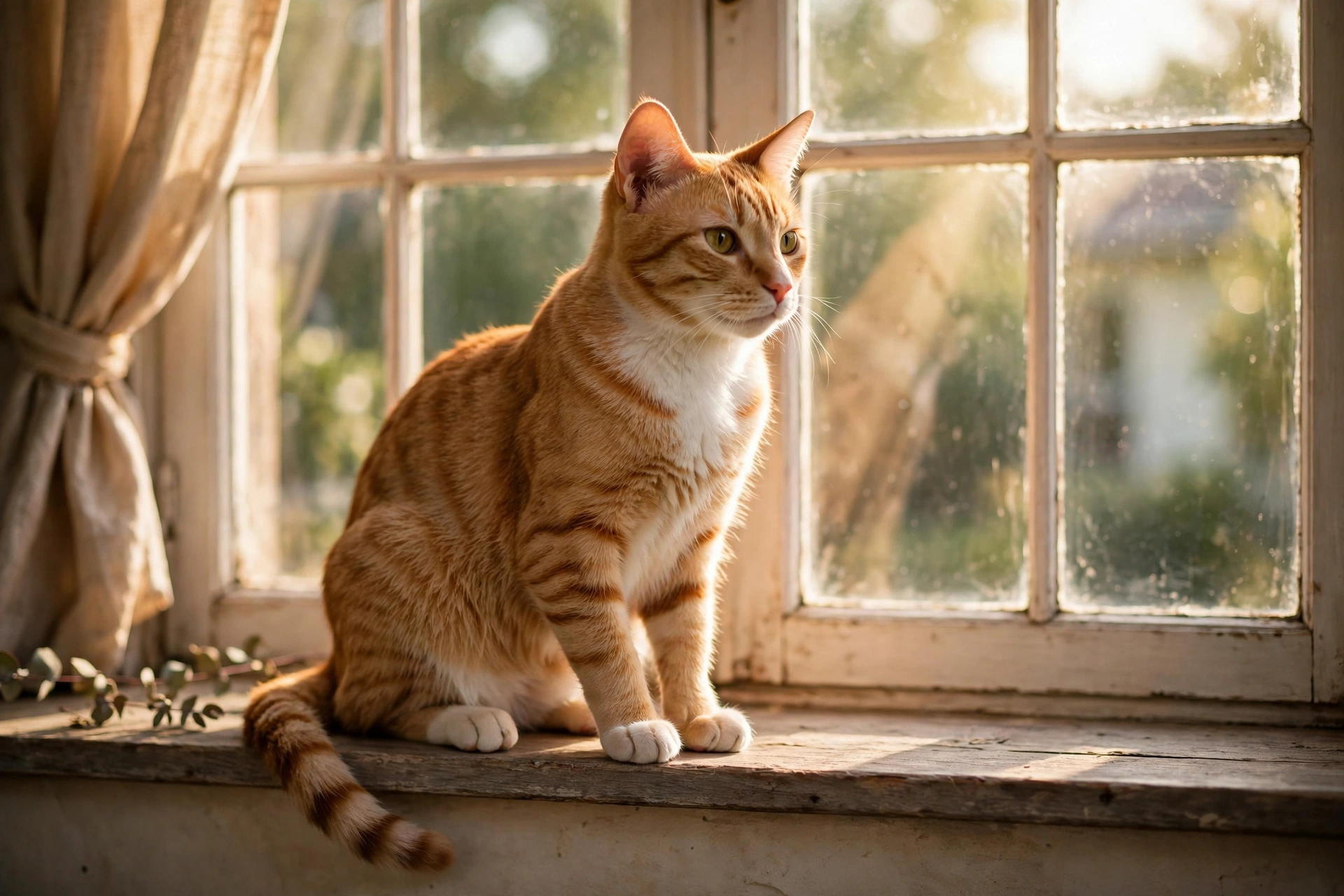
    Slender orange tabby cat with a white chest sitting on a sunny windowsill indoors
    About one orange cat in five is a girl — a rarer find, and a reason to check before you name.

    Famous orange cats worth borrowing a name from

    Orange cats have had more screen time than any other colour, so borrowing a famous name is a shortcut to one everyone recognises. Six of the best:

    • Garfield — Jim Davis’s lasagna-loving orange tabby, in nationwide syndication since 19 June 1978; Davis named him after his grandfather, James A. Garfield Davis (Wikipedia).
    • Morris — the 9Lives mascot, an orange tabby who debuted on television in 1968 (Cats.com).
    • Jones — “Jonesy”, the orange ship’s cat in Alien (1979), who survives alongside Ripley.
    • Crookshanks — Hermione Granger’s large ginger cat in Harry Potter; half-Kneazle, all attitude.
    • Heathcliff — the streetwise comic-strip orange cat, on the scene before Garfield.
    • Hobbes — Calvin’s tiger in Calvin and Hobbes; for a striped orange cat with an imagination.

    How to choose the right name — the shortlist method

    A list of 64 names is only useful if it ends in one name. Here is the method.

    Check the kitten’s sex first — and do not assume a boy. Roughly four orange cats in five are male, and that statistic quietly pushes people into choosing a boy’s name before they know what they have (Britannica; Chewy). Ask the vet or the shelter, or wait until you know. An orange girl called Max is fine if you chose it on purpose; less fine if you chose it because everyone assumed.

    Keep it to one or two syllables. Cats learn short names fastest, and you will say this name hundreds of times a week — at the food bowl, at the door, at the vet. Leo, Milo, Ruby, and Cheeto all pass. Aurelius is beautiful, but you will shorten it within a week, so pick the shorter version first.

    Say it out loud — the vet-waiting-room test. Stand in your kitchen and call the name across the room, then imagine a receptionist calling it in a crowded waiting room. If it feels embarrassing, sounds like another word, or gets lost in a mumble, cross it off. A name has to work shouted, whispered, and said by a stranger.

    Try it for a few days. Pick three favourites, not one, and use each for a day or two. Watch which one the kitten answers to, which one feels natural when you are half asleep, and which one still makes you smile on day three. The right name is usually the one you stop noticing, because it fits so well you forget you chose it.

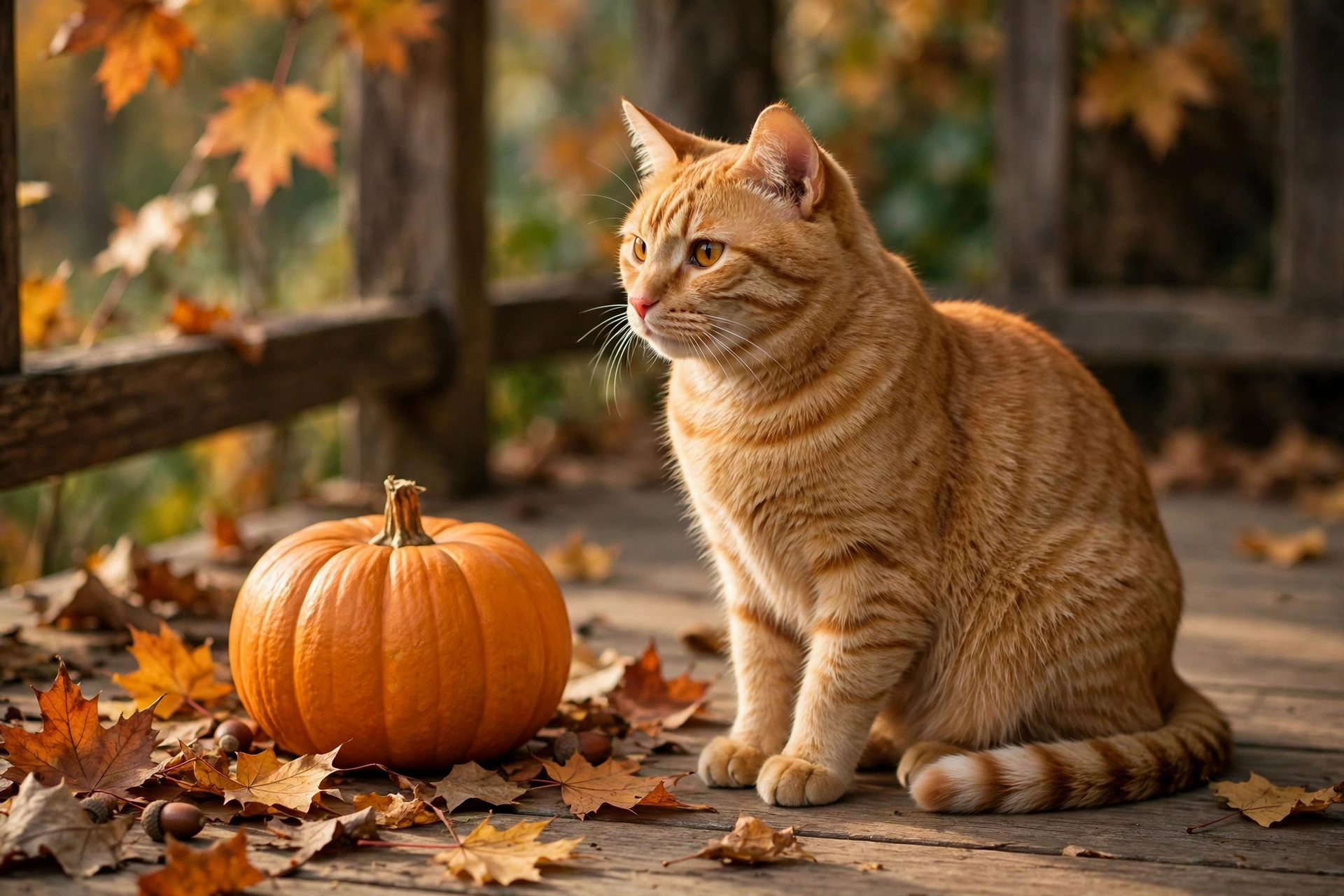
    Orange tabby cat sitting beside a small pumpkin on a porch with autumn leaves
    Pick three favourites, try each for a day or two, and keep the one that still makes you smile.

    Frequently asked questions

    Are most orange cats really male?

    Yes. About 75 to 80 percent of orange cats are male and about 20 percent are female, because the orange gene sits on the X chromosome: a male needs one copy, a female needs two (Britannica; Cats.com).

    Are orange cats a breed?

    No. Orange is a colour and a pattern, not a breed. Orange tabbies appear across many breeds and in ordinary mixed-breed cats — the same orange can show up in a pedigree Maine Coon or a shelter kitten (Chewy; Petful).

    Is every orange cat a tabby?

    Yes. Orange pigment cannot be masked the way black pigment can, so every orange cat shows some tabby patterning, even if you only see it in bright sunlight. The five patterns are mackerel, classic, spotted, ticked, and patched (Chewy; Cats.com; Petful).

    Are orange cats really goofier or less intelligent than other cats?

    No — that is internet folklore, not science. There is no peer-reviewed evidence that coat colour drives personality in cats, and the “one orange braincell” joke is a meme, not a finding (Petful). Socialisation and the individual cat matter far more than the coat.

    What is a good name for an orange girl cat?

    Start with the girls’ section above — Leona, Clementine, Ruby, Poppy, Saffron, Hazel, Maisie, Sadie, Penny, and Autumn — and the shade sections work too: Sienna, Scarlett, and Flannery suit a girl just as well as a boy. Check the kitten’s sex first, then pick from the shade that matches her coat.

    What are the most popular orange cat names?

    The names on almost every list are Garfield, Simba, Leo, Ginger, Marmalade, Rusty, Amber, and Pumpkin — they turn up across the ranking pages from Rover, Catster, Petfinder, and Adopt-a-Pet. They are popular because they work, but for a name the vet has not already called three times today, the shade and personality sections above are the better place to look.

  • 12 Winter Mistakes That Leave Your Cat Cold

    12 Winter Mistakes That Leave Your Cat Cold

    Most cats that suffer in the cold are not strays. They are pets whose owners thought they had it covered — a warm house, a full bowl, a thick coat. But a cat does not get cold because of one big thing going wrong. It gets cold because of small mistakes that add up, and the ones that matter most are rarely the ones people expect.

    If you are wondering how to keep cats warm in winter, these twelve mistakes are where to start.

    In this article

    1. Sleeping outside in the cold
    2. A bed on a cold floor
    3. Heating pads and space heaters
    4. Frozen or stale water
    5. Feeding too much or too little
    6. A shelter that is too big
    7. Blankets instead of straw
    8. Antifreeze spills
    9. Snow, salt and ice melt on paws
    10. The car hood and wheel wells
    11. Left alone in a cold car
    12. Kittens, seniors and vulnerable cats

    1. Letting a pet cat sleep outside in the cold

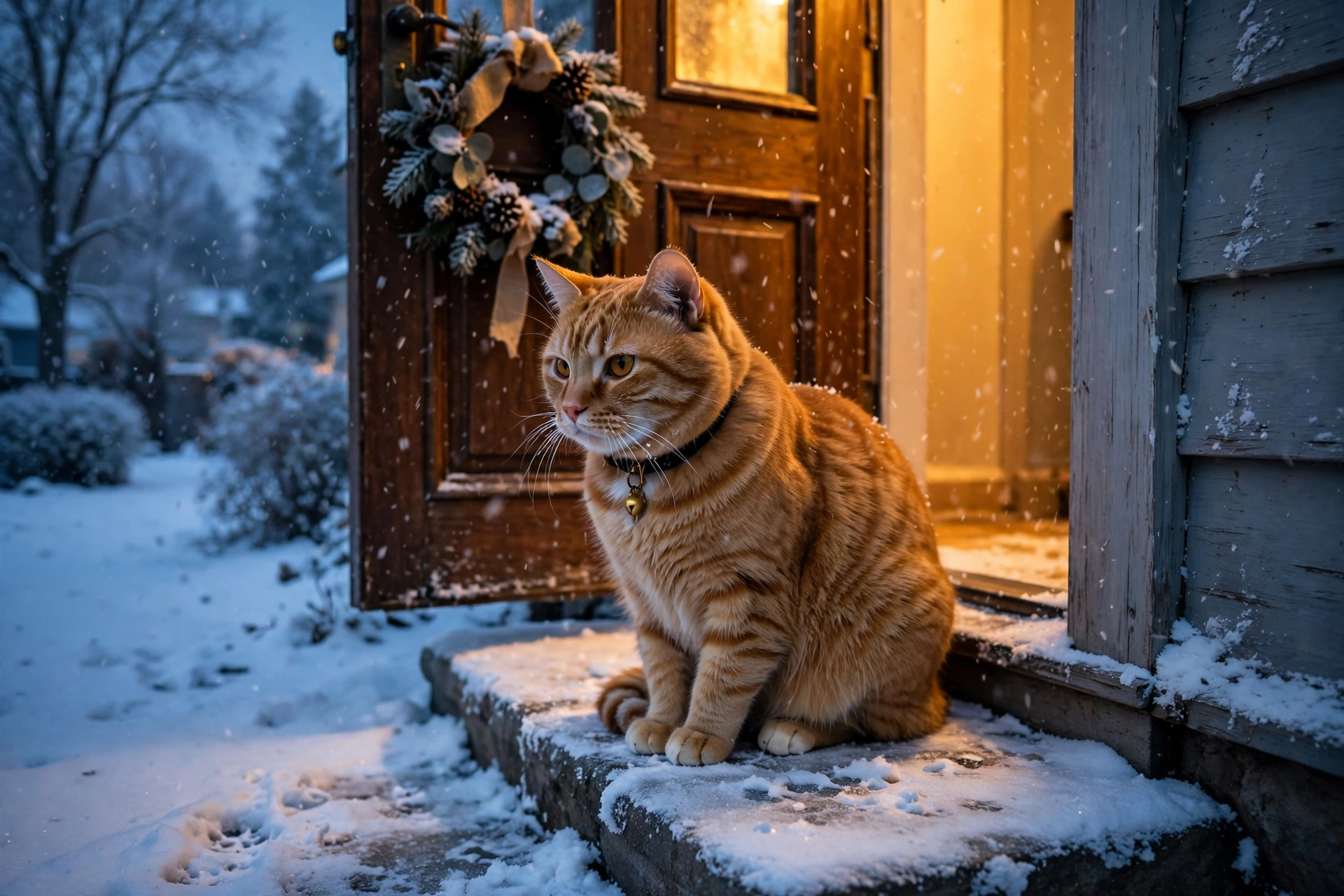
    A pet cat belongs indoors in winter. A thick coat is not the protection people assume. The Cornell Feline Health Center is direct about it: the combination of low temperatures, wind, and snow or ice can leave a cat with hypothermia or frostbite. International Cat Care adds that free-living cats grow a thicker winter coat, but it only protects them while the fur stays dry — once fur gets wet or frozen, it stops insulating.

    There is no single temperature that fits every cat. Coat, body fat, age, health, wind, and wet weather all change the risk. There are, however, useful caution points. PetMD’s guidance, as summarised by the veterinary site Rexvet, is that most cats start to feel uncomfortable below about 45°F (7°C), and that below freezing — 32°F (0°C) — every cat risks frostbite and hypothermia with long exposure.

    The RSPCA gives a similar picture: cats do best between 10°C and 25°C, and it suggests keeping cats inside overnight below about 7–8°C. Read those figures as caution points, not rules. A dry, calm evening is very different from a wet, windy one.

    The ASPCA offers the simplest test: if it is too cold for you, it is probably too cold for your pet. That test is the simplest answer to how to keep cats warm in winter: if you would not want to sleep out in it, neither would your cat.

    Ginger tabby house cat sitting on a snowy doorstep at dusk, looking cold, with warm light glowing from the house door behind it
    A pet cat belongs indoors in winter — if it’s too cold for you, it’s too cold for your cat.

    2. Putting your cat’s bed on a cold floor or in a draft

    The ASPCA’s advice is straightforward: a warm place to sleep, off the floor and away from all drafts — a cozy bed with a warm blanket or pillow is perfect.

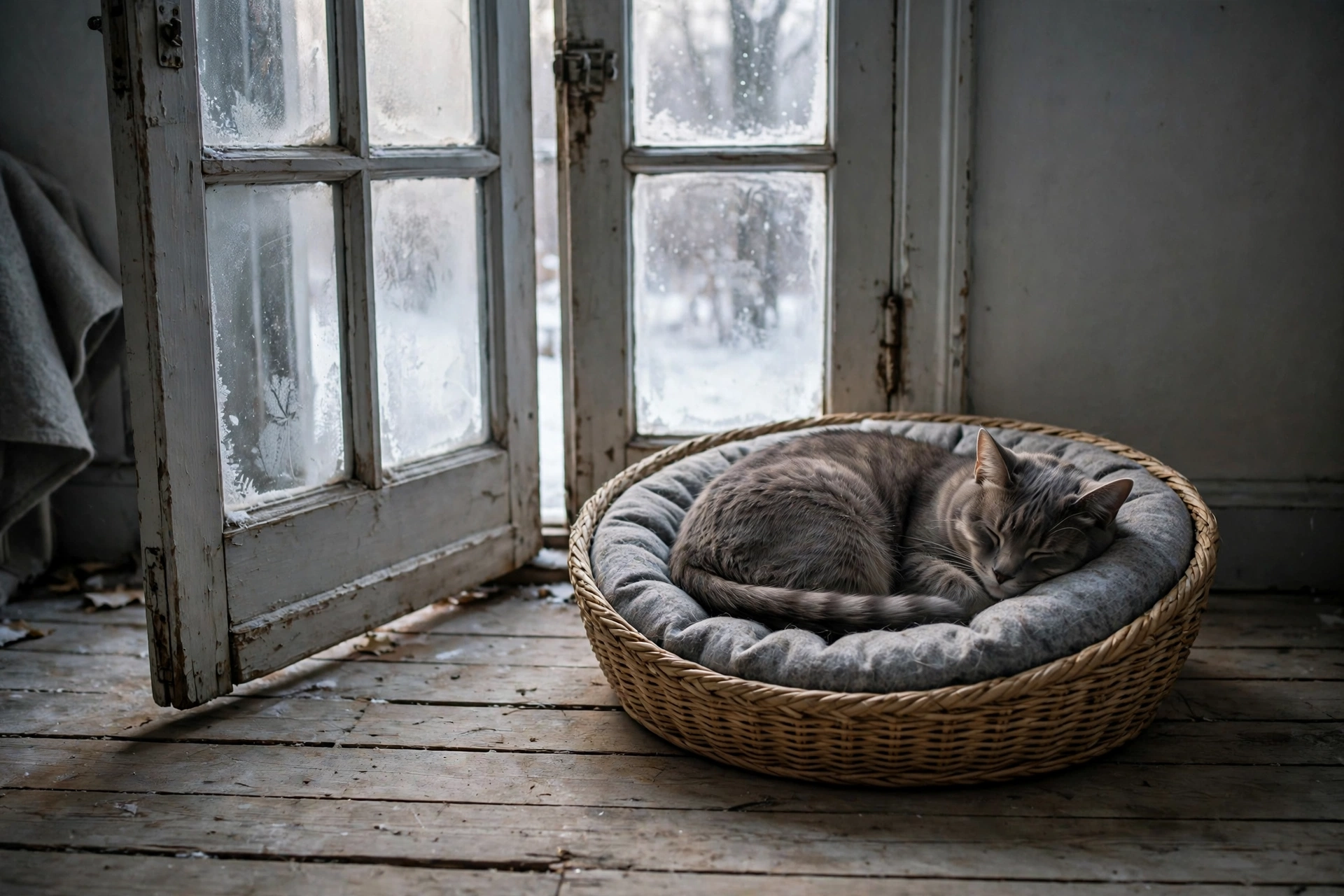
    Cold air sinks, so a bed on a tile, wood, or basement floor is colder than it looks. Raise it a few inches, or move it to a carpeted room, and block floor-level drafts; a rolled towel along a door bottom often does the job.

    Then offer choices. Cats move between warm and cool spots through the day, and a cat that can choose regulates its own temperature better than one with a single bed. A sunny windowsill by day and an enclosed bed for long naps will cover most cats. Enclosed beds trap the cat’s own body heat — the same reason cats squeeze into boxes.

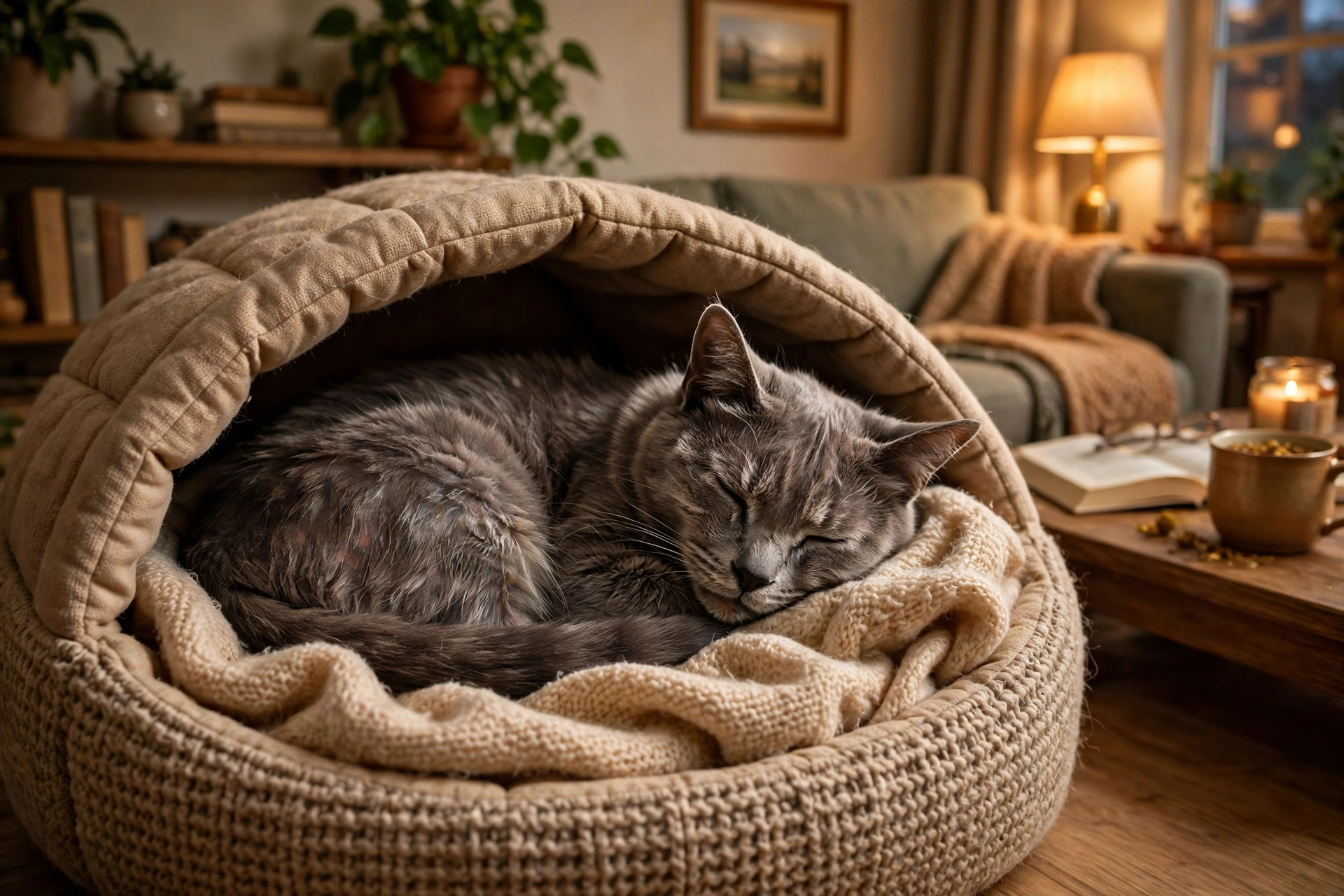
    Grey cat curled asleep in a wicker bed on a bare wooden floor beside a drafty door in winter
    Cold air sinks — a bed on a bare floor is colder than it looks.

    3. Placing a heating pad directly on your cat

    For seniors, thin cats, and cats recovering from illness, gentle heat helps — but the kind of heat matters, and this is where winter care goes wrong most often indoors.

    Self-warming mats are the simplest option: they reflect the cat’s own body heat back, need no electricity, and have no cable to chew. A microwavable heat pad, warmed and slipped under part of the bedding, is another good choice — put it under only part of the bed, so the cat can move off it.

    Electric heating pads need real caution. A heating pad can heat up over time and cause burns, especially in older, arthritic, or sick pets that sleep deeply or get up slowly. Never place a heating pad directly on a cat. The AVMA cautions that space heaters can burn a pet that sleeps against them, or be knocked over and start a fire — keep them where the cat cannot press against them, and never leave one running in a room with an unsupervised pet.

    A self-warming mat in a round wicker bed shows how to keep cats warm in winter for a senior cat
    A self-warming mat gives gentle heat with no cable, no plug, and nothing hot enough to burn.

    4. Letting your cat’s water freeze or go stale

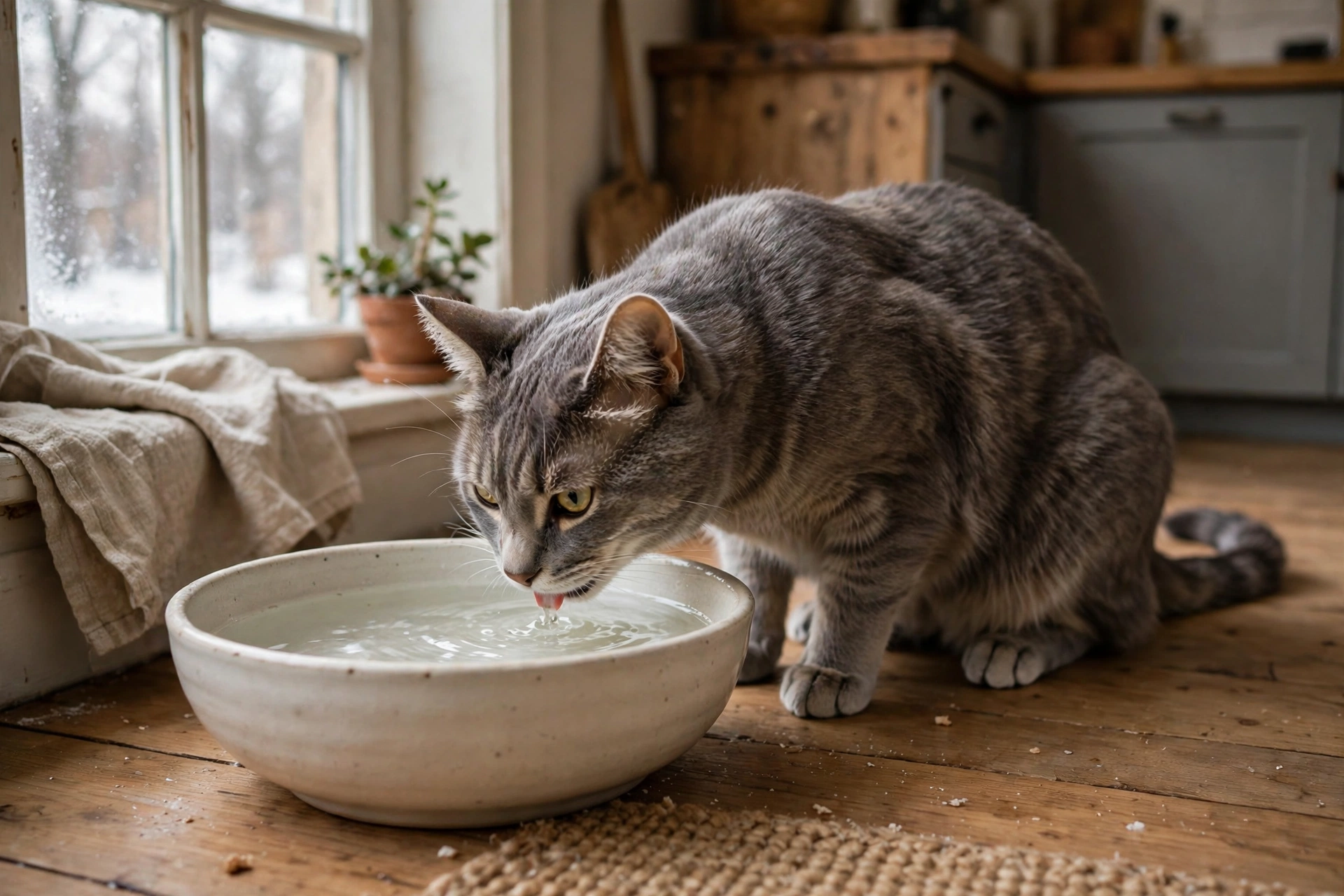
    Fresh water matters all winter. International Cat Care stresses fresh, clean water at all times, and the ASPCA agrees: drinking plenty of water helps keep a cat — and its skin — hydrated. Some cats drink more readily from a wide bowl, a running tap, or a fountain; cats that love drinking from the sink are not being difficult.

    Heated indoor air is dry, and it pulls moisture from skin and coat. The ASPCA suggests keeping the home humidified and toweling a cat dry as soon as it comes inside, and bathing less often during cold spells, since frequent bathing strips the essential oils that keep skin from flaking.

    Outdoors, water is the hardest part of winter care: a bowl can freeze overnight, so check it daily. Cornell suggests a solar water heater or thick plastic bowls rather than shallow ceramic ones, which freeze faster and can crack; a heated water bowl is the most reliable option where you have outdoor power. Alley Cat Allies suggests fresh food and water daily, or twice daily, and a sheltered feeding station keeps food, water, and the cats out of the weather.

    Grey cat drinking fresh water from a wide ceramic bowl on a kitchen floor in winter
    Fresh, clean water matters all winter — indoors and out.

    5. Feeding an indoor cat extra food — or an outdoor cat too little

    Cornell notes that cats burn more calories staying warm, and the ASPCA suggests feeding a little extra in the cold months — but that is for cats spending real time in the cold, not an indoor cat asleep on the sofa.

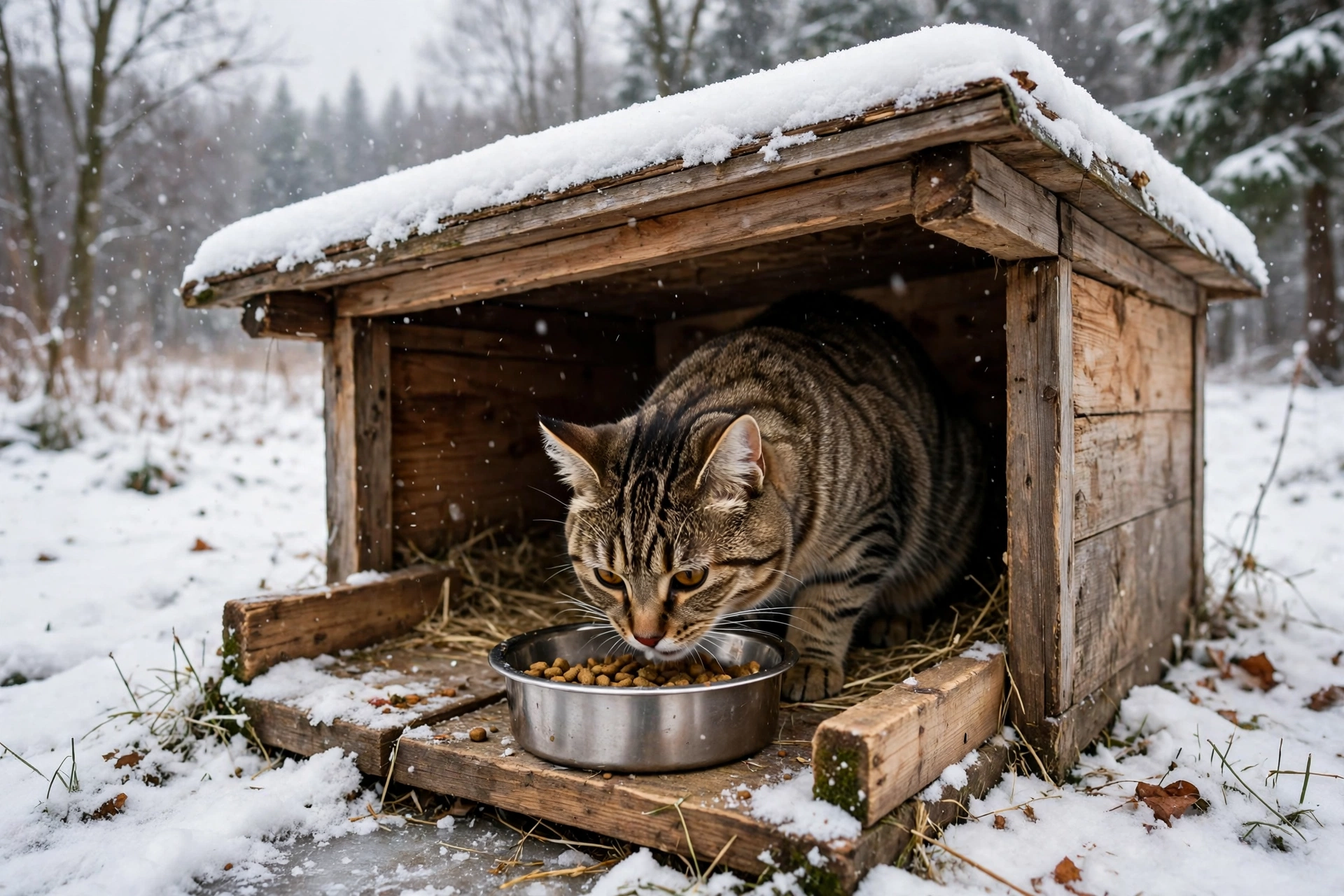
    Outdoor cats are a different story: feed them a little more, and put the food outside the shelter, so the smell does not draw other animals in. Alley Cat Allies suggests fresh food and water daily, or twice daily, and a sheltered feeding station keeps food, water, and the cats out of the weather. Feeding a little extra is a small, cheap part of how to keep cats warm in winter, and it makes a real difference to a cat spending the night outside.

    Tabby cat eating from a food bowl at a sheltered outdoor feeding station in the snow
    Outdoor cats burn more calories staying warm, so they need a little extra food.

    6. Building an outdoor shelter that’s too big, on the ground, or facing the wind

    This section is for community cats — strays and feral cats that live outdoors and cannot come inside. Alley Cat Allies puts it plainly: they are well adapted to outdoor life, and they still do better with a little help.

    A good outdoor shelter is small, insulated, raised off the ground, and out of the wind. A shelter of about 2 by 3 feet and at least 18 inches high holds three to five cats, and a smaller one for one or two cats is warmer still. Bigger is colder.

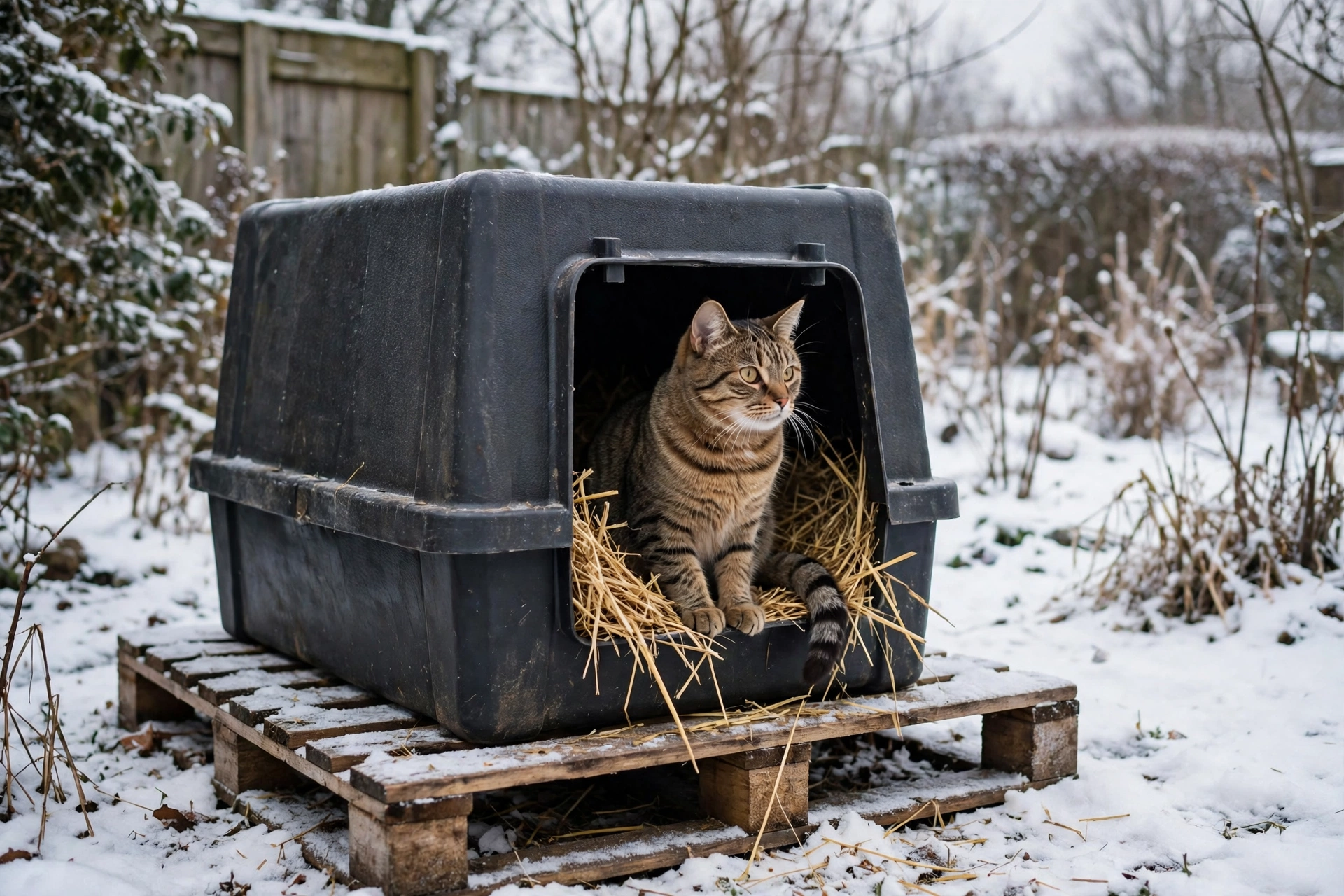
    A large plastic storage tote with a cat-sized doorway works well, as does a sturdy foam cooler. Line the walls with foam board, and raise it off the cold ground on a pallet or bricks — Cornell recommends this so body heat is not lost into the earth. Cut the doorway six to eight inches wide, a few inches up from the floor, facing away from the prevailing wind. Get the shelter right and you have done the hardest part of how to keep cats warm in winter for an outdoor cat.

    Small insulated outdoor cat shelter made from a plastic storage tote, raised on a wooden pallet off the snowy ground
    Small, insulated and raised off the ground — bigger is colder.

    7. Using blankets, towels or hay instead of straw

    This is the detail people get wrong most often. Fill the shelter with straw: it repels moisture, insulates, and lets a cat burrow in and stay warm. Never use hay — it soaks up moisture, gets wet and cold, and can mold. Never use blankets, towels, or folded newspaper either: they soak up moisture and freeze. Cornell says to avoid newspaper, cloth, and hay, and International Cat Care says folded blankets or towels will make the cat colder, not warmer.

    Blankets are fine indoors. Outdoors, straw is the bedding: pack it loosely, about a third to halfway up the inside walls, and swap it out when it gets damp or dirty.

    Tabby cat sitting in a black plastic outdoor shelter filled with golden straw on a snowy day
    A small, raised shelter filled with straw — not blankets — keeps an outdoor cat dry and warm.

    8. Leaving antifreeze where a cat can reach it

    Cold itself is only part of winter, and antifreeze is the most dangerous part of it. Cornell calls antifreeze extremely toxic to cats if ingested, and warns that its sweet taste attracts them. The ASPCA says the same: antifreeze is lethal for dogs and cats, and even small amounts can kill.

    Clean up any spill from a vehicle immediately, store containers tightly closed and out of reach, and consider products made with propylene glycol, which the ASPCA describes as a safer option than ethylene glycol. If you think your cat has licked antifreeze or any other poison, call your veterinarian or the ASPCA Animal Poison Control Center at (888) 426-4435 right away — treatment works best when it starts quickly. Cats that lick or chew at strange substances are following their nose.

    A bright green antifreeze spill on a concrete garage floor being cleaned up with paper towels
    Antifreeze is lethal to cats — clean up any spill immediately.

    9. Forgetting to wipe your cat’s paws after snow and salt

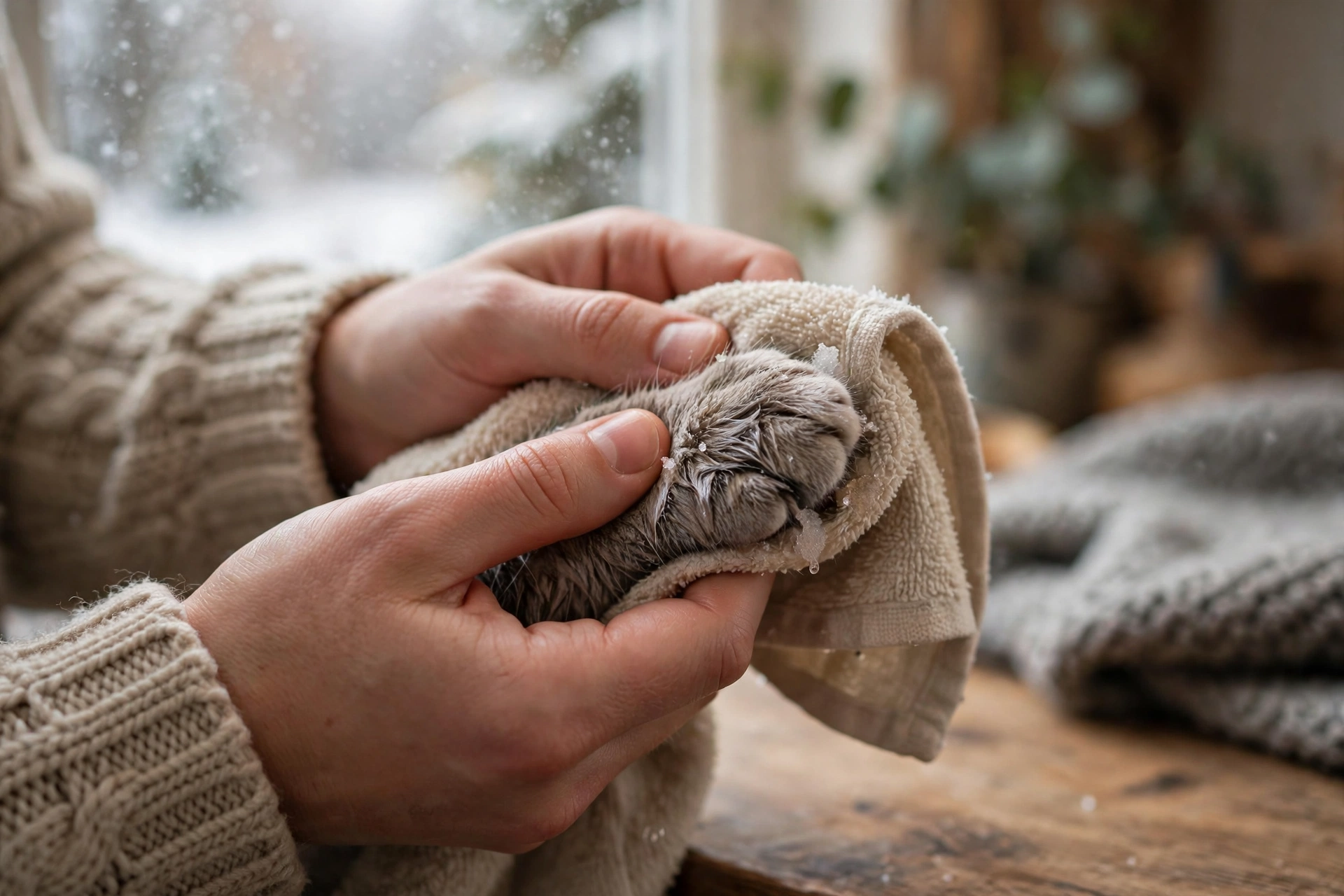
    De-icing salt and chemical ice melts can irritate a cat’s paws and are dangerous if swallowed when the cat licks its feet clean. The ASPCA advises washing and drying your pet’s feet and stomach after coming in from snow or ice, and checking for cracks in the paw pads or redness between the toes.

    Make it a habit every time the cat comes in: a quick wipe with a warm, damp towel, then dry the paws properly before the cat settles down to groom. A little petroleum jelly on the paw pads before going outside helps protect them, and booties help more for a cat that will tolerate them. Towel the cat dry as soon as it comes inside, too — wet fur stops insulating, and a damp cat chills fast even in a warm room.

    A cat’s paw being gently wiped with a towel after coming in from the snow
    Wipe paws after snow and salt — ice melt is dangerous if a cat licks it off.

    10. Starting the car without checking the hood

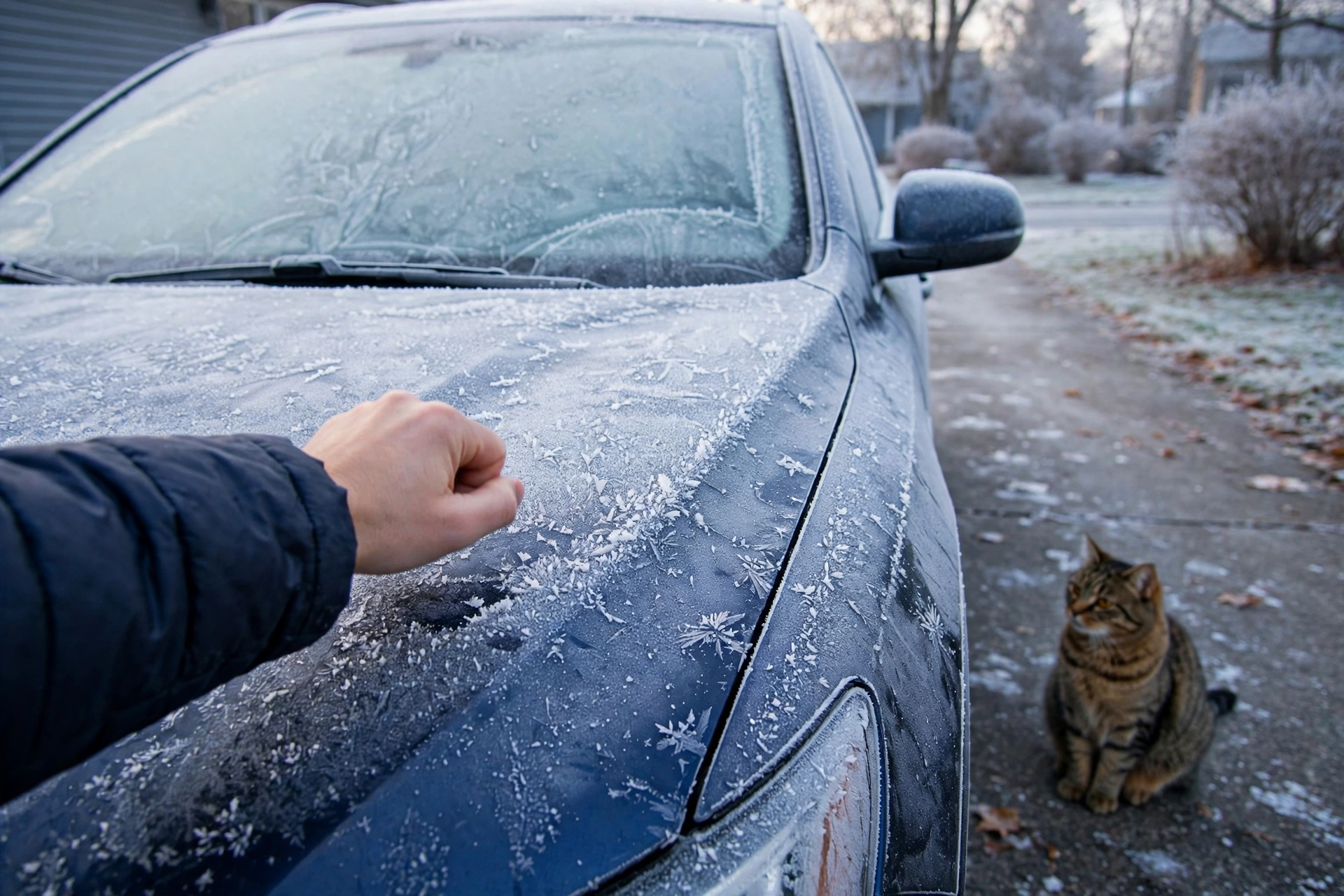
    Outdoor cats shelter in warm engine compartments and wheel wells, and they can be seriously injured when a car starts. Cornell advises checking the wheel wells and either honking the horn or banging on the hood before starting the car, to give any cat sheltering there a chance to leave. The ASPCA gives the same advice.

    A person’s hand knocking on the frost-covered hood of a car on a cold winter morning
    Bang the hood before you start the car — cats shelter in warm engine compartments.

    11. Leaving a pet alone in a cold car

    Never leave a pet alone in a car in cold weather. A car acts like a refrigerator in winter, holding in the cold, and a pet left inside can freeze.

    It is the same mistake as leaving a pet cat outside in the cold, with the same fix: bring the cat inside. The ASPCA’s test applies here too — if it is too cold for you, it is probably too cold for your pet — so if the cat has to travel with you, keep the trip short, keep the car warm while you are in it, and never leave the cat waiting alone in a parked car while you go inside.

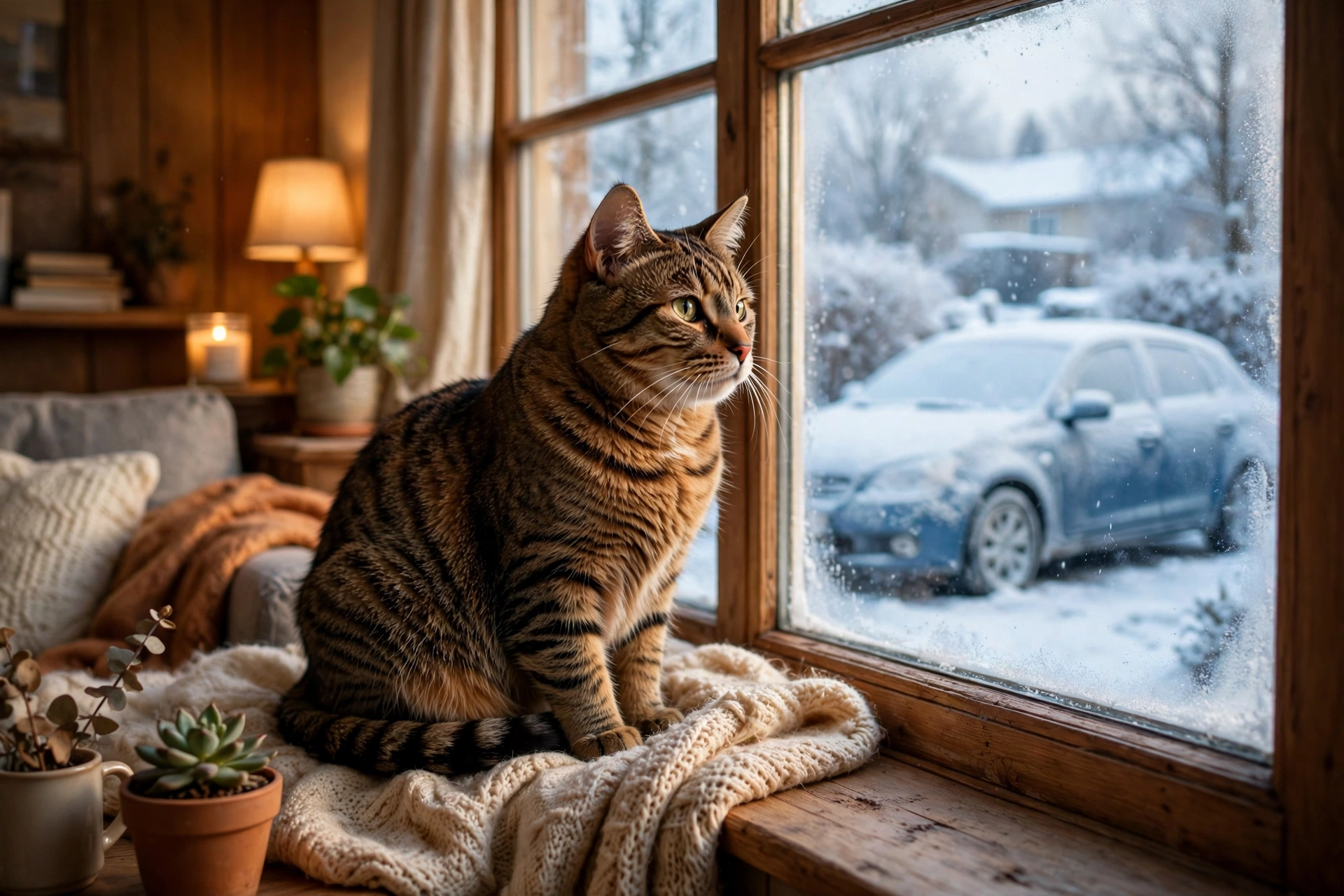
    Tabby cat sitting safe and warm on a windowsill indoors, looking out at a snow-covered car in the driveway
    Bring the cat inside — the warm house is where it belongs, not the cold car.

    12. Treating kittens, seniors, sick, thin and hairless cats like healthy adults

    Some cats feel the cold sooner. Kittens, older cats, sick cats, thin cats, and cats with very short coats or no fur chill fastest — and so do inactive cats and cats that have lost muscle or weight. International Cat Care adds that arthritic cats especially appreciate extra warmth. If your cat falls into any of those groups, winter care is not optional.

    Give these cats the warmest spot in the house: a raised, enclosed bed away from drafts, with a sunny resting place by day. A self-warming mat is a good choice here — it reflects the cat’s own body heat back, needs no electricity, and has no cable to chew — or a microwavable heat pad under part of the bedding, so the cat can move off it.

    Never place an electric heating pad directly on a cat, especially one that sleeps deeply or gets up slowly. And if a vulnerable cat seems cold, hunched, weak or unusually sleepy despite a warm bed, call the vet rather than waiting to see. That is the most important part of how to keep cats warm in winter: act early, before a chill becomes an emergency.

    Elderly grey cat curled up asleep in a warm enclosed bed with a soft blanket in a cozy living room
    Kittens, seniors and sick cats feel the cold sooner — they need extra attention.

    How to tell if your cat is too cold — and what to do

    A cat in real trouble looks different from a chilly one. Knowing how to keep cats warm in winter means knowing how to tell the difference.

    Signs to take seriously: shivering that does not stop once the cat is somewhere warm; a body that feels cold to the touch; a hunched, tucked-in posture that does not relax; weakness, wobbliness, or unusual sleepiness; and slow or shallow breathing. Frostbite most often affects the ears, nose, and paws — check those first. If you see several of these signs together, treat it as urgent.

    What to do: Bring the cat inside and dry it off. Wrap it in warm, dry towels or blankets, or use your own body heat. A warm — not hot — water bottle wrapped in a towel, placed beside the cat, helps. Then call your veterinarian.

    Do not use a heating pad directly on the cat, and do not use a hair dryer: both can burn, and a frightened cold cat will not sit still for either. Warm the cat gradually, and let the vet decide what comes next. A vet will check body temperature — veterinary references put a normal adult cat’s at 100.5–102.5°F, and describe a reading below 99°F as an emergency — which is why a cold, limp cat needs a vet now, not a wait-and-see approach.

    If you are ever unsure, call your vet and describe what you see — knowing the signs that something feels off before winter makes that call easier. Learning the warning signs now is one of the most useful parts of how to keep cats warm in winter.

    Frequently asked questions

    Do indoor cats get cold in winter?

    Yes, they can — especially kittens, older cats, sick cats, and cats with thin or very short coats. A healthy adult cat in a heated home is usually fine with a warm bed off the floor and away from drafts. If your cat spends all winter curled tight in one warm corner, the house may be colder than you think.

    What temperature is too cold for cats?

    As a caution point, most cats start to feel uncomfortable below about 45°F (7°C), and below freezing every cat risks frostbite and hypothermia with long exposure. The simplest test is the ASPCA’s: if it is too cold for you, it is probably too cold for your pet.

    Can I put a blanket in my outdoor cat’s shelter?

    No. Blankets, towels, and newspaper soak up moisture, freeze, and make the cat colder. Use straw instead — it repels moisture, insulates, and lets the cat burrow. Hay looks similar but is not the same: hay holds moisture and can mold. Straw is the outdoor bedding; blankets belong indoors.

    Is it safe to use a heating pad for my cat?

    Only with care. Never place a heating pad directly on a cat — it can heat up over time and cause burns, especially in older or sick cats that sleep deeply. A safer choice is a self-warming mat, which reflects the cat’s own body heat and needs no electricity, or a microwavable pad under part of the bedding so the cat can move off it.

    How do I keep my outdoor cat’s water from freezing?

    Check it daily and refresh it, use a heated water bowl where you have outdoor power, or use thick plastic bowls rather than shallow ceramic ones, which freeze faster. A sheltered feeding station keeps food and water out of the weather, and fresh food and water twice a day beats letting leftovers freeze.

  • The Oldest Cat in the Shelter Might Be Your Best Match

    The Oldest Cat in the Shelter Might Be Your Best Match

    The cats at the back of the shelter

    Walk past the kitten room at any shelter and you will hear it first — the squeaks, the scrambling, the crowd pressed against the glass. Walk a little further, to the quiet row at the back, and you will find the cats nobody is looking at. They are older, greyer, and slower to get up. They have been waiting the longest. And that is a strange thing, because the cat at the back of the shelter is often the best cat in the building.

    If you are thinking about adopting a senior cat, the oldest cat in the shelter might be your best match — and not for the sentimental reasons you expect. November is Adopt a Senior Pet Month, which makes this a good month to look, but the reasons to choose an older cat hold all year round.

    What “senior” actually means — and why the label varies

    There is no single birthday on which a cat becomes a senior, and the label means different things in different places — a cat listed as a “senior” at one shelter might be listed as an adult at another.

    The 2021 AAHA/AAFP Feline Life Stage Guidelines — the framework most US vets use — call cats over 10 “seniors” and cats aged 7 to 10 “mature adults”. The AAFP’s Senior Care Guidelines split it further: senior at 11 to 14, geriatric at 15 and older, while noting there is no specific age at which a cat becomes senior. Shelters often draw the line earlier, commonly at 7 or 8, because that is where adoption patterns start to change.

    None of these is wrong. The veterinary guidelines track health and disease risk; shelters track how long a cat is likely to wait. What matters is not the label but the cat in front of you — its health record, its mobility, and how it behaves in the room with you. When a shelter says “senior”, ask what age they mean. The number is a starting point, not a verdict.

    Why older cats wait longer for a home

    Walk through a shelter and the pattern is easy to see: the kittens draw the crowd, and the older cats wait. The numbers back up what your eyes tell you. Shelter Animals Count’s 2025 data, reported by PetFairs, found senior cats had a 61% adoption rate, compared with 69% for adult cats and 71% for juveniles. In that dataset “senior” meant 7 years and older, and the figures come from shelters reporting through its system — not a census of every shelter in the country — but the direction matches what shelters report year after year. The ASPCA puts it more bluntly: senior pets are often the last to be adopted.

    Why? People worry, reasonably, about how much time they will get. A grey muzzle and a slower gait do not photograph the way a kitten does. And there are quiet assumptions: that an older cat must be sick, difficult, or set in ways that will not fit a new home. Some of that has a grain of truth — health costs do arrive sooner, as explained below — but as a judgement of the cats themselves, it is mostly wrong. An older cat is not a damaged kitten. It is a finished cat, and what you see is largely what you get.

    That waiting has a practical side for adopters, too. Because older cats stay longer, shelters often know them better — their habits, their quirks, how they take to strangers — than they know a kitten who arrived last week. And many shelters reduce or waive adoption fees for senior animals, particularly during November. That is not universal, so ask yours.

    What you actually get with a senior cat

    The best reason to adopt an older cat is also the least sentimental one: you know what you are getting.

    A senior cat’s personality is already formed. A kitten is a promise — it may grow into a lap cat or it may grow into a cat that tolerates you from the top of the bookcase. An older cat has already decided who it is. Spend half an hour with one in a meet-and-greet room and you will learn more about your future together than a kitten’s first month at home will tell you. The ASPCA makes the same point: because a senior pet is fully grown, you know its size, its personality type, and its grooming needs from the start.

    The pace is usually calmer. Most older cats are past the phase of climbing the curtains at 3 a.m. That is not a guarantee — some seniors stay playful well into their teens — but on average, a senior cat asks for a warm lap and a sunny windowsill more often than it asks for a chase.

    Most senior cats are already litter-trained and used to living in a home. If the cat lived in a house before, the basics — litter box, scratching post, sleeping through the night — are usually already learned. That makes the first week easier, though it is not a promise: a stressed or unwell cat can still have accidents, and that is a settling-in problem to solve, not a character flaw.

    What a senior cat will not do is be grateful in the way people imagine. Cats do not keep ledgers. An older cat may bond deeply and quickly, or it may take weeks to decide you are safe — both are normal. Adopt one because the cat in front of you fits your life, not because you expect a thank-you.

    The honest part: health, vet visits, and costs

    This is the section to read twice. Adopting a senior cat is a good decision, but it is a better decision made with open eyes.

    Book a vet visit within the first one to two weeks. Even if the shelter has done its own checks, your own vet should establish a baseline: a full examination, and usually bloodwork, a urine test, and a blood pressure check. The AAHA/AAFP guidelines recommend diagnostic testing for seniors at least yearly, with every six months recommended — blood count, biochemistry, urinalysis, thyroid (T4), and blood pressure. A baseline taken while the cat is well is far more useful than the first tests taken during a crisis.

    Expect check-ups about every six months. The AAHA/AAFP guidelines recommend examinations at least annually for all cats and at least every six months for seniors. The AAFP Senior Care Guidelines say the same: apparently healthy senior cats should be examined every six months, because changes in kidneys, thyroid, joints, and teeth move faster in older animals. Twice-yearly visits are the single most predictable part of the senior-cat budget.

    Know the conditions to discuss with your vet. The age-related problems that come up most often are dental disease, chronic kidney disease, hyperthyroidism, arthritis, and weight change. None is a reason not to adopt — many are manageable for years — but they are reasons to ask the shelter what it already knows and to budget for treatment rather than be surprised by it. Do not change your cat’s diet on the basis of an article; diet decisions for a senior cat belong with your vet.

    Budget for sooner, not later. A kitten’s vet bills are mostly in the future. A senior cat’s may start in the first year — not necessarily large, but the honest budget includes the six-monthly exams, dental work if needed, and the possibility of long-term medication. Pet insurance, if you want it, is worth pricing before you adopt; some policies exclude pre-existing conditions, so the shelter’s records matter here.

    Watch for the quiet changes. Older cats hide discomfort well. Mention to a vet any change in drinking, eating, weight, sleep, jumping, litter box use, or coat condition. Any one of these can mean nothing, or the first sign of something treatable — and the six-monthly visit is what catches it early.

    Questions to ask the shelter before you decide

    The shelter knows this cat. Before you sign anything, ask:

    • Why is this cat here? Surrender, stray, or owner passed away — the answer shapes what to expect in the first weeks.
    • What vet records exist? Vaccinations, spay/neuter status, dental work, bloodwork, known conditions, and current medication. Ask for copies, not just a summary.
    • Is the cat on any medication, and what does it cost? A daily tablet is a small thing if you know about it; a surprise prescription is not.
    • How is the cat eating, drinking, and using the litter box? The shelter watches these every day, and they tell you most about a cat’s health.
    • How does the cat move? Can it jump, climb stairs, or use a standard litter box, or does it need a low entry and a ramp? Arthritis often shows up as reluctance, not limping.
    • How does the cat do with people, other cats, and dogs? What the shelter has actually observed matters more than a general label like “friendly”.
    • How long has the cat been here, and has it been adopted and returned? A long stay is not a warning sign by itself, but it is worth knowing.
    • What does the adoption fee cover, and is there a senior discount? Many shelters reduce or waive fees for older animals — ask what vet care, if any, is included.
    • What support do you offer after adoption? Some shelters offer a settling-in call, behaviour advice, or a trial period. Knowing that in advance is better than finding out when you need it.

    If a shelter cannot answer most of these, that may only mean the cat arrived recently. The questions are worth asking either way.

    Setting up your home for an older cat

    An older cat does not need a renovated house. It needs a small, predictable space to start from, and a few adjustments that make daily life easier on stiff joints.

    Start with one quiet base room. A spare bedroom or a quiet corner with a door that closes is ideal for the first days. Put the bed, food, water, litter box, and a hiding spot in that one room, all on the same floor. The cat should not have to cross the house, climb stairs, or pass the dog to eat or use the litter box. Once the cat is eating, using the box, and coming out to explore, open up the rest of the house gradually.

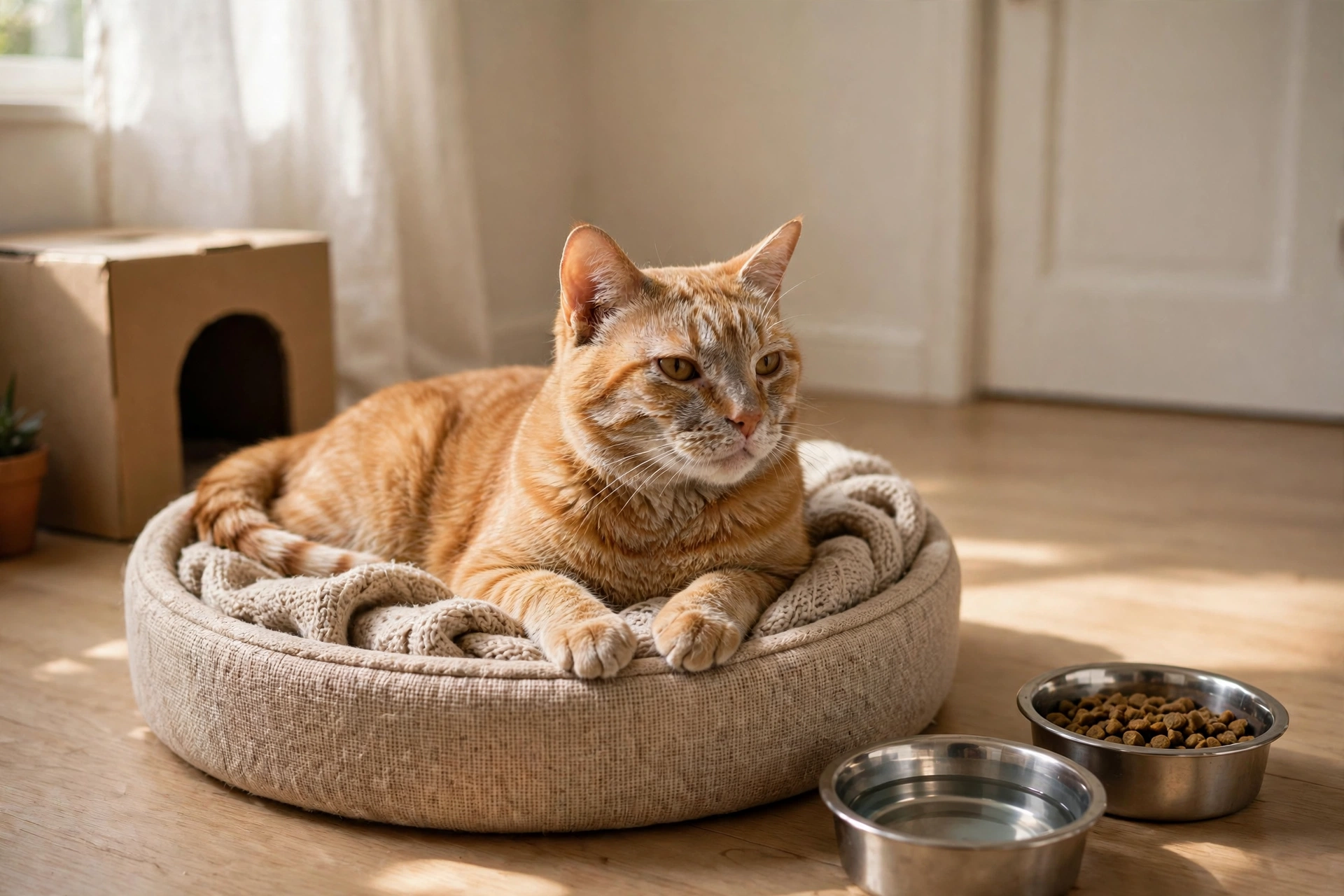
    Senior ginger cat settling into a quiet base room with a round bed, food and water bowls, and a hiding box
    One quiet base room, with everything on the same floor, is the best start.

    Make the litter box easy. A low-entry box matters more than a fancy one. Older cats with stiff joints may avoid a high-sided box, and avoiding the box looks exactly like a litter problem when it is really an access problem. Keep the box in a quiet spot, scoop daily, and if you have a multi-level home, put a box on each floor the cat uses.

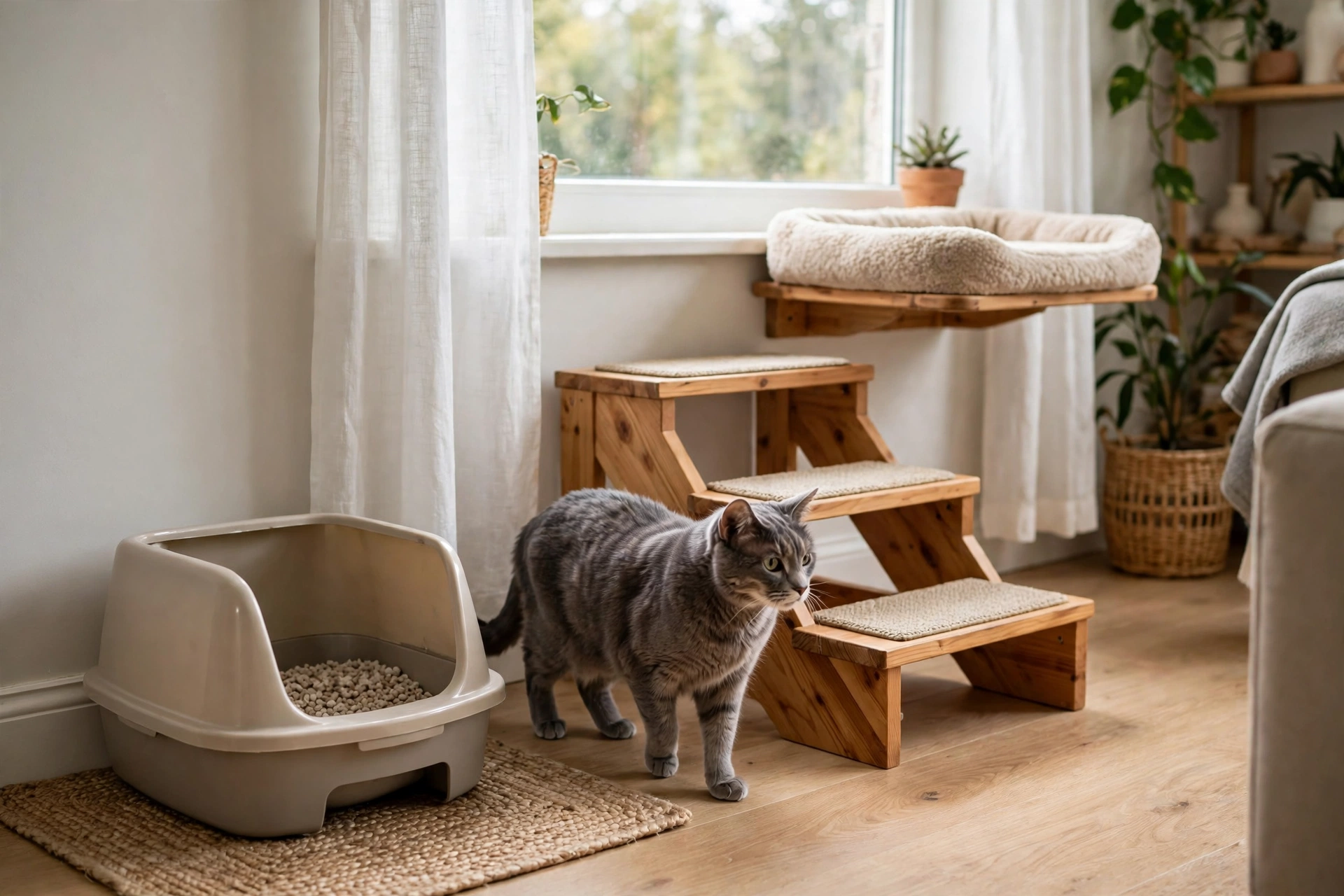
    Give the cat a way up. A favourite windowsill or bed that now requires a jump may quietly become a place the cat stops going. A sturdy set of pet steps or a ramp, or simply a chair placed as an intermediate step, keeps those spots available. Watch where the cat hesitates — that is where help is needed.

    Senior grey cat walking toward pet steps by a low-entry litter box in a bright home
    A low entry and a small step keep the everyday things easy on stiff joints.

    Mind slippery floors, and keep everything close. Wood, tile, and laminate are hard going for arthritic joints — a rug or non-slip mat on the route between bed, food, and litter box helps a lot. Keep food, water, and bed reachable without stairs, especially at night, but keep a little distance between food and litter.

    Offer warmth. Older cats feel the cold more than younger ones. A warm bed in a sunny spot, away from drafts, is often the thing a senior cat values most. A self-warming mat — no cable, no plug, nothing hot enough to burn — is a safe option; never place a heating pad directly on a cat.

    The first weeks at home

    Rescue circles talk about the 3-3-3 rule: three days to decompress, three weeks to learn the routine, three months to feel at home. It is a widely shared rule of thumb, not a scientific timetable — no study pins settling-in to those numbers — but it sets expectations in the right order: the first days will look worse than the cat you met at the shelter.

    The first three days: decompress. Do not expect the cat you met at the shelter. Many cats hide, eat little, and use the litter box at night when the house is quiet. That is normal. Keep the base room calm, keep visits short, and let the cat come to you. Do not force cuddles, do not introduce the cat to the whole household on day one, and do not rearrange the room once the cat has chosen a hiding spot.

    The first three weeks: learn the routine. By now the cat should be eating regularly and using the litter box reliably. Keep the daily pattern — feeding times, play, quiet evenings — boringly consistent. This is also when the real personality starts to show, which may be quite different from the shelter version in either direction.

    The first three months: feel at home. By three months most cats have chosen their spots, their routines, and their person. If a problem has not improved by then — persistent hiding, not eating, litter box avoidance, aggression — ask your vet or the shelter for help rather than waiting it out. It may be medical, it may be environmental, and it is almost always fixable once the cause is found.

    Introduce other pets slowly, through a closed door first, then supervised short meetings. An older cat that has lived with other animals may slot in easily; one that has not may need weeks. There is no prize for the fastest introduction.

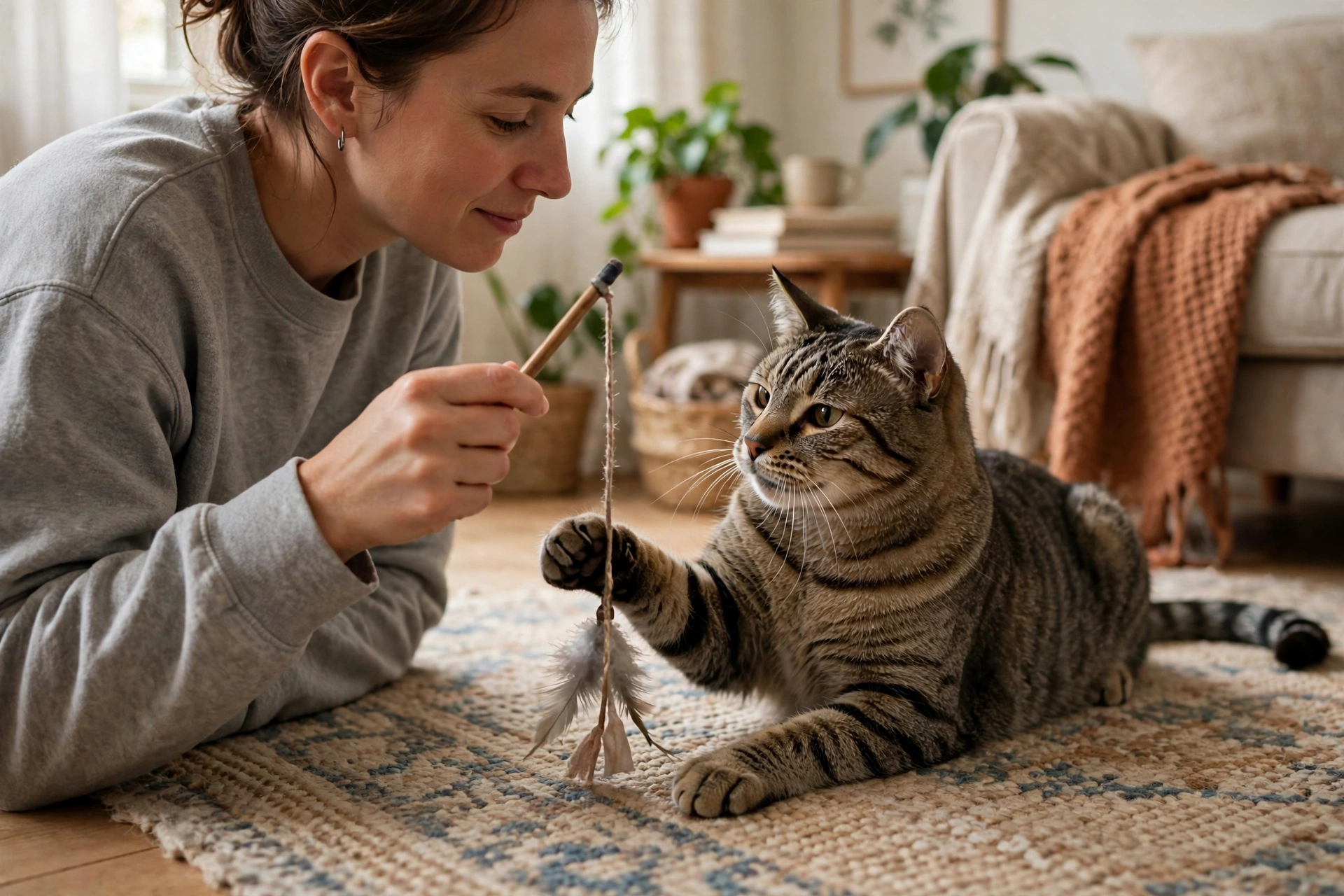
    Person gently playing with a senior tabby cat with a slow wand toy on a living room rug
    Slow, gentle play is enough — the first weeks are about routine, not excitement.

    Is a senior cat right for you?

    A senior cat fits best with someone who wants a companion more than a project. If you want a cat that will sit with you, follow a routine, and be fully itself from the start, an older cat is a strong choice. If your household is calm, your schedule is steady, and you can afford twice-yearly vet visits, you are well placed.

    Think carefully if the honest answers are different: if your budget has no room for a dental procedure or a new prescription; if you are away for long stretches with no one to check in; if your home has small children who want a playmate rather than a quiet companion. None of these is a verdict against adopting. They are the questions that turn a kind impulse into a good home.

    One question worth asking yourself plainly: what will you do when this cat gets older still — when it needs medication, or cannot jump any more, or needs you to carry it to the vet? Senior cats do not stay the age they are adopted at. Adopting one is a promise that runs in the direction of more care, not less. If you can make that promise, the years you get are often the best years a cat has.

    Frequently asked questions

    What age is a senior cat?

    It depends who you ask. The 2021 AAHA/AAFP Feline Life Stage Guidelines call cats over 10 seniors and cats aged 7 to 10 mature adults. The AAFP’s Senior Care Guidelines split it further — senior at 11 to 14, geriatric at 15 and older — and note there is no single age at which a cat becomes senior. Shelters often use 7 or 8 as the cut-off. Ask what the shelter means, and judge the individual cat.

    How much does it cost to adopt a senior cat?

    The adoption fee itself is often lower than for a kitten — many shelters reduce or waive fees for senior animals, particularly in November, so ask yours. The real cost difference is in care: a vet visit within the first one to two weeks, check-ups about every six months, and a budget that allows for dental work, bloodwork, or long-term medication. The fee is the small part; the vet care is the honest part.

    Are senior cats good for first-time owners?

    Often, yes. A senior cat’s personality is already formed, so you know what you are getting, and most are already litter-trained and past the most destructive kitten phase. The trade-off is comfort with vet visits and watching for the quiet health changes older cats show. If you can do that — or you have a vet you trust — a senior cat can be an excellent first cat.

    How long does it take a senior cat to settle in?

    Expect three quiet hidden days, three weeks to learn the routine, and around three months to feel at home — the widely shared 3-3-3 rule of thumb, not a scientific timetable. If eating, litter box use, or hiding has not improved after a few weeks, ask your vet or the shelter for help.

    What should I ask the shelter before adopting a senior cat?

    Ask why the cat is there, what vet records and medications exist, how it eats, drinks, moves, and uses the litter box, how it does with people and other animals, how long it has waited, what the fee covers, and what post-adoption support exists. The answers matter more than the age on paper.

  • Hello world!

    Welcome to WordPress. This is your first post. Edit or delete it, then start writing!