The Siamese Talks Back — Personality, Care, and What Varies Cat to Cat
Say something to a Siamese, and it will probably answer. Not with a polite mew, but with a loud, raspy opinion — a chirp, a yowl, a long complaint about the empty food bowl, or a running commentary on your decision to leave the room. The Siamese is the cat that talks back. This guide starts with siamese cat personality as the registries describe it, and with what the voice costs — because the voice is the whole deal: a Siamese is not a quiet cat that happens to talk, but a conversational cat that happens to live in your house.
What a Siamese actually is
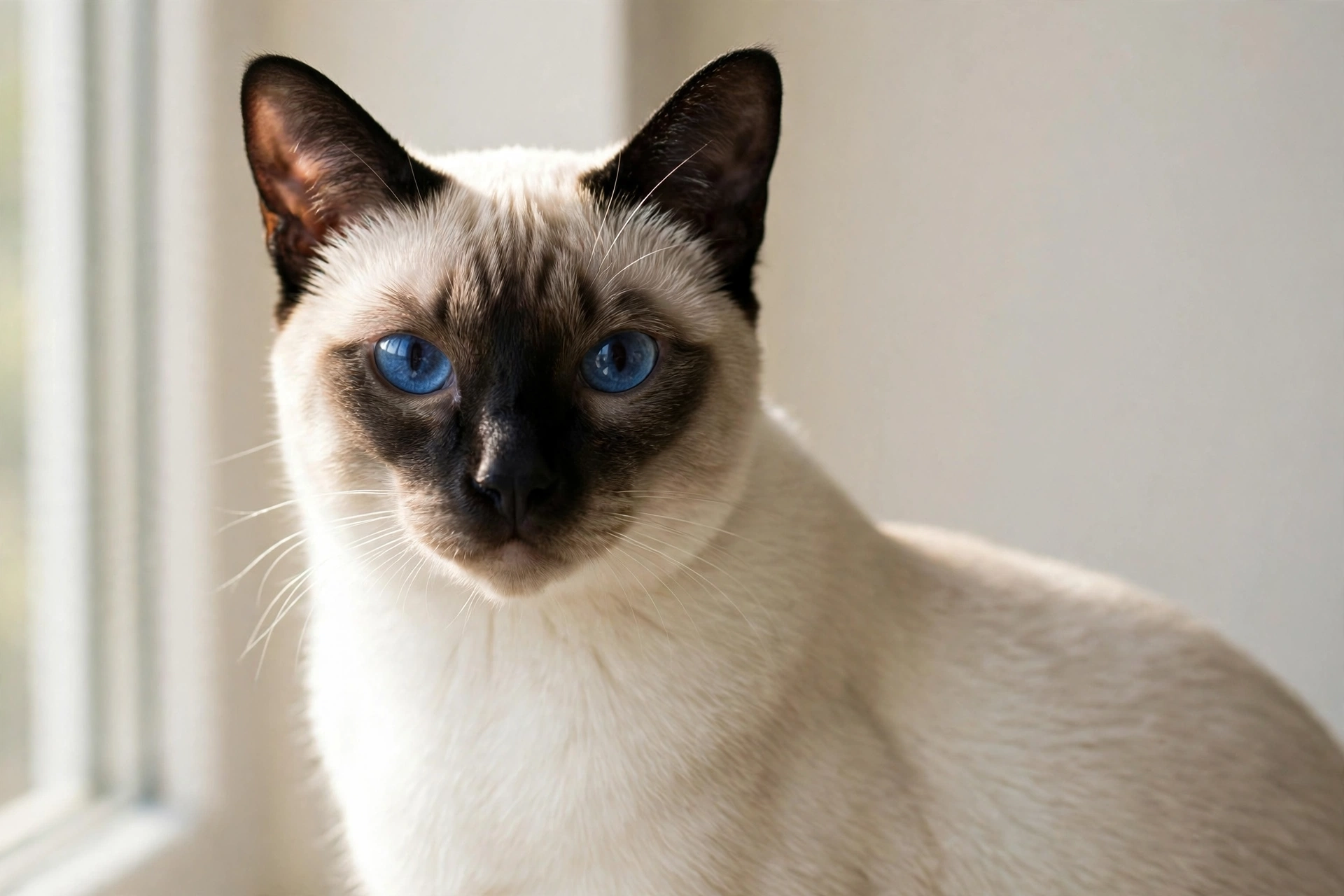
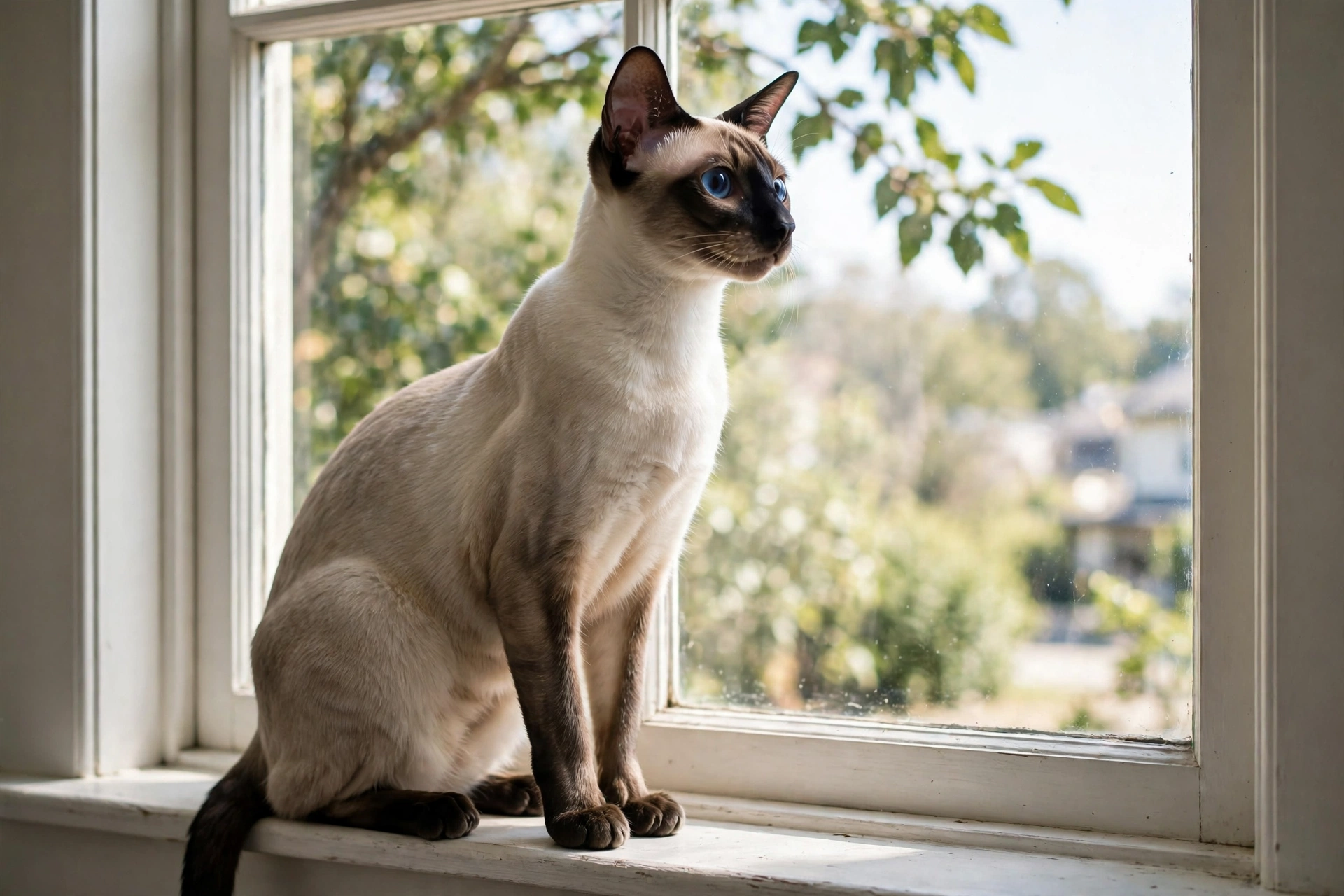
The Siamese is a medium-sized, svelte, refined cat with long tapering lines — that is the Cat Fanciers’ Association’s opening description. It is lithe but muscular, with long slim legs, a long slender neck, and a whip-thin tail. Males generally weigh 10 to 15 pounds and females 8 to 12 pounds, and the whole cat is rarely more than 24 inches long.
The head is a long tapering wedge, with strikingly large ears and almond-shaped eyes that slant toward the nose. The eyes are always blue — deep, vivid blue — and the breed standard calls for them uncrossed. The coat is short, fine-textured, and glossy, lying close to the body, which is why the Siamese looks so sleek and needs so little grooming.
The point pattern is the signature. The body is pale — cream, ivory, bluish white, or glacial white — and the ears, mask, legs, feet, and tail are dark. The CFA recognizes four point colors: seal, chocolate, blue, and lilac; other registries accept more, including red, cream, and lynx (tabby) points, shown by the CFA as the separate Colorpoint Shorthair breed.
Every Siamese kitten is born white or cream-colored. The points develop over the first weeks of life, because the color is temperature-sensitive: the cooler parts — ears, face, legs, tail — grow darker fur, while the warm torso stays pale. A Siamese also darkens with age.
The personality, as the registries describe it
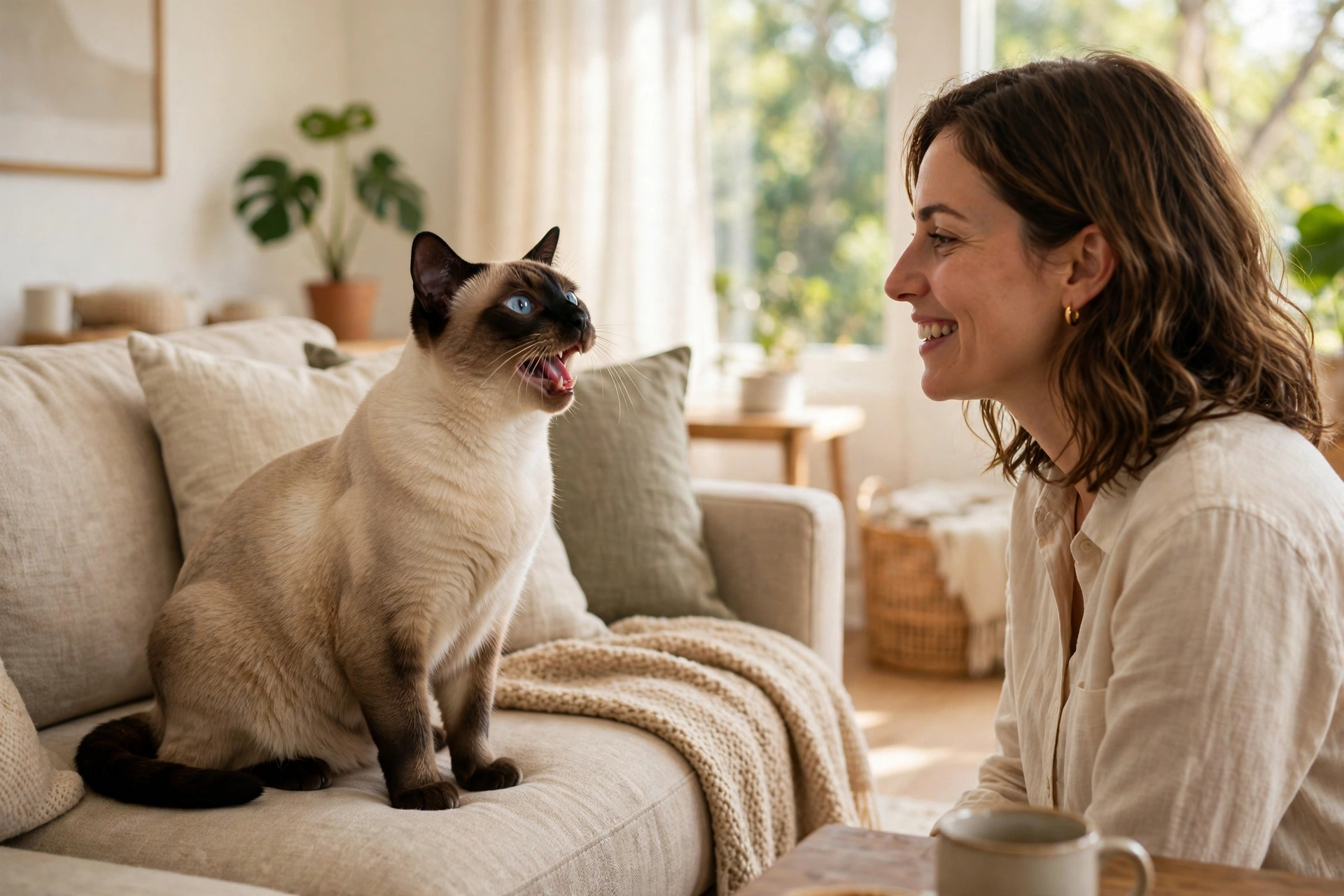
What the registries say about siamese cat personality is consistent — and worth quoting, because it is the standard every Siamese is measured against. The Cat Fanciers’ Association calls the Siamese “unsurpassed by any other breed in its ability to communicate with humans” and “often considered the most intelligent of cats” — “experts at making their desires known, via body language or through their large repertoire of vocalizations”.
TICA‘s description runs in the same direction: “Nicknamed Meezer, the Siamese is just as famous for their voice as their looks. They will ‘talk’ to you all day and night, expressing their opinion on everything and demanding attention.” TICA also calls the breed “very social and people oriented”, a cat that “thrives on attention and affection”.
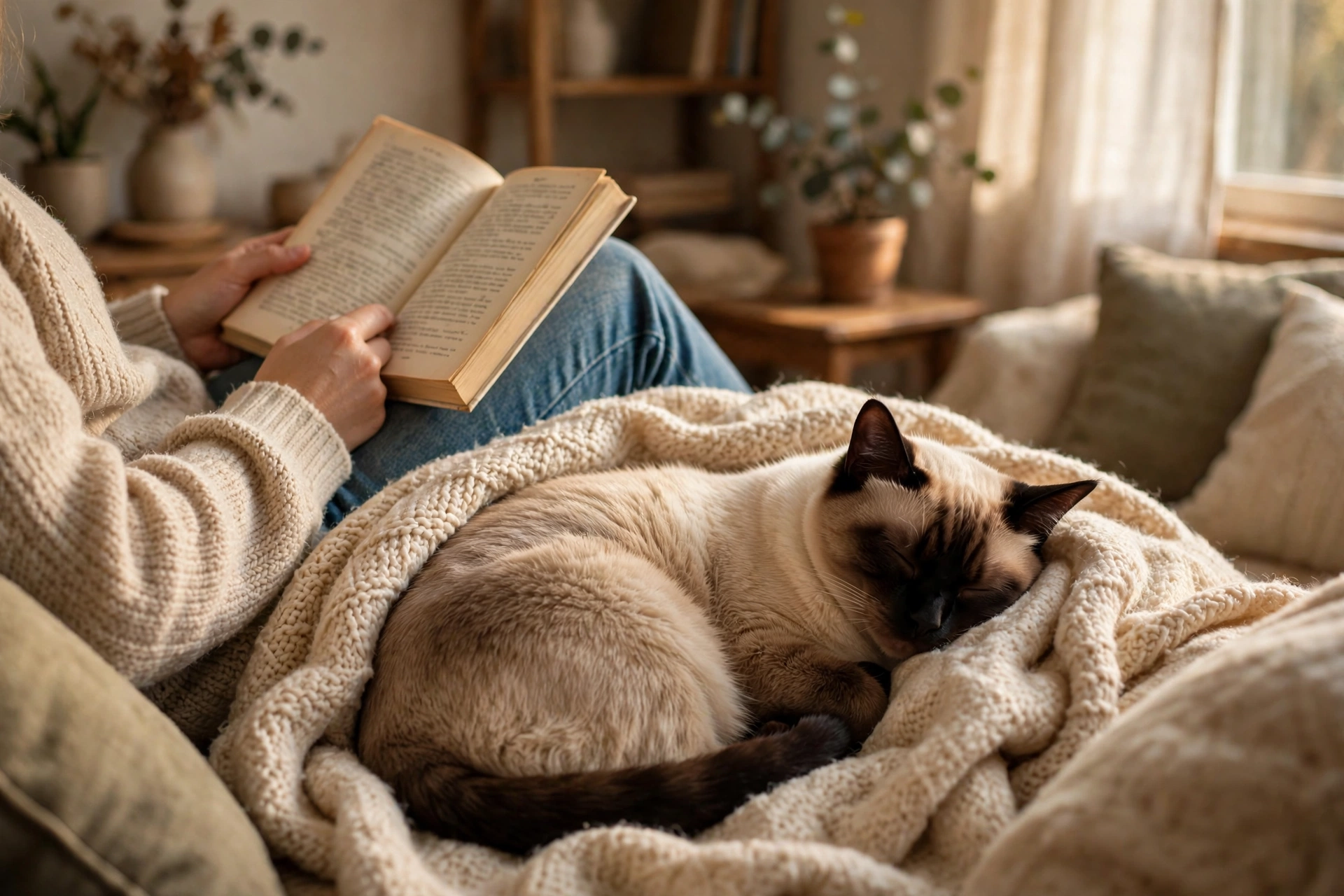
The CFA adds the part other guides leave out: Siamese cats “give a new meaning to the term ‘clingy'”. They do not just love you because you are theirs — they love you because you are warm, and will gravitate to the warmest spot in the house, which the CFA says “is most likely to be your lap.” Expect “loud protests should you need some time and space to yourself”.
The voice — what it is and what it isn’t
The voice is the first thing people notice and the first thing they underestimate. A Siamese does not meow the way most cats meow. The sound is louder, raspier, and more varied — chirps, trills, yowls, and a long, demanding cry. PetMD‘s veterinary source, Dr. Annette Louviere, calls the breed “spunky, talkative, and outgoing” — and, she adds, “while gentle, Siamese cats don’t jump to mind for being laid-back.”
The voice is communication, not noise for its own sake. A Siamese talks when it wants food, when it wants the door opened, when it wants you to come back, and when it wants you to know it has noticed something. Great Pet Care’s breed experts call vocalness “probably the one main characteristic that someone thinking about the breed should be aware of before adopting a Siamese cat”.
What the voice is not: it is not a sign that the cat is unhappy, and it is not something training will remove. A Siamese that stops talking is more concerning than one that never stops — a sudden change in vocalizing, appetite, or energy is worth a conversation with your vet. And the voice is not the same in every cat: some narrate the whole day, some save their opinions for mealtimes.
What varies cat to cat
The registries agree on average siamese cat personality — and leave plenty of room for the individual. Here is what varies most.
Vocalness. Every Siamese talks, but not at the same volume or frequency. Some narrate; some comment only when it matters. Kittens are often the loudest, and the voice usually settles — less constant, not silent — as the cat matures.
The favorite person. Siamese cats bond strongly with their household, and many pick one person to shadow. The chosen person gets followed from room to room, slept on, and talked to the most — the rest of the family still gets affection, but the favorite gets the full performance.
Energy. Siamese are active at every age, and more so than a Ragdoll or a Persian. The energy shows up as climbing, leaping, investigating, and play that lasts longer than a few minutes. A bored Siamese is a destructive Siamese: cupboards opened, objects knocked off shelves, mischief that looks deliberate because, very often, it is.
Modern vs. traditional. Two types exist. The modern show type is the extreme wedge: a long triangular head, very large ears, and an extremely slender body. The traditional type — sometimes called the applehead or Thai — has a rounder head, a sturdier body, and smaller ears, with the same coat and blue eyes. The personality is much the same either way; the difference is looks, not temperament.
Daily care: the routine that keeps a Siamese happy
Indoor life. A Siamese is an indoor cat. It is social, trusting, and not street-smart enough to be left to its own devices outdoors — and would rather be on your lap than alone in a garden. Give it high places instead: TICA notes that Siamese “are great jumpers and love heights, so perches and cat trees should be provided.”
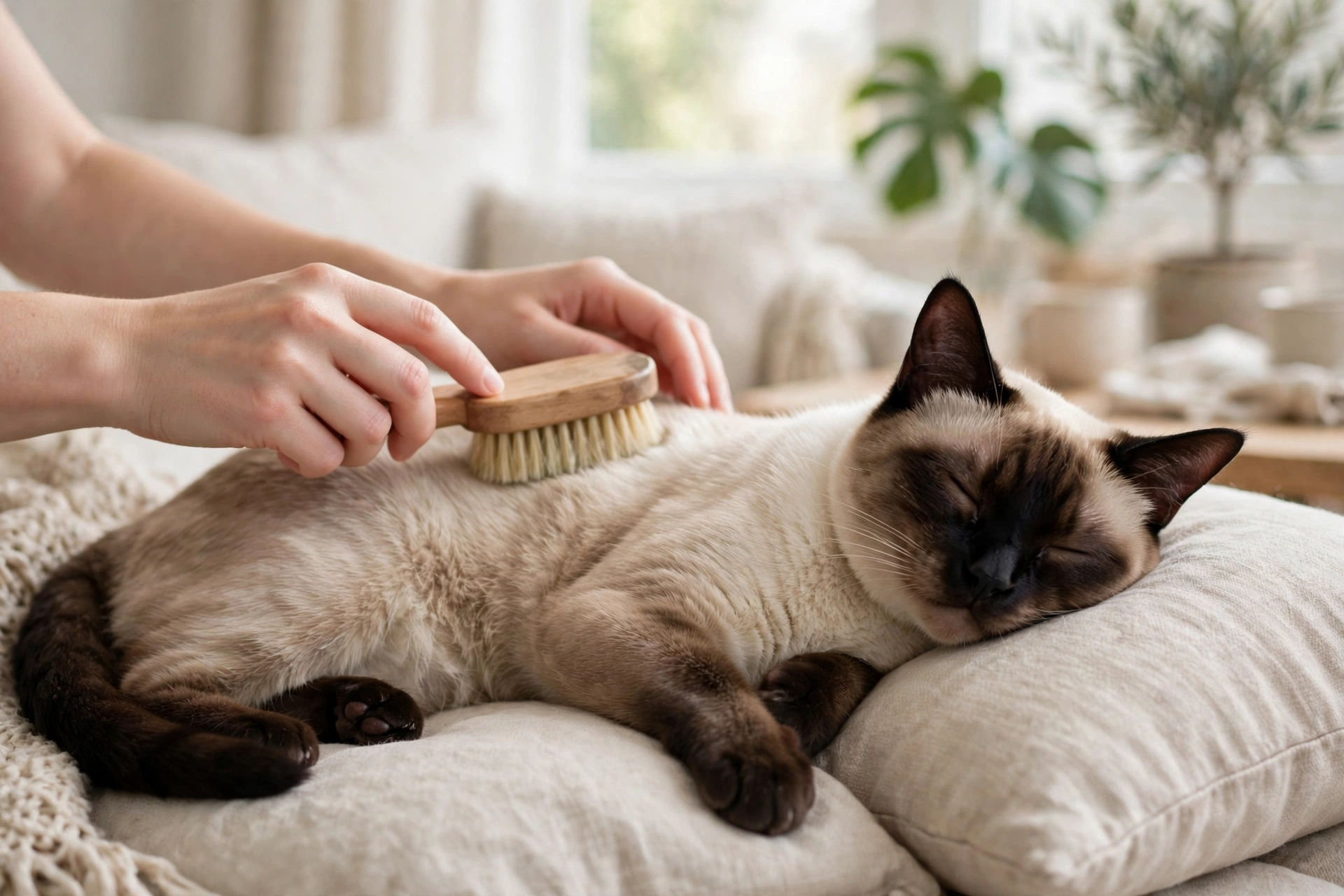
Grooming. The short coat is the easiest part of Siamese care. A weekly brushing with a soft brush removes loose hair and keeps shedding down, and the cat will probably enjoy it — Siamese treat grooming as affection. The teeth are another matter: Siamese are prone to dental problems, so start brushing them daily from kittenhood, while the cat is young enough to accept it. Ask your vet to show you how. Nails need trimming regularly — your breeder or vet can show you how.
Play and training. Siamese are among the easiest cats to train, and among the quickest to get bored — the two facts belong together. They learn routines fast, can be taught to fetch, to walk on a lead, and to come when called, and they love puzzle feeders and toys that make them think. TICA warns that they “require stimulation or a lot of toys to keep them occupied”, and a Siamese without enough to do will invent its own entertainment. Two or three short play sessions a day cover most cats.
Feeding and weight. Siamese are hearty eaters for their size, and weight shows quickly on a slender frame — a pot belly appears after very little overeating. Measure an appropriate amount of life-stage food at each meal, and remember that treats count toward the daily calories. PetMD reports that a high-quality commercial diet approved by the Association of American Feed Control Officials (AAFCO) provides everything a Siamese needs. If you are unsure about portions, ask your vet.
Health to discuss with your vet or breeder
A Siamese from a reputable breeder is generally healthy and long-lived — PetMD puts the average lifespan at 15 years, “known to live well into their 20s”. A few things are worth discussing with your vet or breeder.
Progressive retinal atrophy (PRA). This is the inherited eye disease the CFA names first. PRA is a recessive gene that causes gradual vision loss, and it is detectable via genetic testing. When choosing a Siamese, ask the breeder whether the cats they breed have been tested.
Amyloidosis. The CFA names this as the second issue breeders are working to address: abnormal protein deposits that cause liver problems. Research is still ongoing to determine the responsible genes, and the CFA’s advice is direct — “it’s best to inquire if there is any history of it in your kitten’s lines.”
Asthma. Siamese are among the breeds most often listed as prone to feline asthma, a chronic inflammation of the lower airways. The signs are coughing (often mistaken for a hairball cough — cats do not really cough with hairballs), wheezing, and rapid breathing. Breathing with the mouth open is an emergency: contact a vet right away. Keeping the air clean helps, and a vet can advise on next steps.
Dental disease. Siamese are prone to gum inflammation and tooth resorption, a painful condition in which the tooth structure breaks down. The daily tooth-brushing routine above is the main defense.
Pica. PetMD reports that Asian breeds such as the Siamese are prone to pica — eating non-food items — especially wool-sucking, per a study in the Journal of Veterinary Behavior. A cat that chews fabric, plastic, or string needs the objects removed and a vet conversation.
Crossed eyes and kinked tails. These are the breed’s famous quirks, and historical traits rather than health problems. Early Siamese lines commonly had crossed eyes and kinked tails, both linked to the same gene that produces the point pattern. Crossed eyes are usually harmless and need no treatment, and the show standard calls for uncrossed eyes.
None of this is a reason to avoid the breed — it is a reason to buy from a breeder who tests and to keep a vet who knows the cat.
A short history
The Siamese comes from Thailand, then called Siam — one of the oldest recognized breeds in the cat fancy. Stories say the cats guarded temples and the souls of the departed; PetMD reports those stories as stories, “according to the Siamese Cat Society”, not as established fact. The cats reached England in the 1880s, the Siamese Cat Club was formed in Britain in 1901, and the CFA recognized the breed in 1906.
From the 1950s, show breeders selected for an increasingly long, fine, wedge-headed cat, and by the 1980s the older, rounder style had been pushed out of the ring. Breeders who kept the moderate type had it recognized separately as the Thai. The Siamese is the parent breed of the Siamese Breed Group: the Balinese is, in TICA’s words, “truly a longhaired Siamese”, and the Orientals share the same body with a different coat.
Who a Siamese suits — and who it doesn’t
Siamese cat personality suits a home where someone is around most of the day, with another pet for company — ideally another Siamese — and an owner who wants a cat that behaves like a shadow and a conversation partner. They do well with children who play actively and with cat-friendly dogs, and they suit people who enjoy play and training.
A Siamese does not suit a quiet household that wants a decorative cat, or a home where the cat would be alone for long hours every day. TICA is clear that Siamese “do not like to be left alone for long periods”. It does not suit someone who finds a persistent, raspy voice irritating — the voice is the breed, not a phase. And it does not suit someone who wants an independent cat that keeps its distance. A Siamese’s whole character is closeness — if you want a cat that mostly leaves you alone, get a different breed.
Cost and rescue. No single price fits this breed — prices vary too widely by region, lineage, and breeder to quote a figure. A reputable breeder will have done the PRA genetic test and will ask about the kitten’s lines for amyloidosis. Siamese-specific rescue groups also rehome adult Siamese, which is worth considering if you would rather adopt than buy.
Frequently asked questions
Are Siamese cats hypoallergenic?
No. Siamese cats are not considered hypoallergenic, despite the short coat. They shed less than a longhaired breed, but they still produce the allergens that bother sensitive people. Spend time with the breed before committing if allergies are a concern.
Do Siamese cats go cross-eyed?
Some do. Crossed eyes were common in early Siamese lines and are linked to the same gene that produces the point pattern. The condition is usually harmless and needs no treatment — but a sudden change in the eyes is different: tell your vet.
How long do Siamese cats live?
A long time. PetMD puts the average at 15 years, “known to live well into their 20s”. With measured food, daily play, and regular vet visits, a Siamese is a fifteen-year commitment or more.
Are Siamese cats good with children and other pets?
Yes, with supervision. TICA says the Siamese “loves people of all ages, including children, cat-friendly dogs and other cats”. Teach children to play gently, and introduce other pets slowly.
Why is my Siamese so loud?
Because that is the breed. The Siamese voice is loud, raspy, and frequent by design — the CFA calls the breed “unsurpassed” at communicating with humans. What matters is change: a cat that suddenly goes quiet, or cries far more than usual, deserves a check-up.
A Siamese is not a cat you own. It is a cat you live with — a roommate with opinions, a shadow with a voice, a companion that will follow you from room to room and tell you what it thinks of your schedule. If you want quiet, look elsewhere. If you want a conversation, the Siamese has been waiting to have it.