Your Cat Doesn’t Want the Gift — It Wants the Box
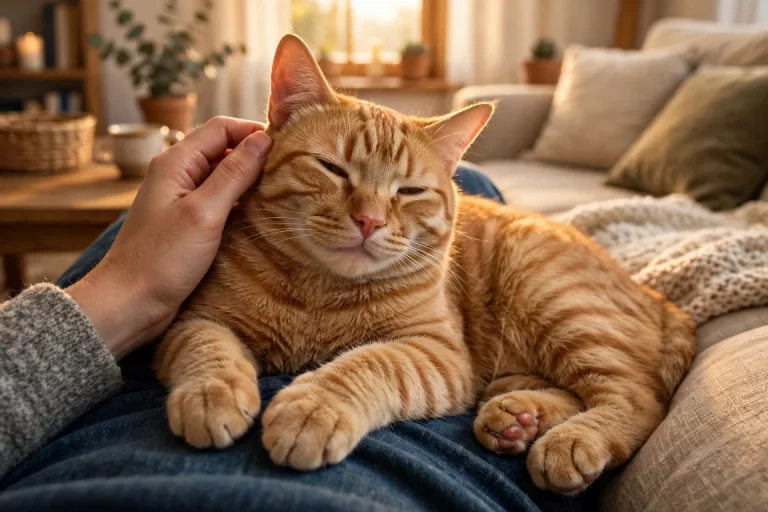
You buy the expensive cat bed. You carry it home, unwrap it, place it in the sunniest corner of the room, and step back to admire your generosity. Your cat walks past it without a glance, climbs into the cardboard box the bed came in, turns around twice, and goes to sleep.
It is the oldest joke in cat ownership. The box is doing several jobs the bed cannot do — and once you know what those jobs are, the choice stops looking strange. The question is not why your cat ignores the bed. The question is why do cats like boxes, and what is a plain cardboard box offering that a purpose-built bed is not?
Reason 1: Safety — a box is a place nothing can sneak up on
The first reason is the most important one, and it is the only one with a proper experiment behind it.
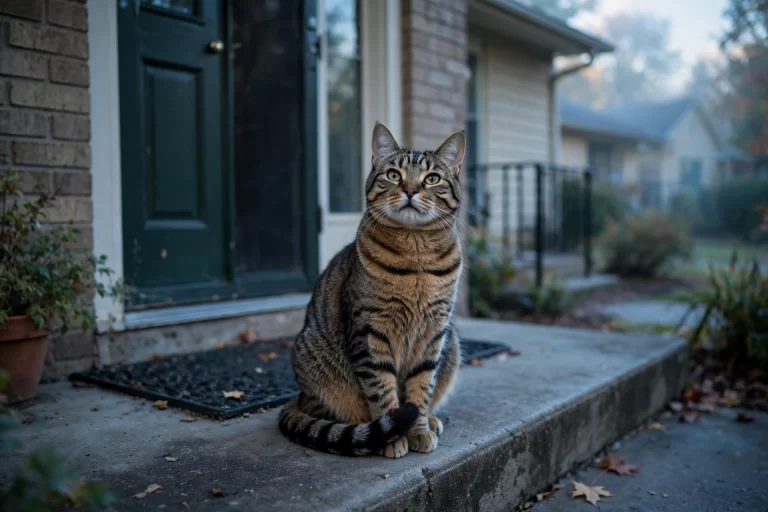
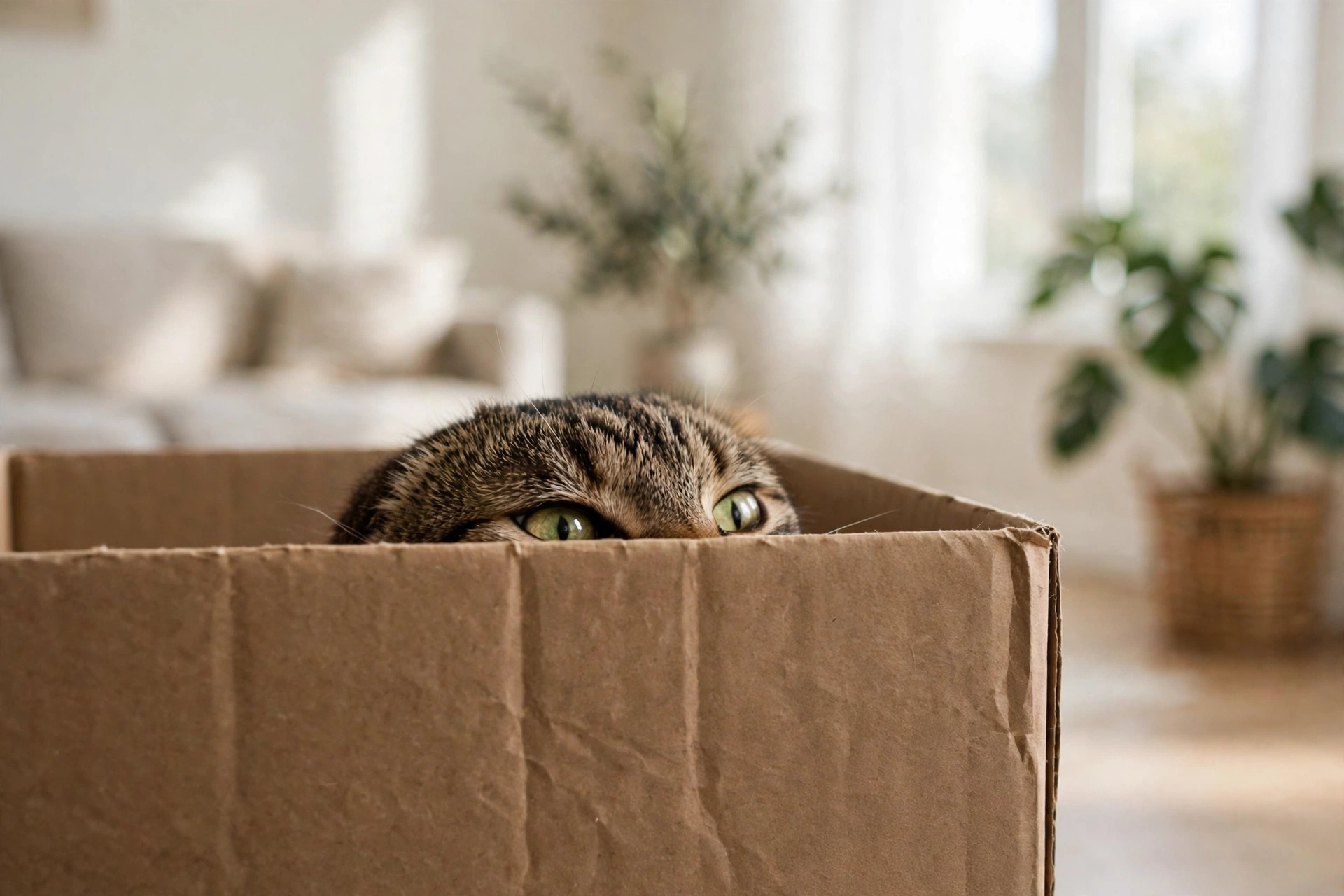
Cats are both predator and prey. In the wild, a small cat is hunted by larger animals, and its first response to trouble is not to fight — it is to hide. Hiding is, in the words of Utrecht University ethologist Claudia Vinke, “a behavioral strategy of the species to cope with environmental changes and stressors.” A box gives a cat exactly that strategy in a portable form: walls on three sides, a roof overhead, and only one direction to watch. Nothing can come at the cat from behind. Everything that approaches has to come through the front, where the cat can see it.
The experiment that proved it is worth describing properly. In 2014, Vinke and colleagues at Utrecht University studied 19 newly arrived cats at a Dutch animal shelter — one of the most stressful places a cat can be. Ten cats were given a hiding box. Nine were not. Over 14 days, the researchers scored each cat’s stress using the Kessler and Turner Cat-Stress-Score, a standard behavioural scale.
By day 3, the difference was clear: the cats with boxes had significantly lower stress scores, and their scores were far more consistent — the box was working for nearly every cat that had one. The cats without boxes caught up eventually, but not until around day 14. The box group had reached that same calm level eleven days earlier. The authors’ conclusion was careful and specific: the hiding box “appears to be an important enrichment for the cat to cope effectively with stressors in a new shelter environment the first weeks after arrival.”
A follow-up trial in 2019, also in a Dutch shelter, found the same pattern in a larger test: cats with a hiding box reached a low, steady stress level seven days earlier than the cats without one. It also found the limits of the trick. Nearly all the cats lost significant weight in their first two weeks, box or no box, and the boxes made no difference to that — and no difference to how quickly the cats were adopted. A box is not a cure for shelter stress. It is a head start on coping with it, in the hardest first days.
An earlier study points the same way from a different angle: in 1993, researchers found that cats which could hide had lower levels of cortisol, the stress hormone, than cats deprived of a hiding place. The mechanism is simple. A cat that can hide does not have to stay alert. A cat that cannot hide has to watch everything, all the time — and that is exhausting.
Your house cat is not in a shelter, but the instinct is the same. A new home, a new baby, a visitor, a thunderstorm, a dog next door, a vacuum cleaner — any of these can send a cat looking for walls. The box is the wall it can carry around.
Reason 2: Warmth — your house is colder than your cat likes
The second reason is temperature, and it is a bigger gap than most people realise.
According to a 2006 study by the National Research Council, cats are most comfortable at temperatures between 86 and 97 degrees Fahrenheit. Most homes are kept at about 72 degrees. That is a gap of 15 to 25 degrees between the temperature your cat prefers and the temperature you keep the living room at — and your cat feels it.
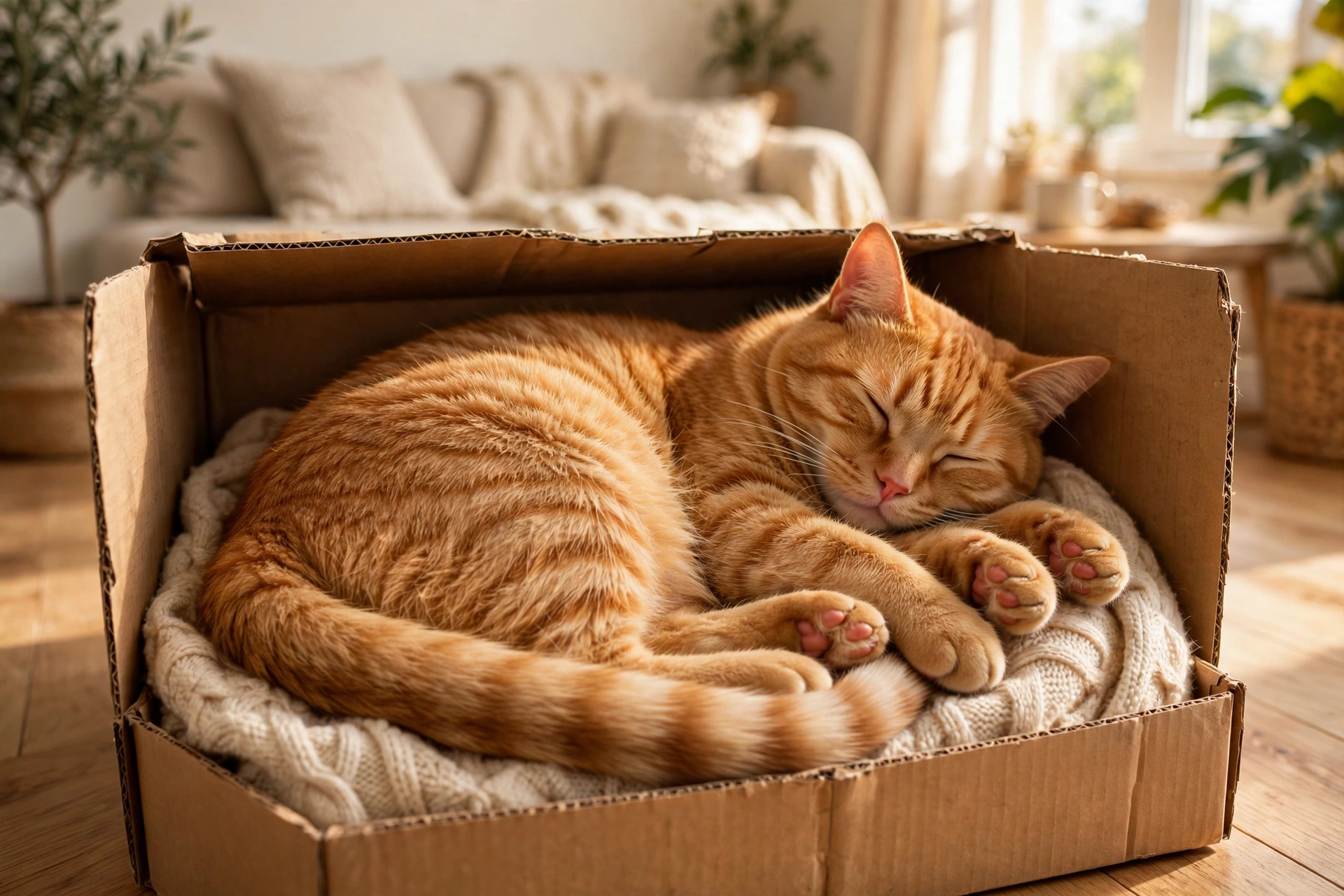
Cardboard helps twice. First, it is an insulator: the corrugated layers trap air, and the box traps the cat’s body heat inside a small space instead of letting it escape into the room. Second, the small space forces the cat to curl up into a ball, and a curled cat loses far less heat than a stretched-out one. The box is, in effect, a small warm room inside a cold big one.
That is also why the box habit gets stronger in winter, and why cats seek out the warmest spots in the house — the sunny windowsill and the laundry fresh from the dryer. A box is the warmest thing in the room that the cat can also hide in, which is why it beats the expensive bed: the bed is soft, but it is open, and open is cold.
Reason 3: The hunting blind
The third reason is the one the cat would give, if it could: a box is a perfect place to hunt from.
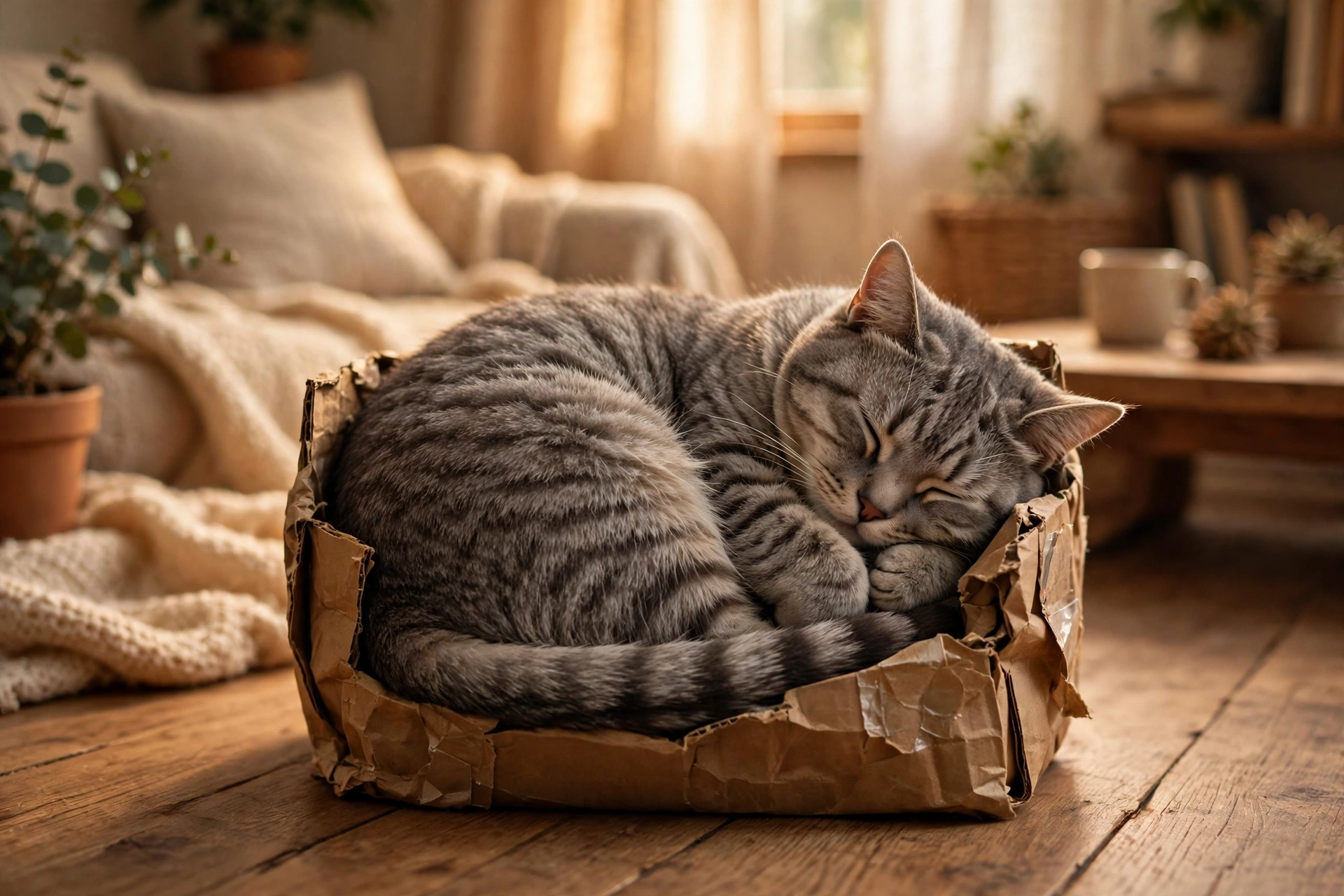
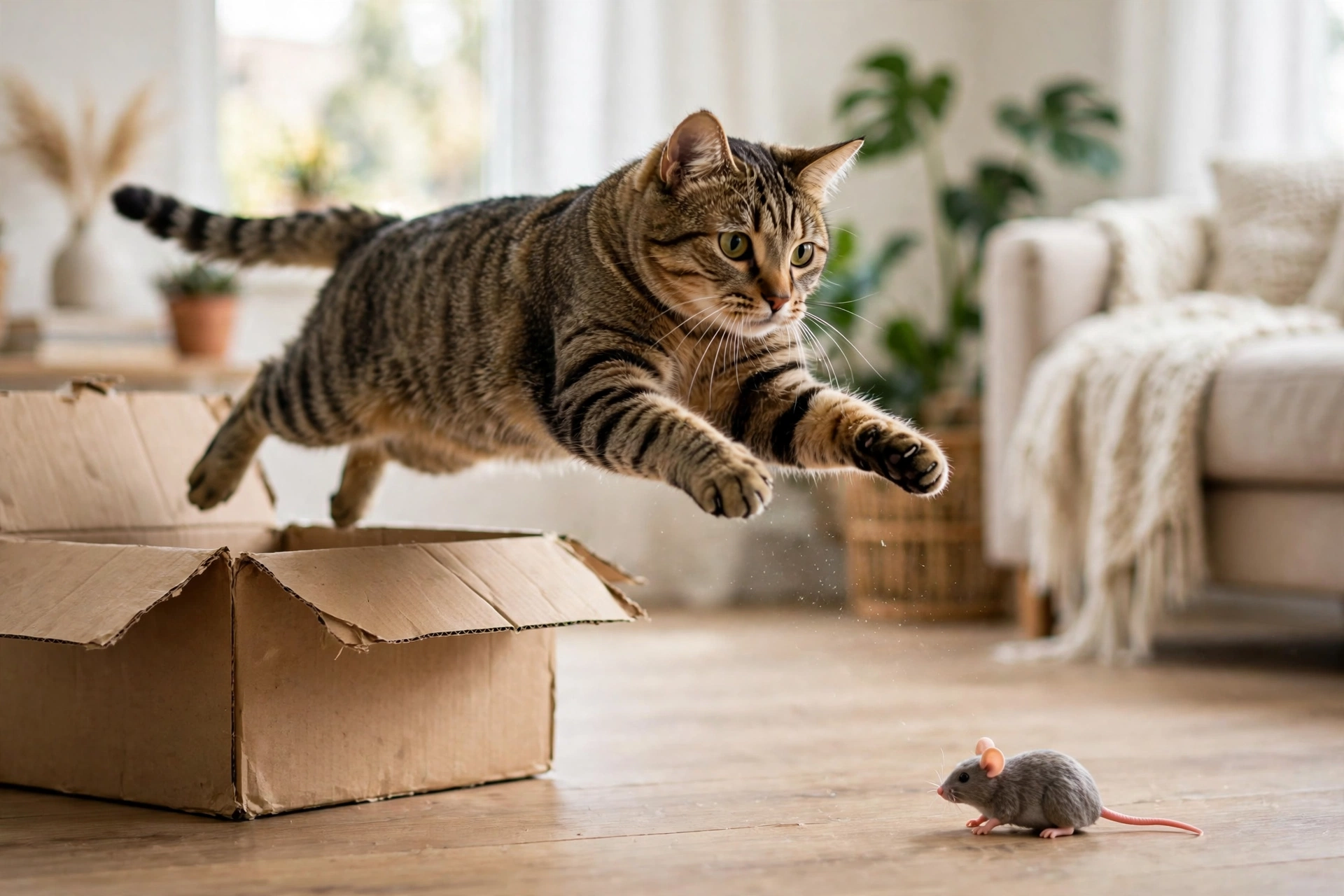
Cats are ambush predators. They do not chase prey across open ground the way a dog does. They hide, they wait, and they pounce — and the hiding is half the skill. A box gives a house cat a blind with a roof: the cat crouches inside, ears forward, eyes on the gap, and waits for something to walk past. Then it explodes out of the box, all four paws at once, onto a toy, a foot, or an unsuspecting housemate.
It is play, not real hunting, but the sequence is the real one: concealment, patience, ambush. Watch a cat in a box and you will see the whole routine, compressed into a living room: the slow lowering of the body, the butt wiggle as it lines up the leap, the sudden burst. The box is not furniture to the cat. It is a hunting hide.
That is also why cats love boxes with a hole cut in the side, and why a box with two openings is better than one with a single entrance: one way in, one way out, and a view of the room in between. A hunting blind needs an exit as well as an entrance — a cat that feels trapped in a box will not use it.
Reason 4: The fit — if it fits, I sits
The fourth reason is the strangest, and the most fun. Cats will squeeze themselves into boxes that look far too small for them — a shoebox, a cereal box, a box that leaves the tail hanging out the end — and then sit there looking entirely satisfied.
Part of it is the pressure. A tight space presses gently against the cat’s body on all sides, and the effect seems to be calming — the same reason a cat will wedge itself behind a cushion or under a blanket. The Cat Fanciers’ Association notes that the security of a box may even mimic the snug warmth a kitten feels while cuddling its mother and littermates, though that is an idea rather than a proven finding, and it is worth saying so.
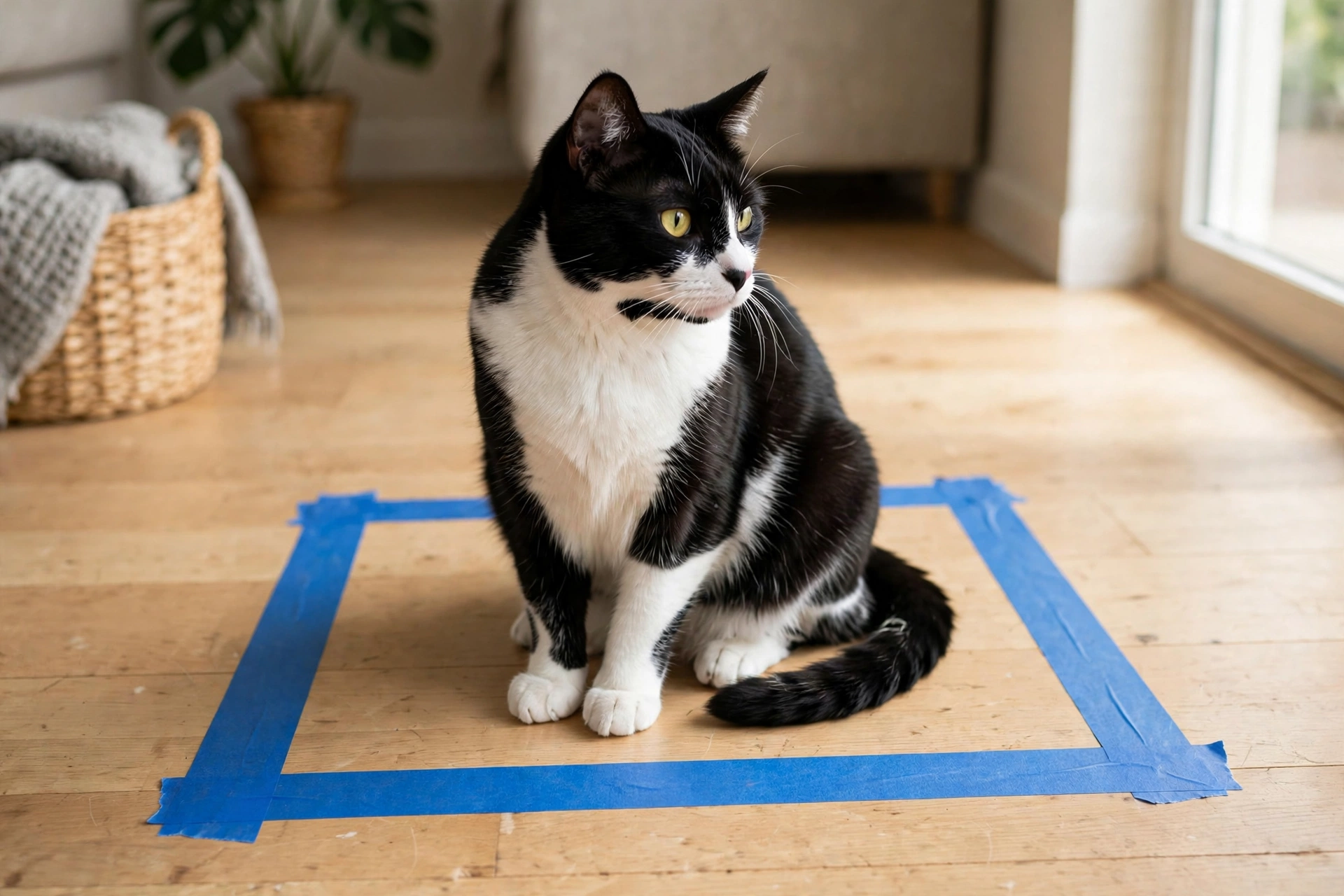
The most famous demonstration of the fit instinct does not involve a box at all. In an experiment reported by the Cat Fanciers’ Association, researchers taped a square on the floor — no walls, no roof, no box, just four lines of tape — and cats walked over and sat inside it. The square alone, with nothing to hide behind, was enough to attract them. It suggests the cat is not only after shelter. It is after the feeling of being enclosed, even an imaginary enclosure.
So the shoebox is not a mistake. To the cat, the squeeze is the point.
Reason 5: Curiosity, texture, and play
The fifth reason is the simplest: a new box is interesting.
Cats are curious, and a box that has just arrived in the house smells different — of the warehouse, the delivery van, the shop, the outside world — and it presents a puzzle to be investigated. The cat sniffs every corner, climbs in, climbs out, and bites a corner.
Cardboard is also the perfect texture for a cat to bite, scratch, and shred. It gives under the claws in a satisfying way, and unlike the sofa, nobody minds when it gets destroyed. A box is a scratching post the cat is allowed to ruin.
And once the cat has used the box, it becomes the cat’s. Cats have scent glands on their cheeks, and a cat that rubs its face along the edge of a box is marking it — leaving a scent signature that says, in chemical terms, this is mine. The box becomes a personal kingdom: a small piece of territory the cat has claimed, furnished with its own smell, and defended by sitting in it.
When hiding means something else
A cat that loves its box is normal. A cat that hides far more than usual, or that will not come out of its box at all, is a different matter — and it is worth knowing the difference.
A healthy box-lover comes out for food, for play, for attention, and for the sunny windowsill. It uses the box as a base and leaves it regularly. A cat that has started hiding all day, that eats less, that stops grooming, or that flinches when approached may be unwell or frightened, and that change is worth a vet visit — not because hiding itself is a disease, but because a change in a normal behaviour is one of the few ways a cat tells you something else is going on.
The same applies after a big change: a move, a new pet, a new baby, building work. A cat that retreats to a box during the upheaval is coping. A cat that is still hiding weeks later, long after the change has settled, deserves a closer look. The box is a tool for coping, not a permanent address.
How to make a box safe
A box is the cheapest cat furniture there is, and it takes about a minute to make it safe.
Remove the hazards first: staples, tape, handles, string, and any loose pieces the cat could chew off and swallow. A piece of string or tape in a cat’s stomach is a veterinary emergency, not a toy. Cut off any plastic handles and peel away any tape the cat can reach.
Give the cat an exit. A box with a single small entrance can feel like a trap, especially in a multi-cat home where one cat can block the doorway. Cut a second hole on another side — an escape route makes the box far more attractive, and far less stressful.
Then let the cat choose. Put the box somewhere the cat already likes to sit — near a window, near the family’s main room, near a sleeping spot — and leave it alone. Rotate boxes when they get shredded; a fresh box is a fresh puzzle. And if the cat ignores the box for a week, do not be surprised — the box that is ignored today may be the only place the cat wants to be tomorrow.
Frequently asked questions
Is it normal for a cat to sleep in a box all day?
Yes, for many cats. Cats sleep 12 to 16 hours a day, and a box is warm, dark, and safe — a good sleeping spot by every measure a cat cares about. It becomes a concern only if the cat stops coming out for food, play, or attention, or if the hiding is a sudden change from its normal behaviour.
Why does my cat sit in a taped square on the floor?
Because the feeling of enclosure seems to be enough on its own. In an experiment reported by the Cat Fanciers’ Association, cats walked over and sat inside a square taped on the floor — no walls, no roof, just four lines of tape. It suggests cats are drawn to the idea of a boundary, not only to the shelter a real box provides.
Should I buy my cat a special box, or will any box do?
Any clean cardboard box will do. The cat does not care about the brand, the colour, or the price — it cares about the size, the warmth, and the hiding. A box the cat can curl up in snugly, with an entrance and an exit, is all it needs. Remove staples, tape, handles, and string first.
My cat hides in a box and won’t come out — should I worry?
It depends on how long it lasts and what else has changed. A cat that retreats to a box during a noisy day or after a big change is coping normally. A cat that hides all day, eats less, stops grooming, or stays hidden for weeks is worth a vet visit — a change in a normal behaviour is information, and the vet can check whether something medical is behind it.
Do all cats like boxes?
Almost all of them, but not literally every cat. Some cats prefer high perches, some prefer under the bed, and some prefer the back of the sofa. The instinct to hide is common to the species, but each cat has its own favourite hiding place. If your cat ignores boxes, it has simply found a better one somewhere else in the house.
A box is the cheapest thing in the house and the most wanted. It is a hiding place, a warm room, a hunting blind, a playground, and a small piece of territory — all for the price of the packaging. That is why do cats like boxes: not because the box is special, but because it does five jobs at once, and the cat worked that out long before you did.