Your Cat Hears the Mouse in the Wall — and a Whole World You Can’t
Open the fridge two rooms away and your cat appears before the door has finished swinging. Shake a treat bag in the next room and two ears swivel like radar dishes before the cat has even stood up. At three in the morning, the same cat sits bolt upright, staring at a blank wall — listening to something you cannot hear at all.
Your cat is not ignoring you when it fails to come when called. It heard you. It also heard the fridge, the treat bag, the mouse in the wall, and the moth behind the curtain — all before you noticed any of them. The real question is not whether your cat hears well. It is this: how far can cats hear — and what is all that hearing tuned to catch?
The answer lives in a band of sound your ears never touch — and in a pair of ears that work more like radar dishes than the ones on the sides of your head.

The numbers: what “further” actually means
Start with the measurement. In 1985, researchers Rickye and Henry Heffner trained cats to respond to pure tones across the audible spectrum and measured the quietest sound the cats could detect at each pitch. The result, published in the journal Hearing Research, was a hearing range from 48 hertz to 85,000 hertz when the test tones were played at 70 decibels — one of the broadest hearing ranges measured in any mammal.
That 85,000-hertz ceiling needs a small explanation, because you will see different numbers in different places. Hearing limits depend on how loud the test tone is. At a quieter test level of 60 decibels, the same cats topped out around 79,000 hertz. The Louisiana State University comparison table, which standardises the figures, lists cats at 45 to 64,000 hertz. All three numbers describe the same ears; they differ because the tests differ.
Here is the comparison that matters:
| Who | Hearing range | Upper limit |
|---|---|---|
| Human (young adult) | 20 Hz – 20,000 Hz | 20,000 Hz |
| Dog | 67 Hz – 45,000 Hz | 45,000 Hz |
| Cat | 45 Hz – 64,000 Hz | 64,000 Hz (up to 85,000 Hz in lab tests at higher volumes) |
A cat hears pitches almost two octaves higher than a human can, and about one octave higher than a dog. At the low end the three species are much closer — a cat’s lowest audible pitch, around 45 to 48 hertz, is not far from a human’s 20 hertz. The cat’s advantage is almost entirely at the top: the high, thin sounds that humans and dogs never register.
Peak sensitivity — the pitch a cat hears most clearly — sits around 8,000 hertz, in the range of a rustling leaf, a squeaking hinge, and a small animal moving through dry grass. That is not a coincidence. It is the sound of dinner.
Why so high? The mouse channel
The cat’s upper range lines up almost exactly with the world its prey lives in. Mice communicate with each other in squeaks ranging from about 17,000 to 80,000 hertz — ultrasonic vocalizations that are, to a human ear, total silence. Rats use a similar band, with distress calls around 22,000 hertz and social chatter reaching higher still. A mouse in the wall is not quiet. It is shouting, on a channel only its own kind — and its predators — can hear.
That is what the cat’s high-frequency hearing is for. The Heffners’ own conclusion was that cats “evolved extended high-frequency hearing without sacrifice of low-frequency hearing” — they kept the full low end and added a private ultrasonic band on top, tuned to the prey they have hunted for thousands of years. A cat does not need to see a mouse to know where it is. It can hear the mouse talking.
It is worth saying what this does not mean. Cats do not hear everything, and they are not the best hearers in the animal kingdom — bats, dolphins, and many rodents hear higher still. The cat’s range is remarkable for a land mammal that also has to hear low sounds, and it is remarkable because it matches, almost note for note, the sounds of the animals cats eat.
The ear itself: 32 muscles and a radar dish
The range is only half the story. The other half is the equipment, and a cat’s ears are built like no other pet’s.
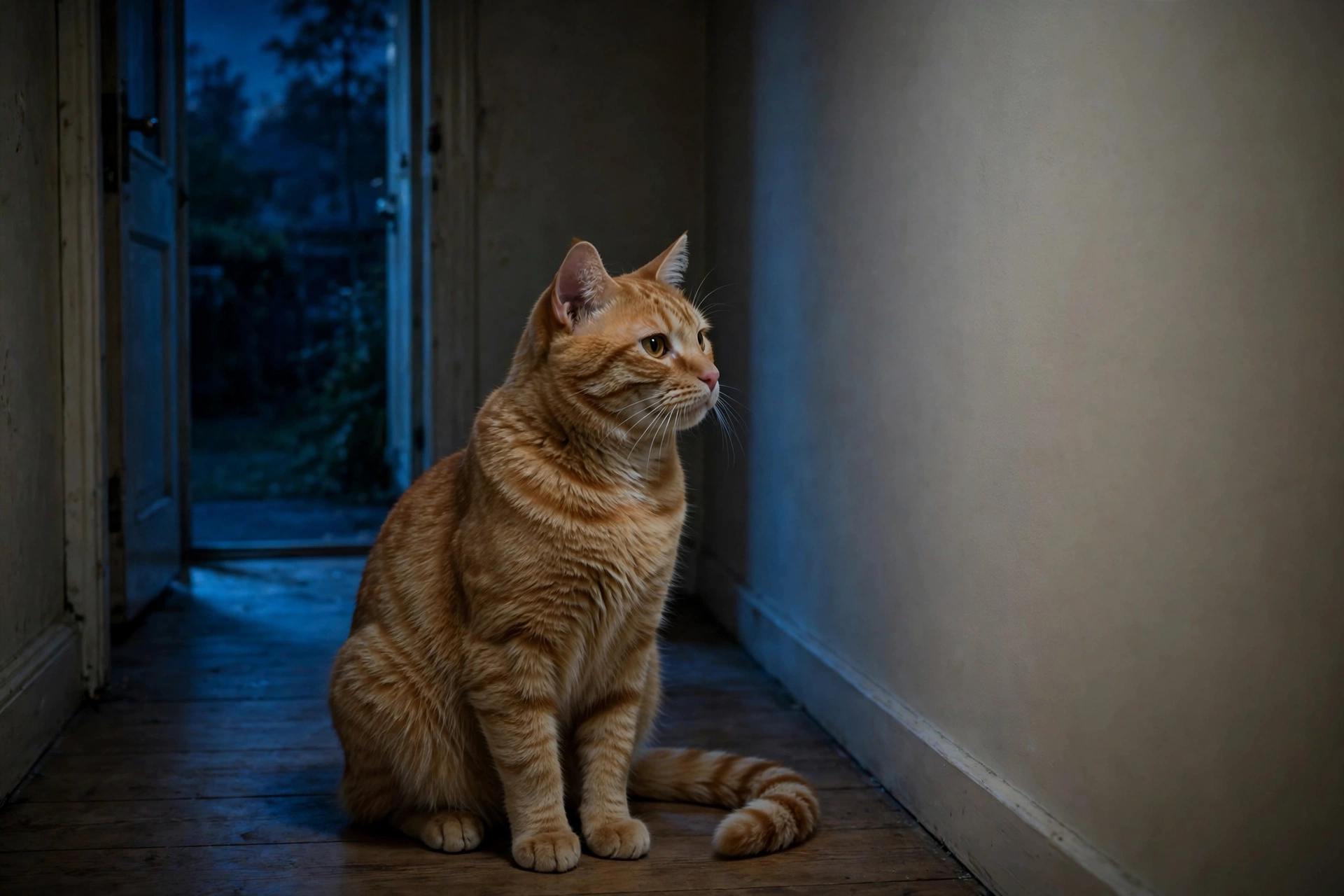
Each ear has 32 muscles. A human ear has about six, and most people cannot move their ears at all. A dog has 18. Those 32 muscles let a cat rotate each ear independently through a full 180 degrees — one ear can point forward while the other swivels back, tracking two sounds at once. Watch a cat that has just heard something interesting and you will see it: the ears turn, tilt, and settle, each one aiming itself like a satellite dish.
The shape helps too. The pinna — the pointed, triangular outer ear — funnels sound into the ear canal, and a cat’s ear canal is deeper and longer than a human’s, which concentrates the sound further on its way to the eardrum. From there the middle ear’s three tiny bones pass the vibration to the inner ear’s cochlea, the snail-shaped structure that turns vibration into nerve signals for the brain. The inner ear also holds the vestibular system, the balance organ that lets a cat land on its feet — hearing and balance share the same small piece of anatomy.
Two ears working independently also give the cat its precision. By comparing the tiny differences in timing and loudness between the sound arriving at the left ear and the right ear, the brain triangulates the source. Cornell’s CatWatch newsletter puts the result plainly: a cat can tell the direction of a sound from a metre away to within eight centimetres. That is the difference between pouncing on a mouse and pouncing on empty grass.
Hearing in the dark
Cats are crepuscular hunters, most active at dawn and dusk, when light is low and the world is full of small sounds. Hearing and night vision work as a pair: the ears find the sound, the eyes confirm the movement, and the pounce follows. The ears do the first job in conditions where the eyes cannot — behind a wall, under a floorboard, in grass too tall to see through.
The hunting sequence is easy to recognise once you know it. The cat goes still. The ears swivel and lock on. The body lowers. Then the pounce, aimed at a spot the cat has located by sound alone. It is the same freeze-listen-pounce pattern whether the target is a mouse in the garden or a toy dragged across the carpet — and the full story of what the cat’s eyes contribute in the dark is in the site’s night-vision article.
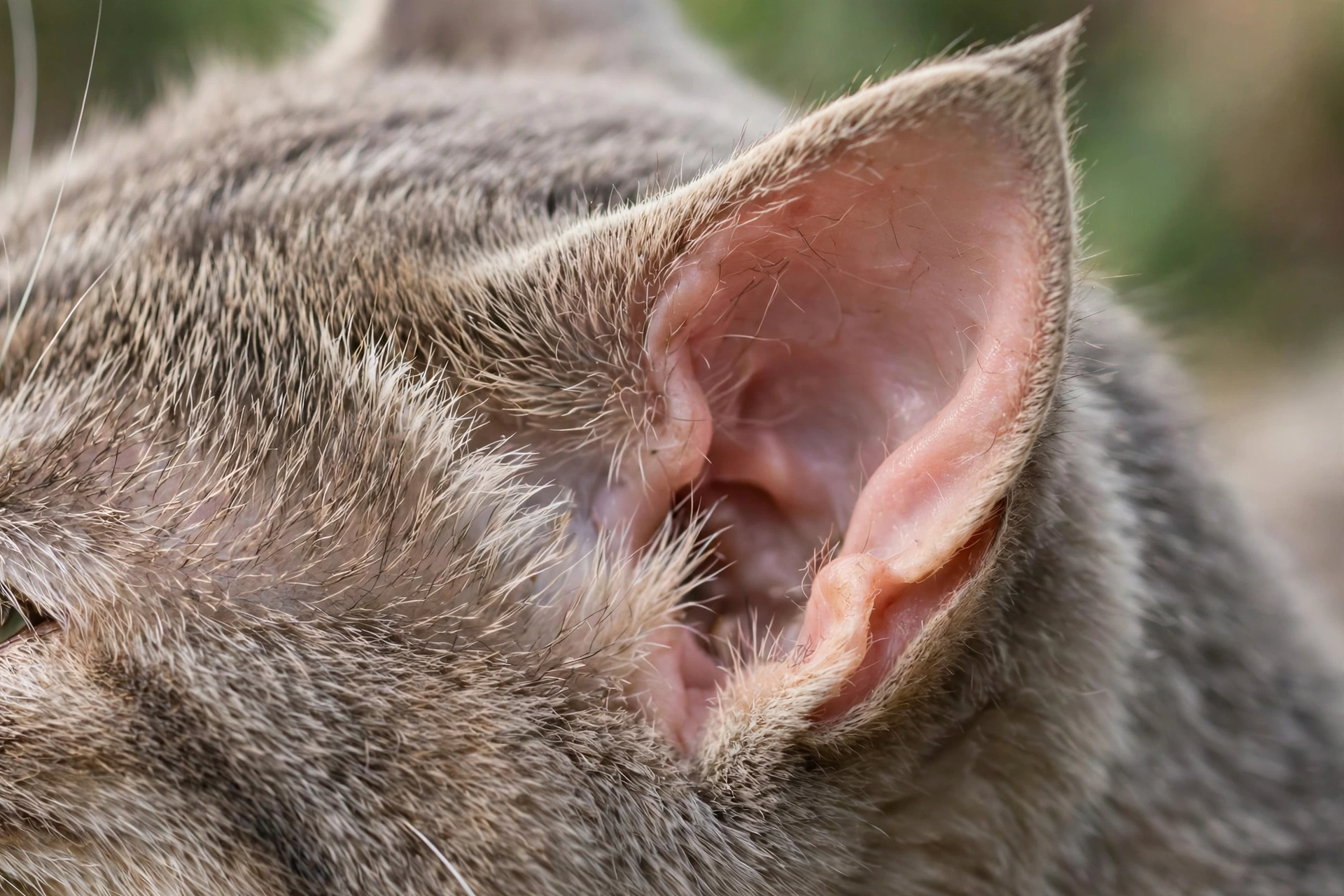
That is also why a cat will sit and stare at a wall at three in the morning. It is not seeing something you cannot see. It is hearing something you cannot hear — a mouse in the cavity, water moving in a pipe, an insect in the plaster — and it is waiting for the sound to tell it where to look.

What your cat is actually listening to
A cat’s hearing is not a passive sense. It filters, and it learns what matters.
It learns its own name. In a 2019 study at Sophia University in Tokyo, cats distinguished their own names from other words of the same length and sound, even when a stranger said them — and the full story of that experiment is in the site’s article on name recognition. A cat that does not come when called has usually heard its name perfectly well. Coming is a separate decision.
It learns your voice. Research published in 2022 found that cats responded differently when their owner used the high, sing-song voice reserved for them than when the owner spoke to another adult — the cat knew it was being addressed, and answered in the only language it has that a human understands. The full story of that conversation is in the site’s meowing article.
And it learns the sounds that pay. The can opener, the treat bag, the fridge door, the rustle of the food bag — a cat maps the household by sound, and the sounds that predict food get answered fastest. The sounds that predict nothing — your voice saying “get off the counter,” for instance — get heard and filed away, and then ignored. That is not deafness. That is a cat with priorities.
One more sound worth knowing about: electronic pest repellers. The devices are designed to emit frequencies in the 20 to 65 kilohertz range to deter rodents — which sits squarely inside a cat’s hearing range. A cat can hear them perfectly well. If a repeller goes up in a room and the cat starts avoiding that room, the sound is a reasonable first suspect.
When hearing fades
Hearing is not a permanent gift. It arrives late and, for many cats, leaves early.
Kittens are born deaf. Their ear canals stay closed until they are between 10 and 14 days old, and their hearing is not fully developed until they are at least six weeks old. A kitten that seems unresponsive to sound in its first two weeks is not ignoring anything — it cannot hear yet.
At the other end of life, hearing fades gradually. The Cornell Feline Health Center notes that a cat’s eardrum thickens with age, and hearing difficulties are often found in geriatric cats. PetMD puts the usual onset of noticeable signs at around age 10: a cat that stops coming when called, stops reacting to the can opener, meows louder than it used to (because it can no longer judge its own volume), startles when touched from behind, or hides more than it used to. Cats compensate so well — with vibration, sight, and scent — that owners often miss gradual hearing loss for months.
Some hearing loss is present from birth. About 80 percent of white cats with two blue eyes show signs of deafness from about four days old, according to Cornell. It cannot be corrected, and the cats affected generally adapt well — they simply live in a quieter world from the start.
Two things matter if you suspect hearing loss. First, a gradual change is a reason to book a vet visit and ask for a hearing check — the vet can test each ear separately and look for treatable causes such as ear infection, which is the most common acquired cause. Second, a sudden loss of hearing is different: PetMD is clear that it should be treated as a medical emergency, and the cat should be seen by an emergency veterinarian immediately.
A deaf cat — born deaf or deaf with age — can live a full, comfortable life indoors. Approach from the front so the cat sees you coming, use vibrations (a stomp on the floor) or visual signals instead of calling, and keep the cat strictly indoors: a cat that cannot hear a car, a dog, or a slammed door has lost one of its main defences.

Frequently asked questions
How far away can a cat hear?
No study has measured an exact distance, so treat any precise figure as an estimate. What is commonly cited by veterinary sources is that cats hear quiet, high-pitched sounds four or five times farther away than humans can. What has actually been measured is the frequency range — 48 hertz to 85,000 hertz in the laboratory — and the direction-finding: a cat can tell where a sound is coming from to within eight centimetres from a metre away.
Can cats hear ultrasound?
Yes. Ultrasound is any sound above about 20,000 hertz, which is the ceiling of human hearing, and a cat’s range runs up to roughly 64,000 hertz — 85,000 in laboratory tests. That covers the squeaks of mice and rats, and some “silent” dog whistles that people cannot hear at all.
Why does my cat ignore me if its hearing is so good?
Because hearing and obeying are different things. A cat that does not come when called has usually heard its name perfectly well — studies show cats distinguish their own names from similar words — and has decided not to come. The sounds that predict food, like the can opener, get answered fastest. The sounds that predict nothing get heard and ignored.
Do cats hear better than dogs?
At the top end, yes. A cat’s hearing reaches about 64,000 hertz, and up to 85,000 in laboratory tests, while a dog tops out around 45,000 hertz — so a cat hears roughly one octave higher than a dog. At the low end the two are similar. Both hear far better than a human, whose range tops out around 20,000 hertz.
What should I do if my cat stops responding to sounds?
Book a vet visit promptly, and ask for a hearing check — the vet can test each ear separately and look for treatable causes such as an ear infection. If the hearing loss came on suddenly, treat it as an emergency and see an emergency veterinarian immediately. In the meantime, approach the cat from the front, use vibrations or visual signals instead of calling, and keep the cat indoors.
The cat staring at the wall at three in the morning is not seeing ghosts. It is listening to a world you will never hear — a mouse talking in ultrasound behind the plaster, a moth’s wings in the dark, a rustle three rooms away. That is how far can cats hear: far enough to catch a conversation you never knew was happening, in a room you thought was silent.