Your Cat’s World Is Blue and Yellow — and Red Is Just a Dark Smudge
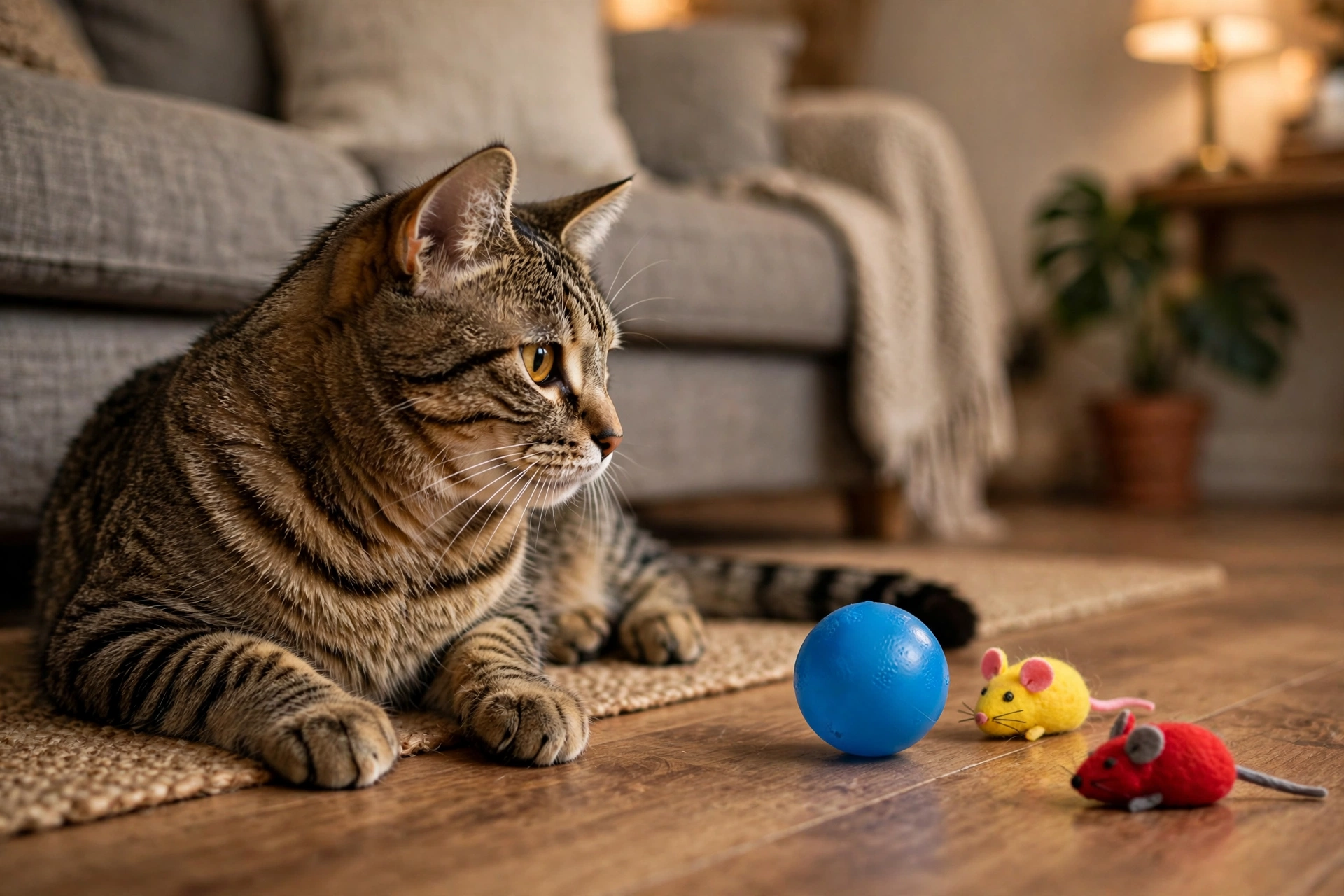
The red toy mouse sits untouched at the bottom of the toy box. The blue ball, meanwhile, gets chased across the kitchen floor every single evening. Coincidence? Maybe. But it is also a small, everyday hint at something real: your cat does not see the world the way you do, and color is one of the biggest differences.
The old idea — that cats see only in black and white — is wrong. Cats do see color, just a much smaller, quieter version of it than you do. Blues and yellows come through clearly; reds and greens blur into muted, greyish tones; and the whole picture is washed out, like a photograph left too long in the sun. That is the short version. The interesting part is how scientists know — and where they still disagree.
The black-and-white myth
For a long time, even scientists assumed animals saw the world in black and white. It was a reasonable guess: nobody could ask a cat what it saw, and the tests that existed were crude. The myth stuck because it felt tidy — humans got the rainbow, animals got the grey scale.
So can cats see in color, or is the old black-and-white story right? Behavioral tests proved the myth wrong. Given a choice between two panels, cats can reliably pick the colored one over a grey one of the same brightness — impossible if their world were truly monochrome. They are not color-blind in the black-and-white sense. They are color-limited, which turns out to be a much more interesting answer.
What the science says: a blue-and-yellow world
The clearest summary comes from Dr. Bruce Kornreich, director of the Cornell Feline Health Center. “They do well with blues and yellows,” he told Inverse, “but they have a little more trouble … distinguishing greens and reds.” It is not that cats can only see two colors — colors combine into blends a cat perceives at different degrees — but blue and yellow come through with the most clarity.
Red is the weakest link. “Red, for example, looks ‘just kind of like a dark color,’” Kornreich describes. A red toy is not invisible to a cat, but it does not look red the way it looks to you — it looks dark, muted, and hard to separate from the greens and browns around it. Pinks read the same way, and purple tends to collapse into another shade of blue.
The second difference is saturation — how rich and vivid a color looks. Even the colors a cat does see look washed out compared with yours. In 2013, artist Nickolay Lamm worked with researchers to visualize a cat’s view of the world: panoramic scenes blurred at the edges, with a desert-like, faded palette. Your cat’s world is not grey. It is pastel, and then some.
How a cat’s eye is built for this
The reason sits in the retina, the light-sensitive layer at the back of the eye, which holds two kinds of light-detecting cells: rods, which handle dim light and movement, and cones, which handle color and fine detail.
Cats are built rod-first. Their retinas hold far more rods than cones — roughly 25 rods for every cone, compared with about 4 to 1 in people — which is why they see so well in dim light and track movement so sharply. The price is paid in cones: people have about ten times more cone cells than cats do, according to Purina, so people pick up far more color variation.
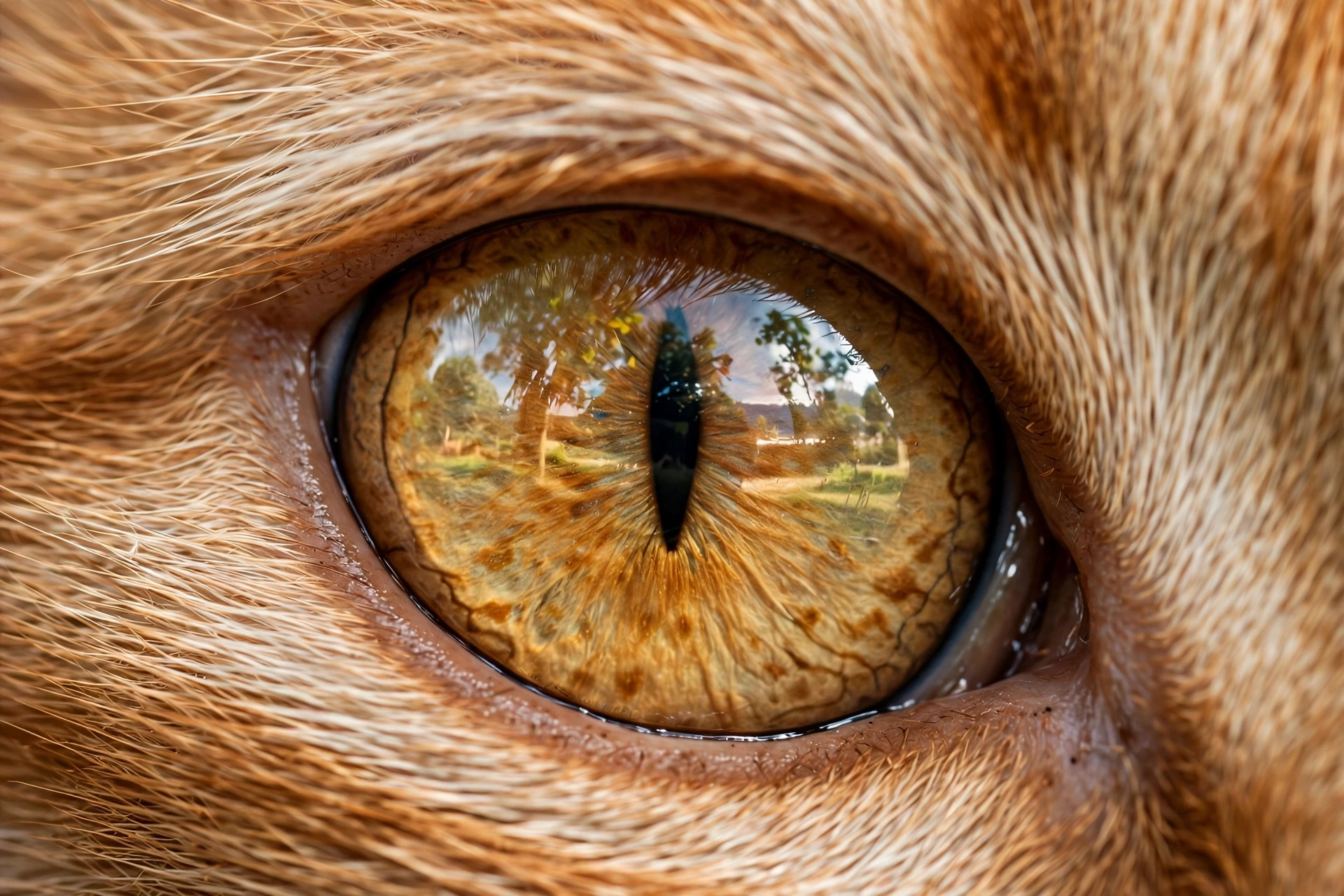
The cones a cat does have are tuned differently from yours. Kornreich explains that feline cones contain two types of proteins called opsins, each stimulated by different wavelengths — one most sensitive to blue light, the other to yellow-green. That makes cats what scientists call dichromatic: color vision built on two channels instead of three. Humans have a third opsin, making us trichromatic. Veterinary references put the two feline cone peaks at about 440 and 555 nanometres — blue and yellow-green — which is why those colors come through best.
How scientists know: asking a cat to choose
None of this comes from asking a cat what it sees. It comes from watching what a cat can tell apart.
The standard test is a two-choice task: a cat is shown two panels and rewarded for choosing the colored one over a grey one matched for brightness, so brightness alone cannot give the answer away. If the cat can reliably pick the color, it can see it; if it cannot, the two look the same.
The most careful test was published by Clark and Clark in 2016 in Experimental Eye Research. Two cats experienced with two-choice tasks were shown single-wavelength lights mixed with white light of variable intensity, and asked to tell the colored light from white. They could tell the colors apart across most of the range tested — from violet-blue through to green — but at one wavelength, around 505 nanometres, both cats failed across multiple trials. That failure point is called a neutral point, and it is the fingerprint of dichromatic vision: at 505 nm, the two cone channels cancel each other out and the color looks the same as white. The pattern matched a human deuteranope — a person with red-green color blindness — more closely than normal three-color vision.
Electrical recordings from the retina tell the same story from a different angle. Most electrophysiological studies have found two light-sensitive receptors in the cat eye, near 460 and 560 nanometres — the same blue and yellow-green pair. A cat’s color world, measured two different ways, keeps coming back to the same two channels.
The honest debate: two cones or three?
Here the story gets messier, and it is worth saying so plainly, because the sources do not all agree.
Some veterinary sources describe cats as having three cone types, like people — just far fewer of them, and with a weak response to the red end of the spectrum. The VCA’s overview says human eyes and cat eyes both have three cone types, and Kornreich himself has been quoted in different interviews describing cats both ways. A few electrophysiological studies have found a third receptor, between 500 and 520 nanometres, which could in theory allow a third channel of color vision.
The Merck Veterinary Manual sounds the deepest note of caution: although cone cells are responsible for color vision, “it is uncertain whether cats can see colors.”
So what should a reader take away? The anatomy is genuinely debated. But the functional evidence — what cats can actually tell apart in controlled tests — points the same way every time: a world built on blue and yellow, with reds and greens muted and confused, closely resembling red-green color blindness in people. Whether the hardware counts as two cone types or three weak ones, the cat’s experience is the same: a limited, washed-out palette.
Cats vs. humans — and what about dogs?
The comparison makes the trade-offs easy to see:
| Feature | Humans | Cats |
|---|---|---|
| Color vision | Trichromatic — 3 cone types | Dichromatic-like — 2 main channels |
| Colors seen best | Full spectrum | Blues and yellows |
| Colors hardest to separate | — | Reds, greens, pinks |
| Cone cells | About 10× more than cats | Far fewer |
| Visual acuity | 20/20 | About 20/100–20/200 |
| Field of view | About 180° | About 200° |
Dogs sit in the same boat: they are dichromatic too, seeing mainly blues and yellows while reds and greens blur. The VCA puts it simply — dogs can only see in blue and yellow, while cats are thought to see shades of blue, grey, and possibly yellow too. Cats and dogs are not seeing the world the way you do, and not quite the same way as each other either — but their palettes rhyme.
One more comparison matters: sharpness. A cat’s visual acuity runs about 20/100 to 20/200 by human standards, meaning a cat needs to be much closer than you do to see something clearly. The color picture and the sharpness picture go together — a cat’s eye is not a worse version of yours, it is a different instrument, tuned for different work.
Why evolution traded color for night vision
A cat’s eye is a hunting tool, and hunting mostly happens at dawn and dusk — the crepuscular hours, when prey is active and light is low. In that light, color is nearly useless and dim-light sensitivity is everything. So evolution spent the retina’s budget on rods, which catch faint light and movement, and kept only enough cones for basic color.
The trade is visible in the anatomy: a rod-heavy retina, a tapetum lucidum that bounces light back through the retina for a second pass, and pupils that open far wider than yours in dim conditions. Together they let a cat see about six times better than you in dim light — the figure the Merck Veterinary Manual gives, and the subject of the site’s night-vision article.
Color was the price. A retina packed with rods has less room for cones, and fewer cones means fewer color channels. A cat that can spot a mouse twitching in the half-light at twenty paces does not need to know whether the mouse is brown or grey. It needs to know that it moved.

What it means at home
The practical payoff is mostly about toys — and it is smaller than the toy industry would like.
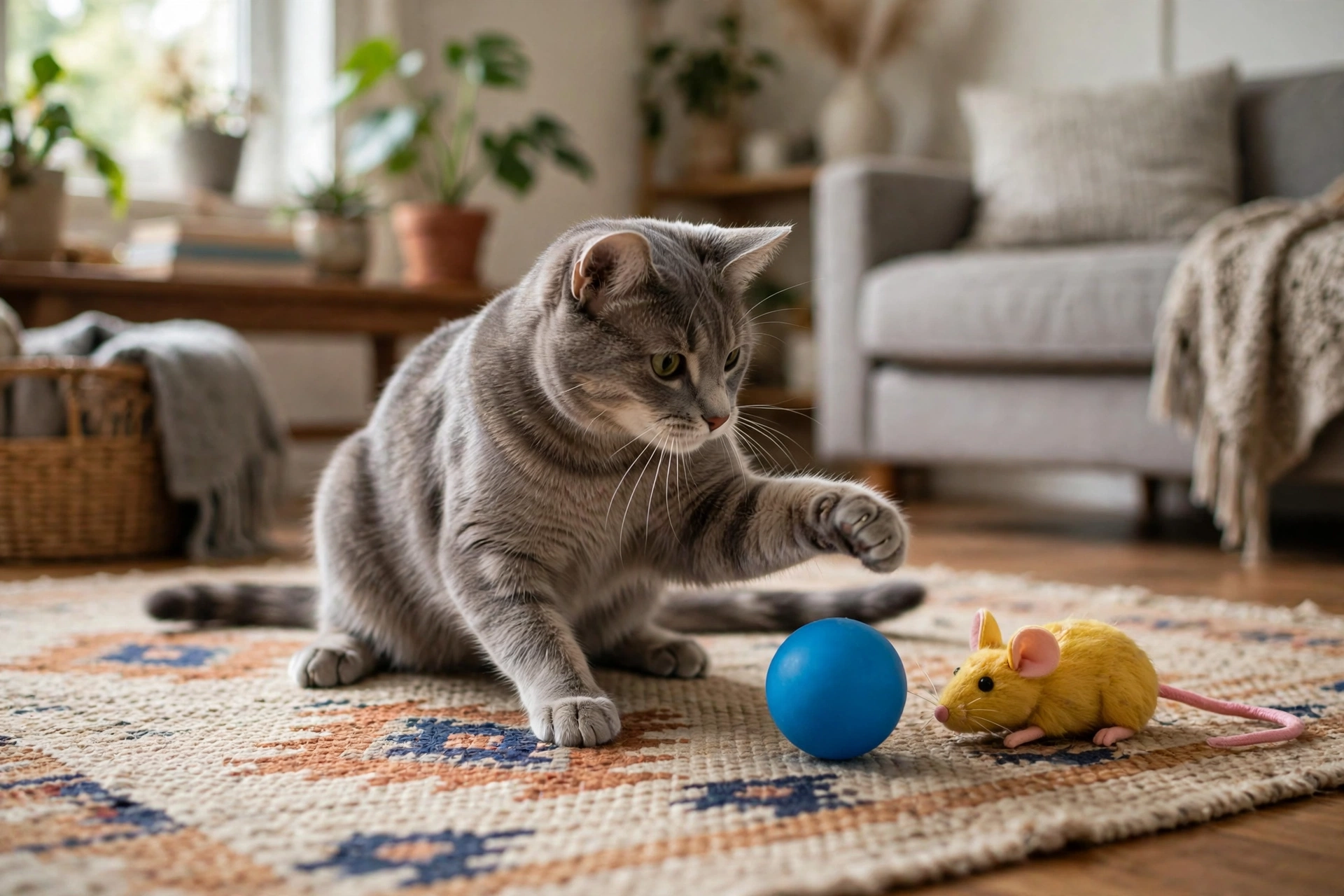
Blue and yellow toys stand out best. A bright blue ball or a yellow toy mouse gives a cat the clearest color contrast against a floor or a rug. A red toy is not invisible — brightness, size, and contrast still make it visible — but its color gives the cat nothing extra. If your cat ignores the red mouse and chases the blue ball, color may genuinely be part of the reason.
Motion matters more than color either way. A dull grey toy that moves will beat a bright blue toy that sits still, every time. Cats are motion hunters first. Color is a tiebreaker, not the main event — which is why a feather wand in any color works, and why a cat will chase a plain brown paper bag with total commitment.
The laser dot is visible, but not because it is green or red. Cats can spot a laser dot easily, and owners sometimes take that as proof their cat sees green or red well. It is not proof of that. A laser dot is intensely bright, tiny, and moving fast — brightness, contrast, and motion make it visible even when the color itself is muted. The cat is chasing a bright moving point, not enjoying the redness.
Your decor does not matter to the cat. A cat does not care whether the sofa is burgundy or teal. What matters is layout, scent, hiding places, and light — the things a cat actually navigates by.

What is still uncertain
Three things remain genuinely open.
First, the cone count. The two-cones-versus-three debate is not settled, and it may turn out that cats have a third cone type that contributes very little in practice. The functional picture — blue and yellow, reds and greens muted — is consistent either way.
Second, the exact palette. The neutral point near 505 nanometres is well measured, but the precise shades a cat experiences cannot be measured at all. No test can tell us what blue feels like to a cat. The visualizations are educated approximations, not photographs of a cat’s inner life.
Third, individual variation. Most careful color tests were done on a handful of cats. Vision varies between individual cats just as it does between people, and age, eye disease, and breed may all shift the picture. The broad pattern is solid. The fine detail is not.
The uncertainties are about the exact numbers and the inner experience, not the direction: cats see some color, less than you do, and best in blue and yellow.
Frequently asked questions
Can cats see in color?
Yes. Cats see color, but a much narrower range than people do. Blues and yellows come through most clearly, while reds, greens, and pinks look muted, dark, or greyish. The old black-and-white idea is wrong — behavioral tests show cats can reliably tell colored panels from grey ones.
Do cats see in black and white?
No. That was the assumption for a long time, but it has been disproved by behavioral tests: cats can distinguish colors from greys of the same brightness. Their world is not monochrome — it is a washed-out, blue-and-yellow version of yours.
What colors can cats see best?
Blue and yellow. Those are the two channels a cat’s eye is built around, with cone sensitivity peaking near 440 nanometres (blue) and 555 nanometres (yellow-green). A bright blue or yellow toy gives a cat the clearest color contrast.
Can cats see red?
Not the way you do. Red looks dark and muted to a cat — Cornell’s Dr. Bruce Kornreich describes it as “just kind of like a dark color” — and reds are easily confused with greens and browns. A red toy is still visible through brightness, size, and movement, but its color adds nothing.
What color toys should I buy my cat?
Blue or yellow, if color is the deciding factor — those stand out best against most floors and rugs. But motion and contrast matter far more than color: a moving feather wand in any color will beat a still blue ball. Choose toys that move, dangle, and crinkle, and let color be the tiebreaker.
Your cat’s world is not the rainbow you see, and it is not the grey scale people once assumed. It is a quieter picture — blue and yellow in focus, reds and greens faded to the edges, everything a little washed out, built for movement in half-light rather than color in full sun. The red toy mouse at the bottom of the toy box is not being snubbed. To your cat, it was never really red at all.