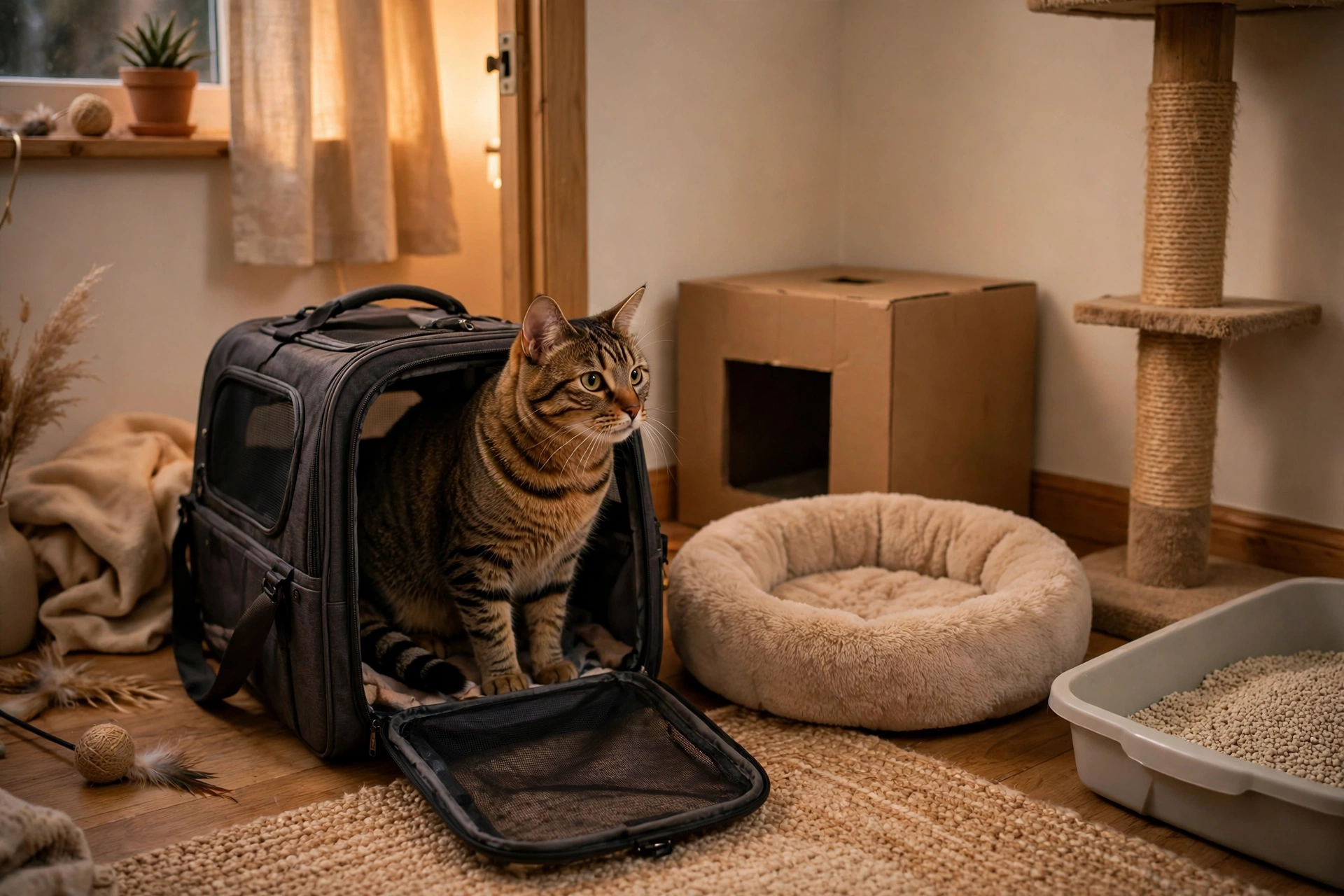
The carrier door opens, the new cat walks into the hallway, and the resident cat is standing right there. There is a hiss, a fluffed tail, and a sprint under the bed — where the new cat will stay for a week. Most bad introductions happen in that first minute, and most of them were avoidable. Cats do not make friends the way people do. They decide whether another cat is safe by smell first, by sight second, and by touch last. Introducing a new cat to your home is not a single event. It is a sequence — scent before sight, sight before touch — and the whole job is to let the cats set the pace.
The goal: tolerance, not instant friendship
A good introduction ends with two cats that can share a home without fear: eating, using their trays, sleeping, and moving around without hiding or guarding doorways. They may become friends. They may simply coexist, passing each other in the hallway like polite strangers. Both are good outcomes.
International Cat Care puts the hard truth first: cats are naturally solitary, and some simply do not want to live with other cats. No method can guarantee friendship. What a careful introduction can do is give both cats the best chance, and avoid the one thing that is hardest to undo: a frightening first meeting. A pattern of fear and aggression can be set in one or two encounters, and it is much harder to break than to avoid.
Preparation: set up the base camp before the cat arrives
Everything about introducing a new cat to your home works better if it is ready before the carrier comes through the door.
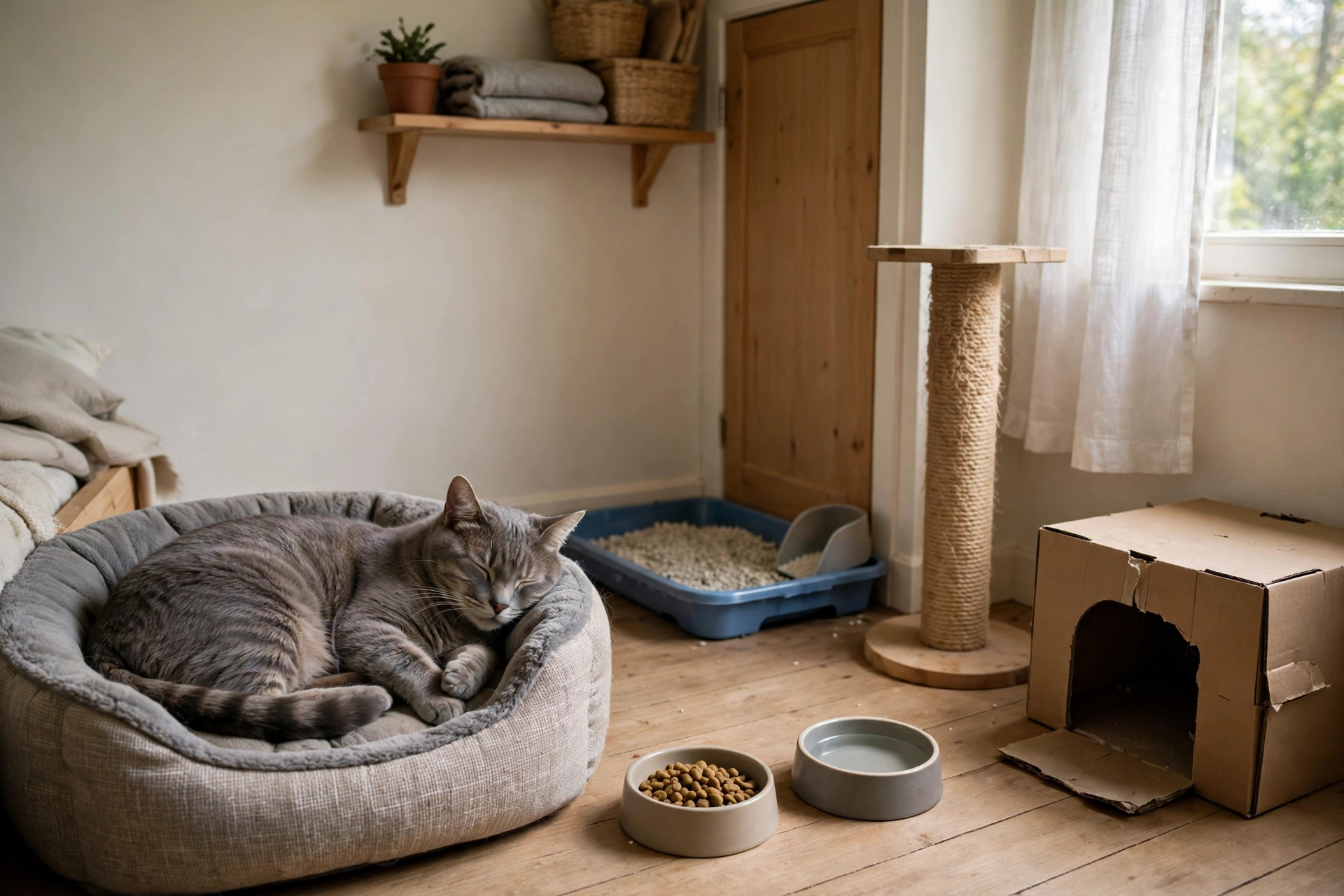
Choose one room. Pick a room the resident cat does not use — a spare bedroom is ideal, a bathroom is fine. Do not use the bedroom if the resident cat usually sleeps there. This room is the new cat’s base camp for the first few days. Set it up with food, water, a bed, hiding places, a litter tray, toys, and a scratching post — new items, or the new cat’s own. Using the resident cat’s belongings can stress both cats.
Plug in a pheromone diffuser. The AAFP’s Cat Friendly Homes handout suggests plugging in a synthetic feline pheromone diffuser 24 to 48 hours before arrival, in the base camp room and where the resident cat spends most of its time. They mimic the calming facial pheromones cats produce, and can help both cats feel the home is familiar. They are a support, not a solution — they do not replace the slow steps below.
Cat-proof the room. Check for open windows, dangling blind cords, small objects the cat could swallow, and gaps behind furniture. Put the litter tray as far from the food and water as possible. Leave the carrier in the room with its door open, lined with a blanket.
The vet check comes first for rescued and stray cats. Any new cat, particularly a rescued stray or shelter cat, must be physically isolated from a resident cat for 10 to 14 days, to make sure it is not incubating a contagious disease. That is also why the base camp room needs a door that closes. Before the cats meet, the new cat should be examined by a veterinarian for parasites and disease and tested for FeLV and FIV, both contagious between cats. Do not start scent swapping before this isolation period is over unless the cat is vet-checked and healthy: some diseases travel on objects.
The first week, day by day
Follow the steps in order. Each one has a green light — the sign the cats are ready to move on. If it is not there, wait: a few more days is always cheaper than fixing a bad meeting.
Days 1–2: the boring first 48 hours. Carry the cat, still in its carrier, straight into the base camp room. Do not stop to greet the resident cat. Open the carrier door and leave. The new cat may hide under the bed or inside the carrier for hours, or for a day or two. That is normal. Visit quietly, sit on the floor, and let the cat come to you. Do not pick the cat up or pull it out of hiding. If the cat will not come out, move the food closer. Eating, drinking, and using the litter tray are the first green lights. A cat that is not eating or drinking at all needs a vet call, not more time.
Days 2–5: scent swapping. Cats recognise each other by smell, and the aim here is to make the other cat’s scent familiar before the cats ever see each other. Swap one piece of each cat’s bedding — a blanket is enough — leaving each cat with enough of its own. The two smells start to mix into one household smell. If either cat hisses at the bedding or avoids it, slow down. At the same time, feed the cats on opposite sides of the closed door, moving the bowls closer each day — the cats learn the smell on the other side means something good.

Days 4–7: swapping rooms. Once the scent step is going well, confine the resident cat briefly to one area — only if that will not distress it — and let the new cat explore. Then do the reverse: let the resident cat sniff around the base camp room while the new cat waits elsewhere. If the resident cat is still hissing at the door or guarding it, stay at this step.
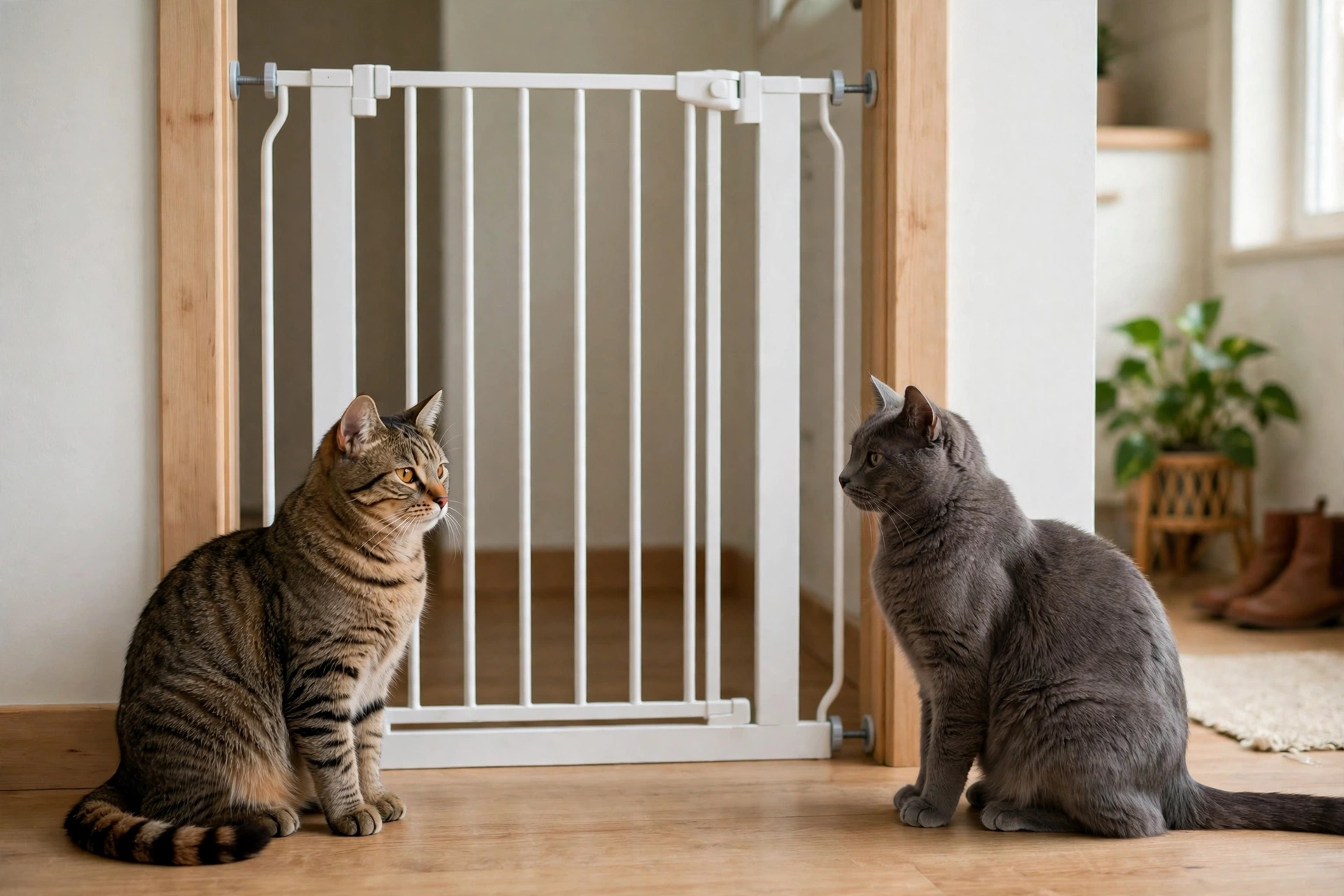
Days 5–7 and beyond: first sight, through a barrier. Only when both cats are relaxed with each other’s scent, let them see each other — never without something between them. A baby gate, a glass door, a mesh screen, or a door held open two or three inches with door stops all work. Metro Animal Services suggests stacking two tension gates at least 36 inches tall, or jamming the door with stops so the cats can touch noses but cannot make full contact. Both cats should be able to go about their business, glancing at each other now and then without staring each other down. If there is hissing, growling, or a tense body with ears rotated back, distract the cat by calling its name and luring it away. And do not use food or play to distract or reward the cats at this stage: cats are solitary eaters and players, and eating or playing in sight of another cat can stress them.
First supervised meeting: 10 to 15 minutes. When the cats are calm through the barrier, remove it quietly and let the new cat emerge at its own pace. Do not carry one cat to the other, and do not leave them alone. If either cat is overly fearful or aggressive, separate them calmly and try again another day. Parallel play helps: two toys, one per cat, played at the same time. End while it is still going well.
Free access, a few minutes at a time. Once supervised meetings pass without trouble, allow free access for just a few minutes, keeping the new cat separate in between. Increase the time gradually, making sure each cat can retreat to its own area. Keep resources separate: one set per cat plus one extra, spaced out so the cats never have to share or compete.
No resident cat? The same base camp, a shorter timeline
Everything above also works for a first or only cat — it just moves faster. Set up the same base camp room, keep the cat there for a day or two, and open one more room at a time as the cat eats, uses the tray, and walks around confidently. The cat still sets the pace: eating, drinking, and exploring means ready for more space; hiding and not eating means not. The point is not to confine the cat, but to give a new home a manageable size, so the cat learns the smells, sounds, and people one room at a time.
Troubleshooting: when it goes wrong
Hiding for days. What matters is the direction: is the cat coming out more each day, eating, and using the tray? If the hiding does not ease over the first week, or the cat is not eating or drinking, contact the veterinary team. International Cat Care’s advice is to get professional help rather than wait it out — hiding that does not improve can mean pain or illness as well as fear. Never drag a cat out of hiding — move food and water closer, sit quietly nearby, and let the cat choose when to emerge.
Hissing and growling. Hissing is communication, not bad behaviour — it means “I am scared, stay back,” and the answer is distance, not discipline. Never punish a cat for hissing, and never hit a cat — punishment does not change the behaviour, it only makes the cat afraid of the person. Step back one stage, give both cats a day or two of calm, and try again.
Litter-tray avoidance. A cat that stops using the tray is usually telling the owner something. First check access: can the cat reach it without passing the other cat, in a quiet spot away from food? Add a second tray in a different area — one per cat, until the cats are completely at peace. If it continues, or the cat strains or cries in the tray, call the vet the same day.
One cat blocking doorways. A cat that sits in a doorway and will not let the other pass is guarding a resource — a room, a tray, or a food bowl. Fix it with layout, not scolding: add a second route, move a tray or bowl so the cats do not have to cross each other’s path, and add vertical space — shelves and perches let cats share a room without sharing the floor.
Common mistakes
Rushing. Do not be tempted to rush — International Cat Care’s warning, and the one-line version of this whole article. Every step skipped is a step that has to be repeated later, usually after a fight.
Face-to-face on day one. The worst mistake, in Metro Animal Services’ words, is to bring the new cat in, put it down in front of the existing cat, and expect them to “make friends” or “work it out.” Cats do not work it out.
Punishment. Spraying water, shouting, or hitting a hissing cat does not teach it to like the other cat — it teaches it to fear the owner too.
Forcing contact. Pulling a cat out from under the bed or holding two cats together “so they get used to each other” creates the fear the plan is designed to avoid.
Skipping the scent step. The cats seem fine, so the owner opens the door. Then the hissing starts, and the owner is back at the beginning — except now both cats have a bad memory of each other. Scent first, always.
Consolidating resources too soon. One food bowl, one litter tray, one bed, shared between two cats that barely tolerate each other, is a recipe for guarding and tray avoidance. Keep separate resources, spaced out, until the cats are genuinely at peace.
Reinforcement: what “done” looks like
There is no single day when an introduction is finished. The process typically takes two to four weeks, and some pairs take six weeks or longer; kittens settle faster, and two adult cats can take months. Watch for the quiet signs: both cats eating normally, using their trays, sleeping in the open, and moving through the house without hurrying past doorways. Keep the routines steady and keep monitoring. Relationships between cats can change over time, so a pair that is fine in week three can still need help in month three. That is the whole method of introducing a new cat to your home: a predictable home, enough resources, and nobody being rushed.

Frequently asked questions
How long does it take to introduce a new cat?
Typically two to four weeks, and some pairs take six weeks or longer. The cats decide: move on only when each cat is comfortable, and go back a stage at any hissing, hiding, or tray avoidance.
Do I need a separate room if I live in a studio?
A whole room is ideal, but a studio can work with a divided space. Use the bathroom as the base camp if it has a door that closes, or section off a corner with a tall baby gate and a covered hiding box, the litter tray as far from the food as the space allows. Open the rest of the studio one area at a time, as the cat becomes confident.
Can I introduce a cat and a dog the same way?
The principle is the same — scent before sight, sight before touch — but dogs add a chase risk cats do not. International Cat Care has a separate guide for introducing cats and dogs: the safe version starts with the dog on a lead and the cat with an escape route. If the dog cannot stay calm on a lead, get help from a qualified behaviourist first.
My new cat won’t come out from under the bed. What do I do?
Wait, and make waiting easy: put food and water near the bed, keep the room quiet, visit briefly and calmly, and do not reach under the bed. If the cat is not eating or drinking at all, or the hiding does not ease over the first week, contact the veterinary team.
Should I use a pheromone diffuser?
It can help, and it is worth trying. The AAFP’s Cat Friendly Homes handout suggests plugging one in 24 to 48 hours before arrival, in the base camp room and where the resident cat spends its time. But a diffuser is a support, not a substitute: it does not replace the slow steps, and it will not fix a rushed introduction.
Introducing a new cat is mostly waiting, done on purpose. One room, then scent, then sight, then touch — and the cats decide when each step is done. It is the difference between a cat that hides under the bed for a week and one that walks into the living room on day three and decides to stay.
Leave a Reply