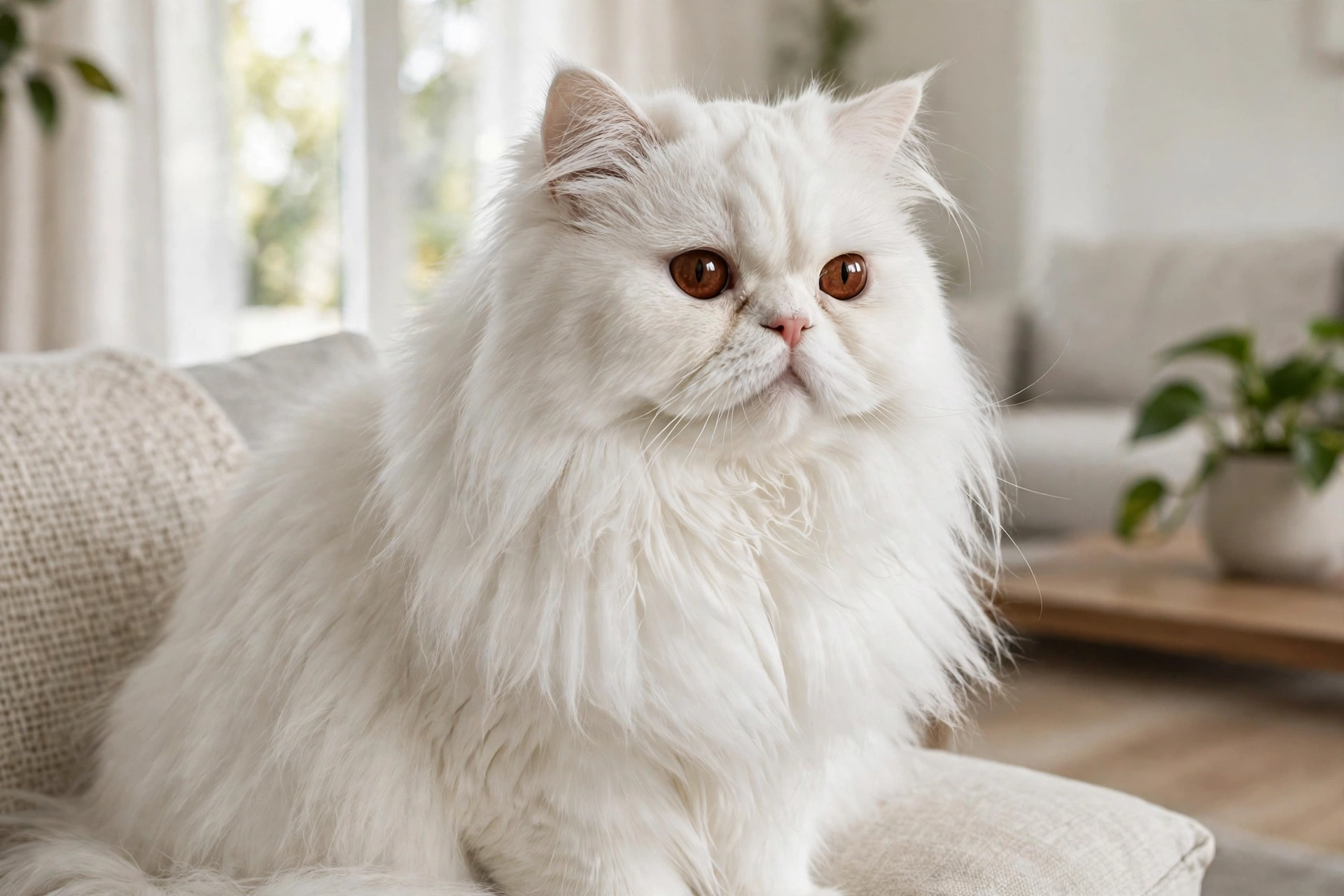
The Persian Wants Your Lap, Not Your Curtains
There is a cat asleep on the sofa right now who has not moved in four hours. It is doing what it was shaped over centuries to do: sit somewhere soft, look beautiful, and wait to be admired. The Persian does not climb the curtains or raid the kitchen counter. It wants your lap, a sunny window, and a comb.
That is the whole deal, and the whole warning: a Persian is not a low-maintenance cat that happens to be beautiful, but a beautiful cat that costs time — ten minutes with a comb every day, a wipe of the eyes every morning, a weekly bath. If you want that bargain, there is no gentler cat. This guide explains persian cat personality as the registries describe it, what the coat and the flat face cost, and what varies cat to cat.
What a Persian actually is
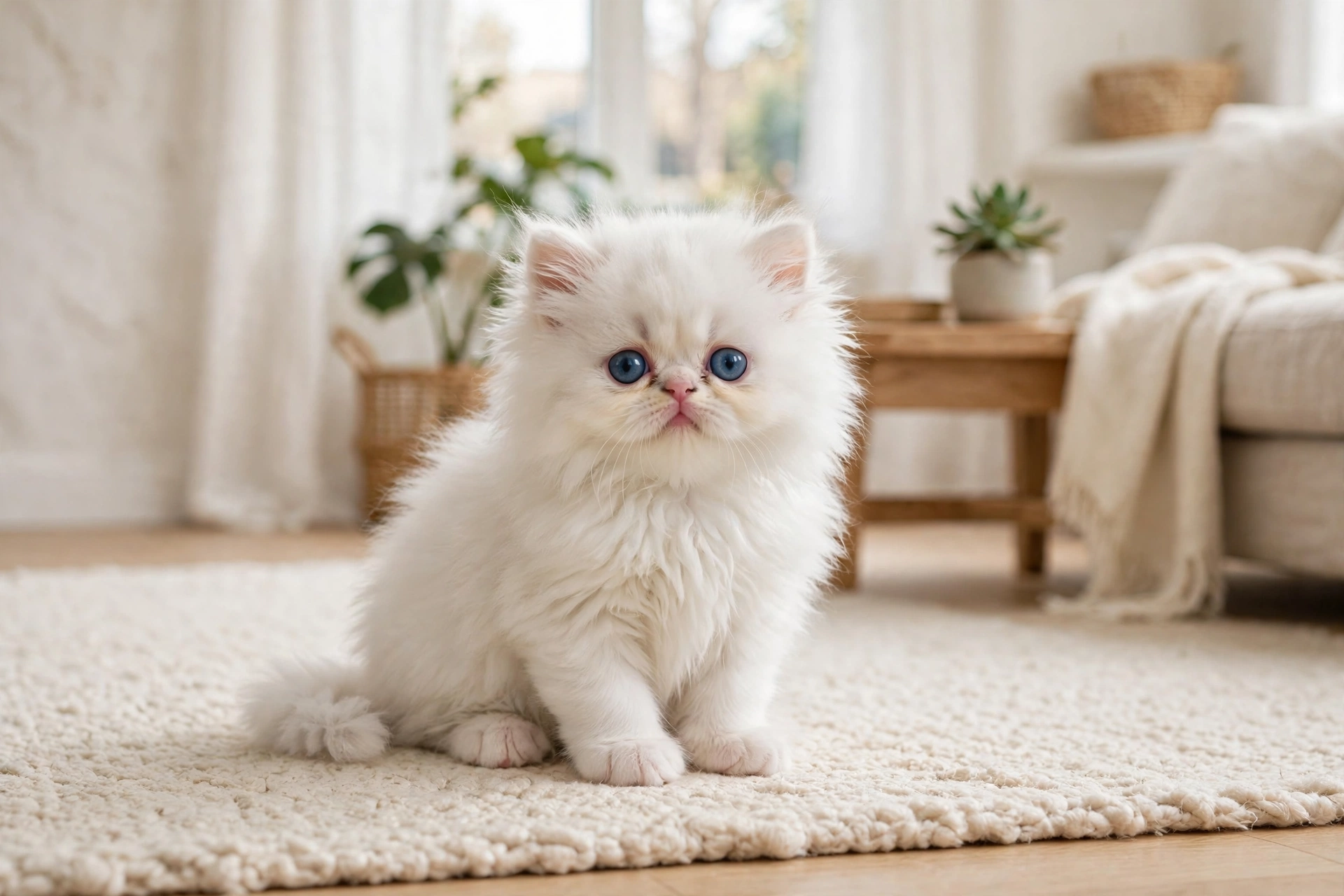
The Persian is a medium-to-large cat built low and solid. TICA describes it as short and cobby, with a deep full chest, short legs, and heavy boning — a cat built to sit rather than to sprint. PetMD gives the size as 7 to 13 pounds and 10 to 15 inches long. The head is round, with small ears, large round eyes, and a short, flat nose; the coat is the hallmark — long, thick, and luxuriant.
One thing the Persian is not is a climber. The Cat Fanciers’ Association puts it plainly: the Persian is “not a cat that is likely to invade the kitchen counter or climb the drapes,” and prefers to “keep their feet on the ground.” So the home needs to work at floor level: a bed on the floor, a perch it can step onto, and a low-sided litter box.
The personality, as the registries describe it
What the registries say about persian cat personality is consistent, and worth quoting. The Cat Fanciers’ Association calls the Persian “playful yet placid,” “easygoing and mellow,” and “happier simply receiving attention and affection” — the “perfect finishing touch to a well-planned home.” PetMD calls the breed docile and intelligent, reserved and wary of new people, and deeply bonded to its own family.
The word that comes up most often is quiet. A Persian is not a silent cat — it meows, it chirps, it asks for things — but it is soft-voiced, and it does not demand attention the way a Siamese does. It waits: it sits near you, or on you, and trusts that you will notice. The CFA notes that Persians are compatible with children of all ages and “peacefully coexist with other pets” — a Persian rarely starts a fight, though a calm cat is not one that enjoys chaos, and a Persian in a loud house will simply retreat to the quietest room.
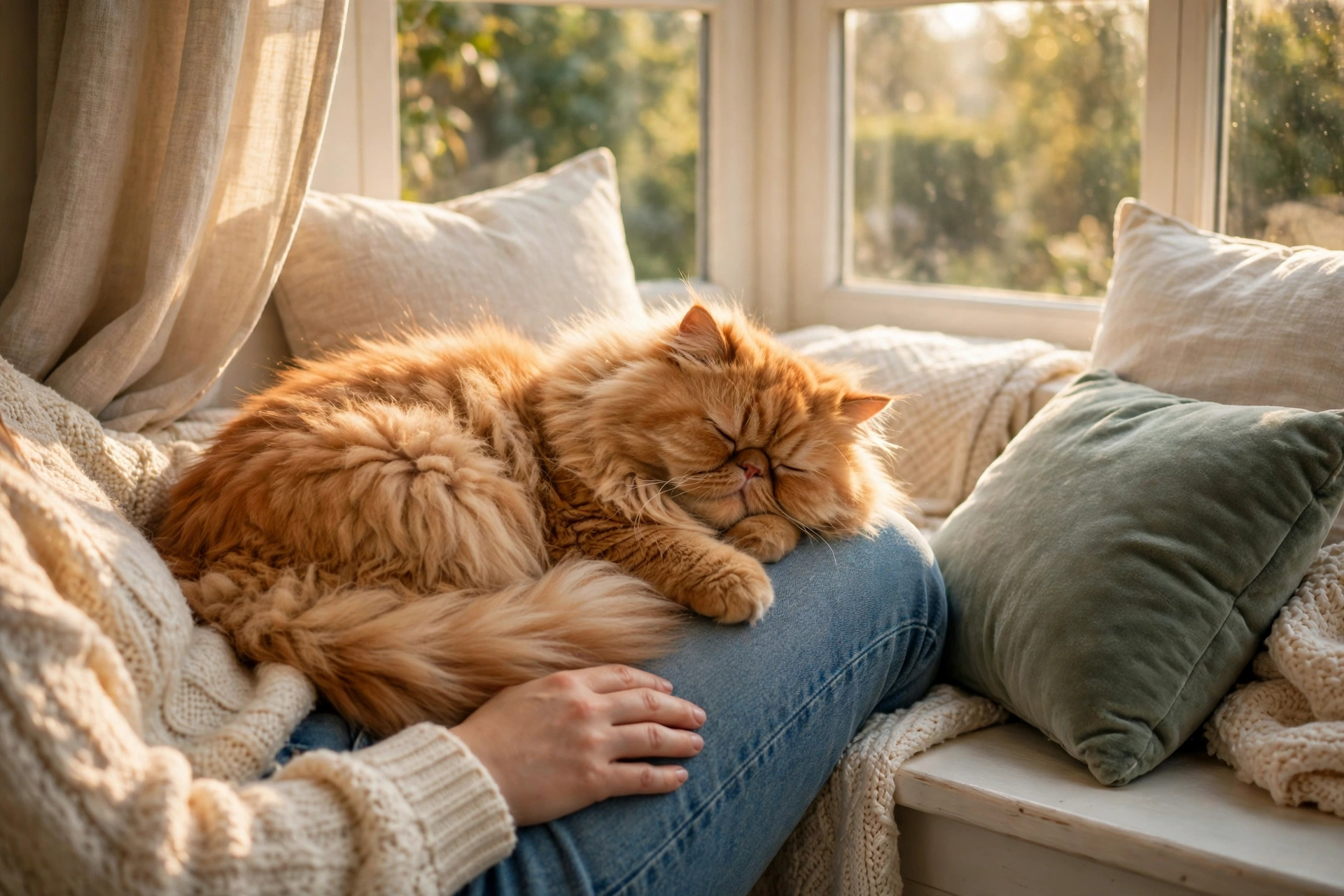
The affection is real, but it is not needy. A Persian will follow you from room to room and settle on the nearest soft surface for hours, and it does not pine loudly when left alone for a working day — though it does better with company. What it wants most is routine: the same lap, the same window, the same combing session at the same time of day.
The flat face: doll-face vs peke-face
The Persian’s face is the first thing anyone notices. The flat face — the short nose, the round head, the large round eyes — comes from a random genetic mutation that breeders selected for, and it exists on a spectrum. At one end is the “doll-face” or traditional Persian, with a moderate nose; at the other is the “peke-face,” named for the Pekingese dog, with an extremely flat profile and a nose set almost level with the eyes.
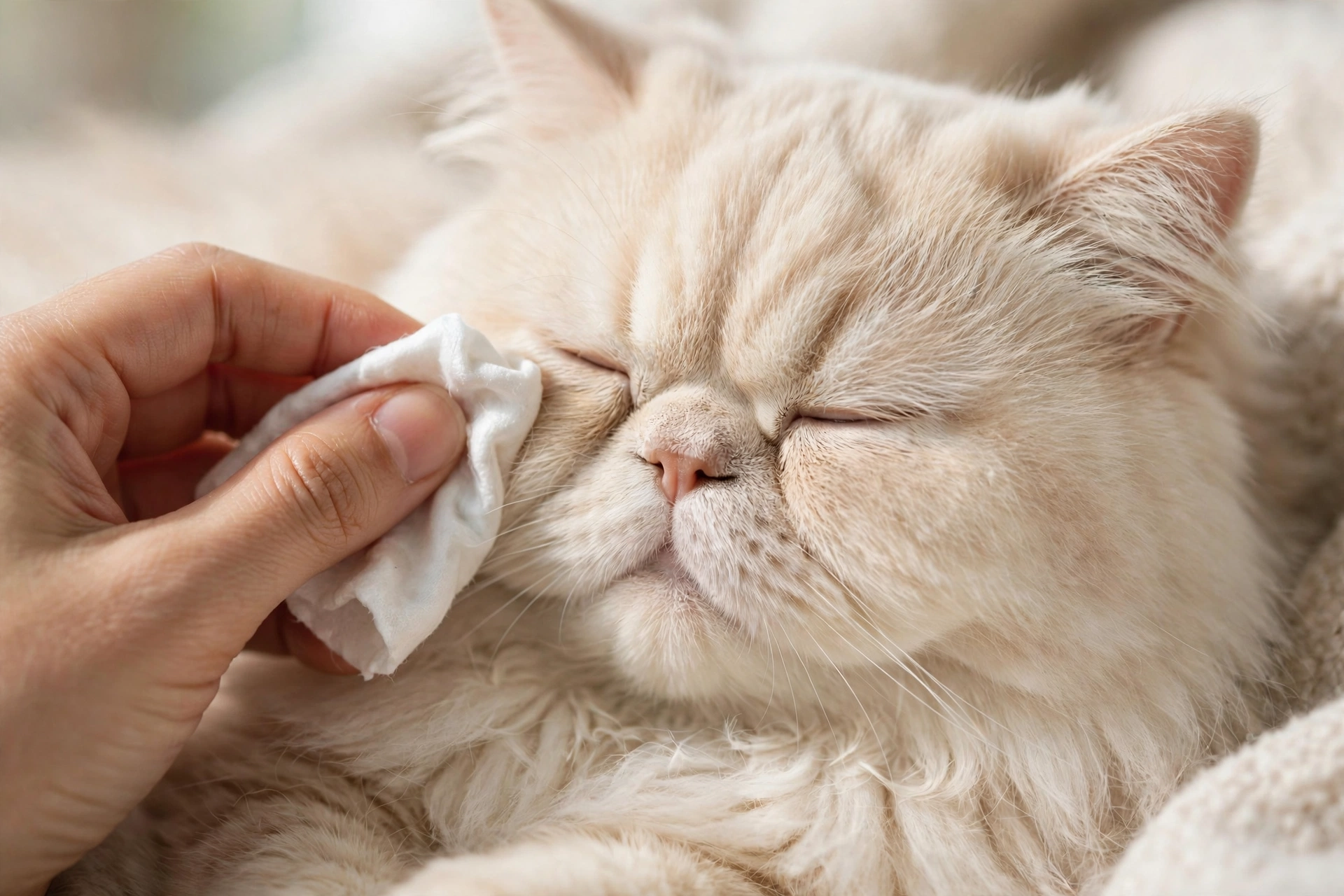
The flatter the face, the more daily care it needs. A flat face squeezes the tear ducts, so tears overflow instead of draining — which is why so many Persians have tear staining, the rust-colored tracks under the eyes. It also crowds the teeth, which is why dental disease is common, and it narrows the airways, which is why some Persians snore. Vetstreet notes that Persians are sensitive to heat and need air-conditioned comfort, and PetMD lists brachycephalic airway syndrome — the breathing difficulty of the shortened skull — among the breed’s reported problems.
None of this means every Persian is unwell. It means the face is a trade-off, and the flatter the face, the steeper the trade. If you are choosing a kitten, the doll-face type is the lower-maintenance choice — ask what the parents’ faces look like.
What varies cat to cat
No breed is a guarantee. Most Persians are calm, but some are playful well into adulthood — chasing a feather wand in short bursts, then collapsing for a four-hour nap. The CFA’s “playful yet placid” is a range, not a contradiction.
Shyness varies too. PetMD describes Persians as reserved and wary of new people, but some greet visitors at the door and others vanish under the bed. A kitten that has met many people before twelve weeks of age is usually the bolder adult. Coat texture varies as well: TICA notes a silky coat in the dominant colors and a soft, cottony coat in the dilutes, and the cottony coat mats faster. Color makes no difference to personality — what matters is the individual cat, the home, and how the kitten was raised.
Daily care: the coat
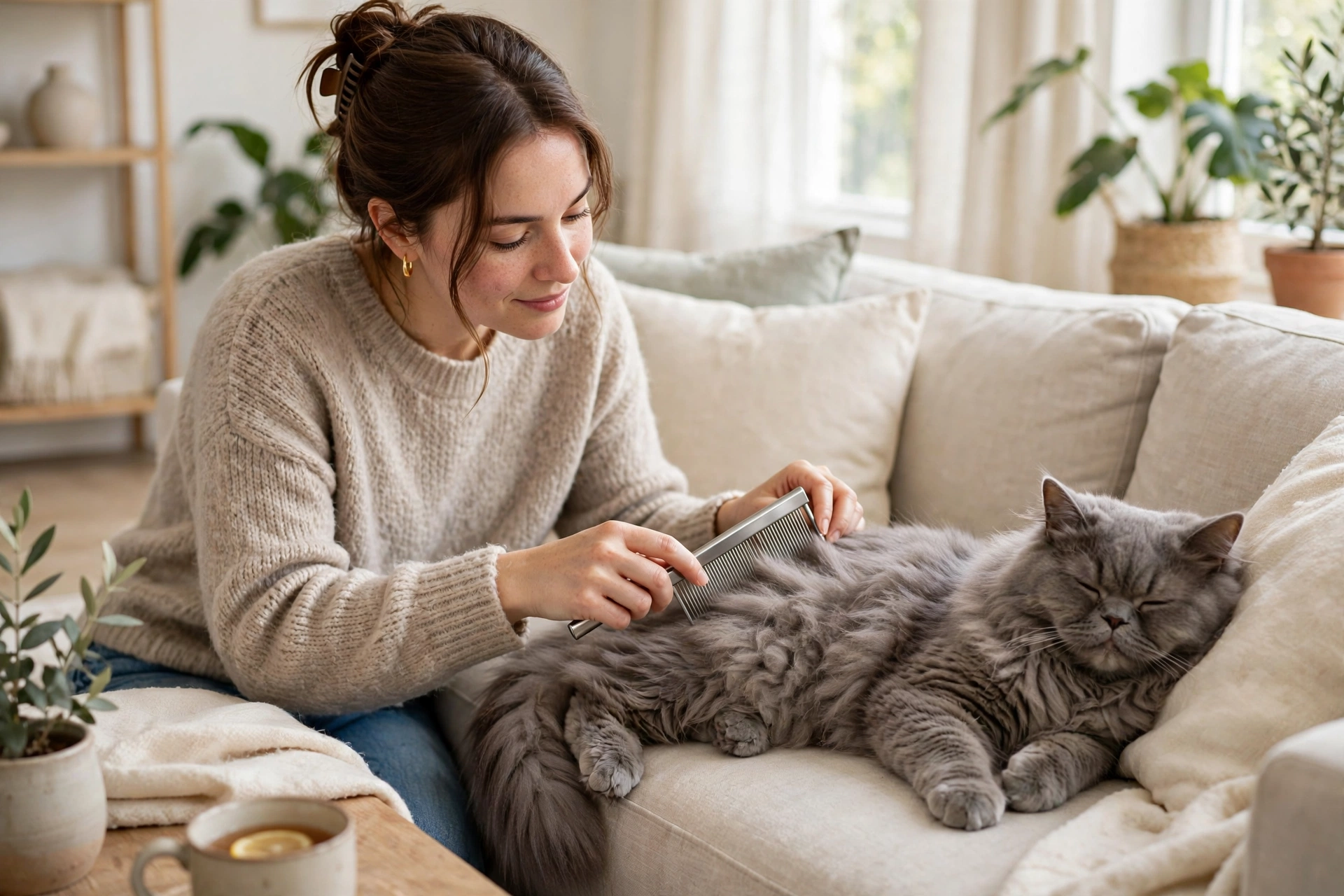
Here is the honest part. The coat needs combing every day — not most days, every day. TICA says so, PetMD says so, and Vetstreet says so, and they all say the same thing about the tool: a stainless steel comb, worked down to the undercoat, not a brush skimming the surface.
A daily comb takes about ten minutes once you and the cat know the routine. Start at the head and work back, combing in sections, and pay attention to the places that mat first: behind the ears, under the chin, in the armpits, and around the back legs. A mat left alone tightens against the skin and eventually has to be cut out. Start in kittenhood, when the kitten is small and the coat is short, and a treat after each session teaches the cat that combing is worth tolerating.
Baths are part of the routine too. PetMD recommends weekly baths, and TICA calls for a regular bath: the long coat collects dust and natural oils, and a bath keeps it from clumping and matting between combings. Use warm water, a cat-specific shampoo, and dry the cat thoroughly afterwards — a damp long coat mats faster than a dry one. Many owners bathe at home; others book a professional groomer every few weeks.
Eyes, nails, teeth, and the weekly check
The eyes need wiping every day. PetMD recommends cleaning them daily with a cotton cloth rinsed in warm water, and TICA says the same. Use a separate damp cloth for each eye, wipe gently from the inner corner outward, and dry the fur afterwards. If the discharge changes — thicker, yellow or green, or the eye looks red or swollen — that is a question for the vet, not a wiping problem.
The nails need trimming every few weeks, the same as any indoor cat: check them weekly and trim the sharp tips when they catch on fabric. The ears need a weekly look — a little wax is normal, but dark debris or a bad smell is worth a vet visit. And the teeth need attention more than most breeds, because the flat face crowds them: PetMD notes that the crowded teeth make dental disease a reported problem, and recommends brushing daily. A finger brush or a small cat toothbrush with cat toothpaste, introduced in kittenhood, is the cheapest dental care a Persian will ever get.
None of this is difficult. It is just daily: ten minutes a day, every day, for fifteen years. The owners who love the breed most enjoy that ritual. If that sounds like a chore, it will feel like one within a month.
Play, feeding, and weight
A Persian does not need much exercise, and it will not ask for much. A few short play sessions a day — a feather wand, a crinkly ball, a paper bag — are enough, and the cat will usually end the game itself. What a Persian does need is a reason to move at all, because the breed is not the most active, and an inactive cat with free access to food gains weight easily. PetMD recommends measured meals of a complete and balanced AAFCO-approved food, rather than free-feeding.
Health to discuss with your vet or breeder
A breed guide is not a health article, and this section is not a diagnosis. It is the conditions the breed’s own sources report as predispositions — the conversations to have with a vet or a breeder before you commit, and the tests to ask about.
Polycystic kidney disease (PKD) is the best-known Persian predisposition, and the one with the clearest test: cysts grow in the kidneys over time, and the CFA notes that PKD is “being well controlled with genetic testing and spaying/neutering of affected cats.” A responsible breeder tests their breeding cats and can show you the results. PetMD notes that symptoms usually show up around seven years of age — drinking more, urinating more, eating less, losing weight — and any of those changes is a reason to see a vet.
Progressive retinal atrophy (PRA) is an inherited eye condition in which the retina gradually degenerates. PetMD reports that night blindness comes first, usually at one to two years of age, and that it leads to total blindness with no cure. Vetstreet reports a different onset — four to eight weeks, progressing rapidly — so reported onset timing varies by source. Genetic testing exists, and a breeder who tests can tell you whether their lines carry it.
Also reported in the breed: hypertrophic cardiomyopathy (HCM), a thickening of the heart muscle, which a vet can screen for; bladder stones, cystitis, and liver shunts (Vetstreet); dental disease, linked to the crowded teeth (PetMD); hydrocephalus in kittens with extreme brachycephaly (PetMD); and brachycephalic airway syndrome, the breathing difficulty of the shortened skull — PetMD describes open-mouth breathing as a medical emergency, and any cat breathing with its mouth open needs a vet promptly.
None of this is a prediction about any individual cat. Most Persians live long, comfortable lives — PetMD gives a lifespan of 10 to 13 years, other breed guides 12 to 16, so a fair range is roughly 10 to 16 years. The point of the list is the questions: does the breeder test for PKD and PRA? What is the family history? Once the cat is home, the point is the routine: regular vet visits, attention to weight, and prompt care when anything changes.
A short history
The Persian is one of the oldest breeds in the cat fancy, with a history PetMD traces to the 1600s, when longhaired cats were brought to Europe from Persia — modern-day Iran — and from Turkey. Queen Victoria kept two Persians, and the breed was shown at the first modern cat show in London in 1871.
Who a Persian suits — and who it doesn’t
A Persian suits a calm home, a patient owner, and a routine that includes grooming. It suits someone who works from home and wants a cat on their lap all afternoon, a retired person who enjoys a quiet companion, or a family with older children. The CFA notes that Persians are compatible with children of all ages and coexist peacefully with other pets — but a Persian in a house full of toddlers and noise will spend its life hiding.
A Persian does not suit a home that is empty all day and chaotic at night, an owner who wants a cat to play fetch, or anyone who cannot commit to daily grooming. It also does not suit someone who wants a cat that keeps itself clean: the coat, the eyes, and the teeth all need a human, every day.
Consider rescue as well as breeders: an adult rescue Persian comes with a known coat, a known face, and a known temperament.
Frequently asked questions
Are Persian cats good with children?
Generally yes — the CFA describes Persians as compatible with children of all ages. But a Persian retreats from noise, so it does best with older children, and any interaction between a young child and a cat should be supervised.
Do Persian cats shed a lot?
Yes. A long, thick double coat sheds year-round, more heavily in spring and autumn. Daily combing removes most of the loose hair — but expect cat hair on clothes and furniture as a permanent fact of life.
How often do Persian cats need grooming?
Every day. The coat needs a daily comb with a stainless steel comb, worked down to the undercoat, and the eyes need a daily wipe with a damp cloth. Baths are recommended weekly. Skipping the daily comb is how mats form.
Are Persian cats hypoallergenic?
No. No cat breed is truly hypoallergenic, and the Persian — with its long coat and heavy shedding — is one of the worse choices for someone with cat allergies. If allergies are a concern, spend time with the breed before committing.
Why does my Persian have tear stains?
The flat face squeezes the tear ducts, so tears overflow instead of draining, and the moisture stains the fur a rusty brown — most visibly on light-colored cats. Daily wiping keeps it under control. If the discharge changes color or thickness, or the eye looks red or swollen, ask a vet.
A Persian is not the cat for everyone. It is the cat for the person who wants a quiet companion on their lap and a daily grooming ritual. The Persian wants your lap, not your curtains — and if you can give it the lap, the comb, and ten minutes a day, it will give you fifteen years of calm.