
Say your cat’s name out loud. One ear twitches — a small, precise rotation toward you, like a satellite dish locking onto a signal. Then nothing. No head turn, no meow, no movement at all. The cat stays exactly where it is, eyes half closed, as if the sound never happened.
Most cat owners have lived this moment. It feels like being ignored, and in a way it is. But the ear gave the game away: something in that sound registered. The cat heard its name, recognised it as different from the other sounds in the room, and decided it was not worth getting up for.
In 2019, researchers in Japan tested it properly, and the results made headlines around the world. Cats can tell their own names apart from other words. What the study did not show is almost as interesting: recognising a sound, understanding a word, and obeying a summons are three different things, and cats are only proven to do the first.
The experiment: four words, then a name
The study, published in April 2019 in Scientific Reports by Atsuko Saito and colleagues at Sophia University and the University of Tokyo, is titled “Domestic cats (Felis catus) discriminate their names from other words.” Its method was designed to catch cats out without them knowing they were tested.
Each cat was tested in its own home, with a hidden speaker about three metres away playing recorded words at roughly conversation volume, about 65 decibels, fifteen seconds apart. The first four were ordinary nouns the cat heard often, matched to the name in length and in the rise and fall of the voice, and emotionally neutral. The fifth was the cat’s own name.
The idea: a cat reacts to a new sound, then gradually loses interest as the same kind of sound keeps coming — habituation. If the fifth sound is genuinely different, interest snaps back. That snap-back, dishabituation, is the whole test.
The researchers filmed every session and scored reactions without knowing which word was playing. They looked for five things: an ear moving, the head moving, vocalising, the tail moving, and the cat shifting its body. The main response, by a long way, was orienting — an ear or a head turning toward the sound. Fewer than one in ten cats vocalised or moved their tails. That matters, because the cats that “did nothing” may simply have answered with an ear twitch — the very response most owners miss.

In the first experiment, 16 household cats took part. Eleven settled into the pattern, losing interest across the four nouns. Then the name played — and 9 of those 11 perked up again, ears or heads moving, as if to say: that one was different.
Next, a harder question: in a home with several cats, every name gets said a lot. Could a cat pick its own name out from its housemates’ names? In the second experiment, 34 cats living with four or more others were tested — 24 household cats and 10 cat-café cats. The household cats could do it; the café cats could not. The likely reason: café cats hear many names from many visitors, so no single name stands out.
The third experiment, with 29 cats, went back to the original setup — name against general nouns — and both household and café cats discriminated their names. In the fourth, the names were spoken by a stranger rather than the owner. Of 33 cats, 20 settled into the pattern, and 13 of those 20 perked up for their own name. Recognition does not depend on who is saying it.
Altogether, the University of Tokyo’s summary says 77 cats took part across the four experiments. Some secondary summaries say 78; the experiments shared some cats, which is where the difference comes from.

Recognising is not the same as understanding
Here is where the headlines need a correction. The authors concluded that cats “are able to discriminate the content of human utterances based on phonemic differences” — in plain language, cats can tell sounds apart by how they are put together. That is a real ability. But lead author Atsuko Saito has been careful to say there is no evidence cats attach meaning to words — not even to their names.
When a person hears their own name, it carries identity: it means me. When a cat hears its name, the evidence says it recognises a familiar sound pattern — one paired, over and over, with things that matter to the cat. It does not follow that the cat has any idea of a “name” as a label for itself. As Mental Floss put it, a cat’s name is best thought of as a learned sound cue, not proof of a human-like sense of identity.
Recognising is also not the same as obeying. A dog that hears its name usually comes, because dogs have been bred for thousands of years to respond to human direction. Cats were domesticated differently — they moved in on their own terms, largely to hunt mice around human grain stores, and were never shaped into obedient working partners. A cat that hears its name and stays put has not failed a test; it has decided the sound does not require action. The study measured ears and head turns, not compliance.
An earlier study by the same lead author, Saito and Shinozuka in 2013, found that cats can tell their owner’s voice apart from a stranger’s voice. Put the two findings together and the picture is consistent: cats pay close attention to human speech, pick out the sounds and voices that matter, and then act only when they feel like it.
How a cat learns its name
No cat is born knowing its name. It is learned by association. PetMD’s veterinary guidance, from vets Teresa Manucy, DVM, and Lisa Radosta, DACVB, explains that recognition most likely builds through positive reinforcement — the name is said, and then something good follows: attention, food, or play. Repeat that pairing and the sound itself becomes a signal that something pleasant may be on its way.
Nicknames work the same way. A cat does not care that “Milo,” “Mimi,” and “Mr. Whiskers” are different words: if each sound has been paired with attention or food, each becomes a recognised cue. Short, distinct sounds are easiest to pick out from household noise, but there is no rule that a cat can only learn one name.
A cat will not learn a name from being told it once. The learning happens through repetition, day after day — which is why a cat that has lived with an owner for years may react instantly, while a newcomer may not react at all. Not stubbornness: the pairing has not happened yet.
Try it at home: the ear test
The 2019 study can be repeated, roughly, in any living room — as an observation, not a pass-or-fail exam. The point is to watch the ears, not to see whether the cat comes.
Pick a quiet moment when the cat is awake but relaxed — not asleep, not eating, not mid-play. Sit a few feet away, out of the cat’s direct line of sight if possible, and say four ordinary, neutral words in a calm, even voice, a few seconds apart. Choose words roughly the length of the cat’s name — two syllables for a two-syllable name — that mean nothing exciting. Avoid “treat,” “dinner,” and “outside.” Then, in the same tone, say the cat’s name.
Watch the ears. A small rotation, a flick, a head turn after the name — when the earlier words got little reaction — is the same response the researchers scored. Do not expect the cat to come: coming was never part of the test.
Repeat on different days, changing the four lead-in words each time. One trial proves nothing: a deeply settled cat may ignore everything. A pattern across several days — ears moving for the name, still for the other words — is the interesting result. And if the cat does nothing, that proves nothing either: some cats in the study did not show the effect, and the findings describe cats as a group, not every individual cat.

Teaching a name to a new cat or kitten
For a cat that has just arrived — a kitten, or an adult with a brand-new name — learning starts from scratch, and the recipe is the one PetMD’s vets describe: pair the name with something good, keep sessions short, and be consistent.
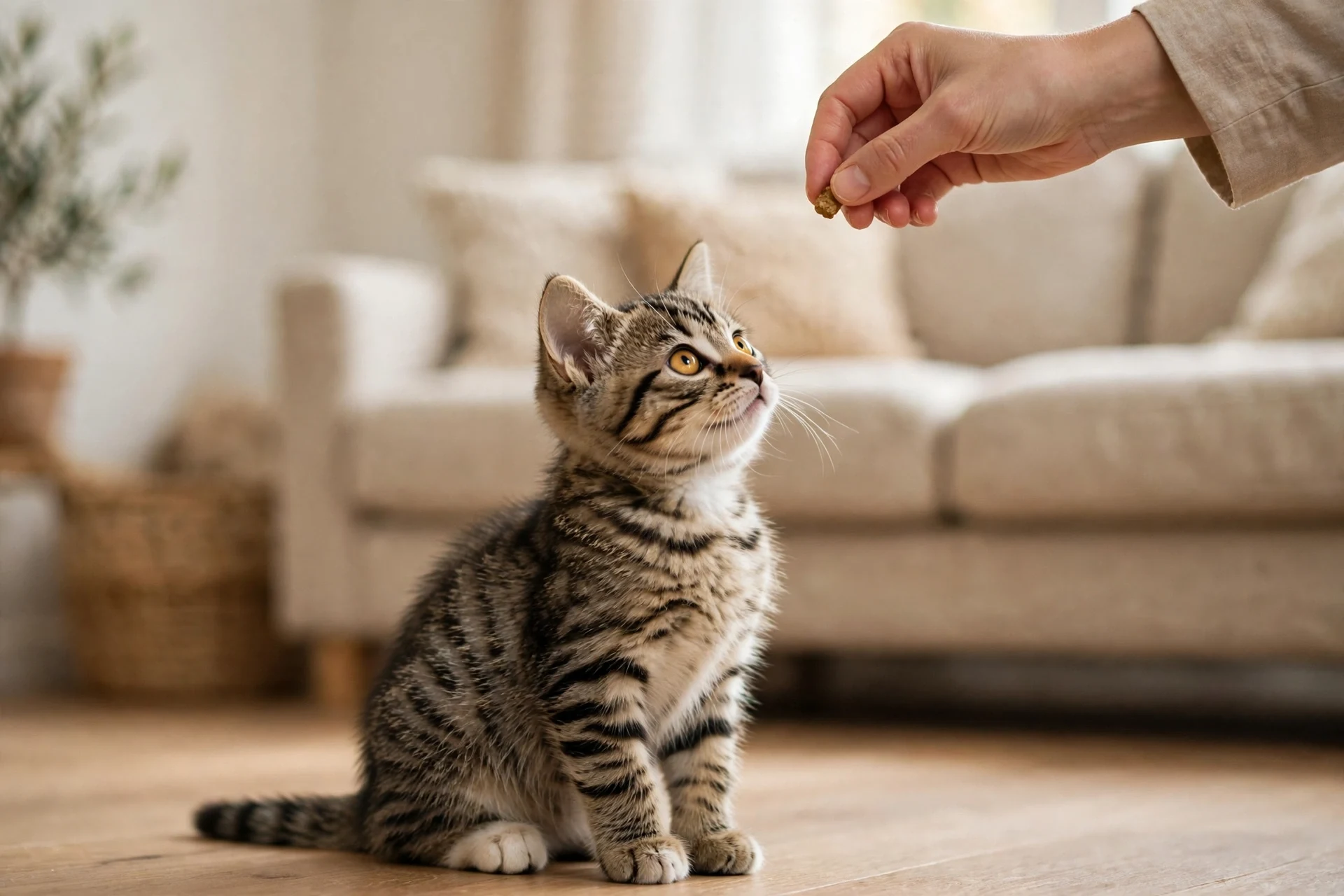
Say the name once, in a warm tone, then immediately offer a small treat or a moment of fuss. When the cat looks toward you — even just an ear turn — reward it. Keep sessions to a few minutes, a few times a day, using the name in the same situations: mealtimes, greetings, before play. Everyone in the household should use the same name, at least at first, so the sound stays consistent.
Do not use the name to scold. If it is mostly heard in an angry voice, the cat will learn it as a sound that predicts something unpleasant — and the likely response is hiding, not coming. Keep the name attached to good things while it is being learned.
Adult cats can learn a new name just as kittens can, and a rescue cat can learn a different one from the name it arrived with. It may take longer if the cat already has a strong association with another sound, but there is no evidence adults cannot learn. Patience matters more than age.
For owners bringing a cat home for the first time, name-learning sits alongside everything else a new cat needs — a quiet room, a litter box, food and water, time to settle in. That first settling-in period is covered in “Introducing a New Cat to Your Home,” which walks through the first days step by step.
Why “ignoring you” is not evidence of anything
The gap between what cats know and what cats do is where most of the misunderstanding lives. A cat that does not come when called is usually described as ignoring its owner, or as not knowing its name at all. The research says something kinder and more accurate: the cat very likely knows the sound, and has simply chosen not to act on it.
The cat may be comfortable and see no reason to move. It may have learned that coming leads to being picked up, or to a bath, or to the carrier. It may be focused on something more interesting, like a bird outside the window. Or the name may be said so often that it has become background noise.
None of that is a failure, in the cat or in the owner. A cat’s relationship with its owner is real — both studies point to cats tracking their people closely — but it is not built on obedience. Expecting a cat to behave like a dog is the fastest way to misunderstand one.
One exception is worth taking seriously. If a cat that used to respond to its name — with an ear turn, a look, a meow — suddenly stops responding, and the change is noticeable in an older cat, mention it to a veterinarian. Hearing can fade with age, and a change in response can be one of the first signs an owner notices. It is not a reason to panic, and not a diagnosis — simply a change worth checking, like any sudden change in an older cat’s behaviour.
Frequently asked questions
Do cats know their names or just the sound?
Just the sound, as far as anyone can prove. A 2019 study in Scientific Reports showed cats can tell their own name apart from other words, including the names of cats they live with. But the study’s lead author has said there is no evidence cats attach meaning to words, not even their names. The name works as a learned sound cue — a familiar pattern paired with attention, food, or play — not as proof the cat understands the idea of a name.
Do cats recognise their owner’s voice?
Yes — a 2013 study in Animal Cognition by the same lead author found cats can distinguish their owner’s voice from a stranger’s. The 2019 name study went further: cats recognised their own name even when a stranger said it, suggesting the recognition is about the sound pattern itself, not just who is speaking.
Can cats learn nicknames?
Yes. A nickname works the same way a name does: said often and followed by something good, the cat learns it as a cue. Cats do not need a sound to be their “official” name to respond to it, and many answer to two or three nicknames. Short, distinct sounds are easiest to pick out.
Why doesn’t my cat come when I call its name?
Because recognising a name and obeying a summons are different things. The 2019 study measured ear and head turns, not coming when called, and fewer than one in ten cats vocalised or moved their tails. A cat that hears its name may be comfortable where it is, may be busy, or may have learned that coming leads to something it dislikes. Not coming is not evidence the cat did not recognise the sound.
Do kittens learn their names faster than older cats?
The 2019 study did not test this, so there is no scientific answer. Kittens are in a fast-learning stage and often pick up a name quickly, especially when it is paired with food and play from the start. But adult cats can learn a new name too — it may take more repetitions. Age matters less than consistency: the same name, said the same way, followed by something good, is what teaches any cat.
The ear twitch is the whole story. Say the name, watch the ears, and accept the rest of the cat’s answer — including the part where it stays exactly where it is. A cat that knows its name and chooses not to come is not being rude. It is being a cat.