Category: Cat Facts & Fascinating Discoveries

  • Can Cats Actually See in the Dark? The Answer Is Better Than You Think

    Can Cats Actually See in the Dark? The Answer Is Better Than You Think

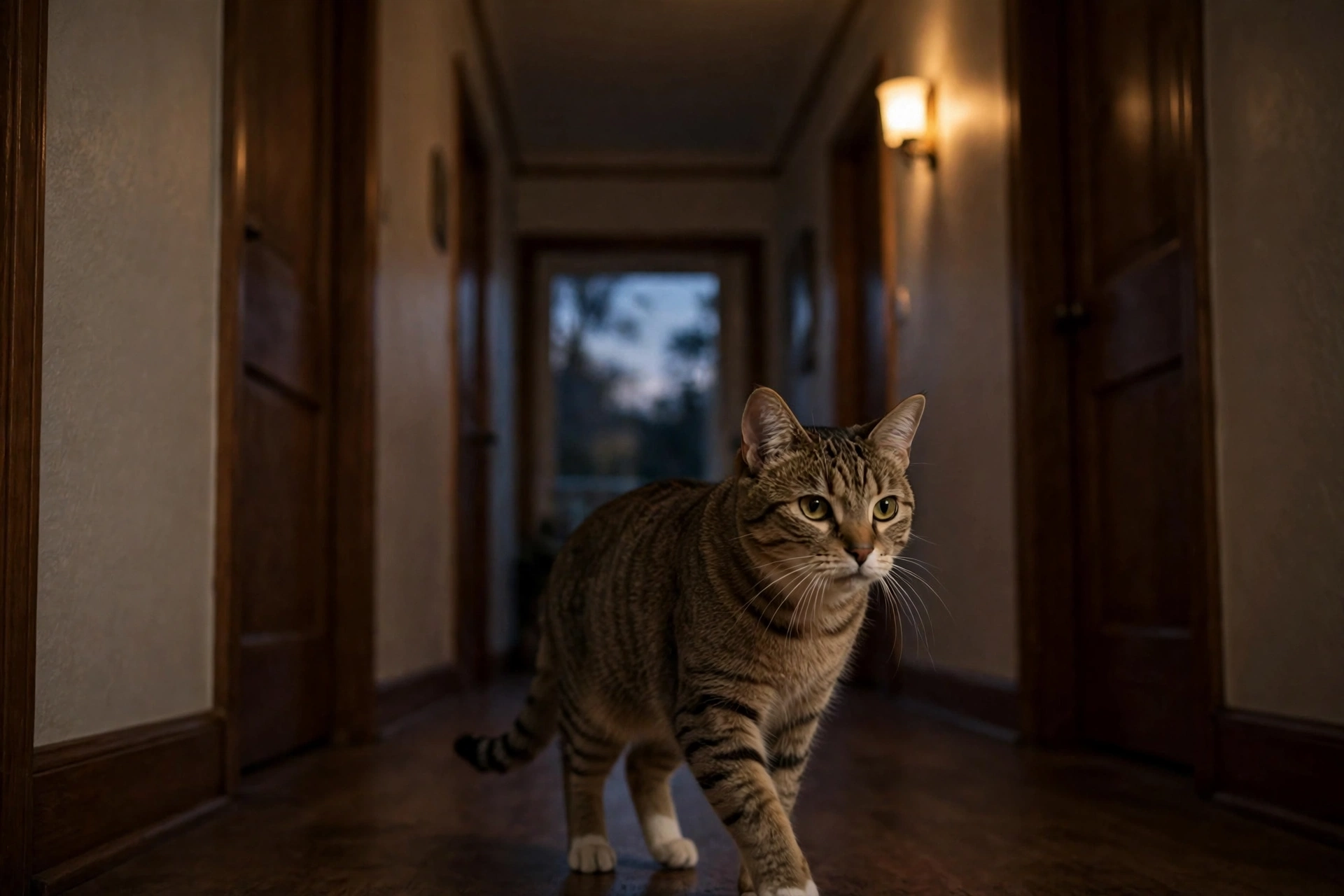
    You get up in the night, barefoot, and stub your toe on a chair leg you swore was somewhere else. Your cat, meanwhile, crosses the same dark hallway without a sound, hops onto the counter, and settles down to watch you limp back to bed. It looks like a superpower. It is not — but the real explanation is nearly as good.

    Cats cannot see in total darkness. No animal can: vision needs light, and a room with no light at all leaves a cat exactly as blind as you are. What cats can do is use very small amounts of light far more efficiently than people. The Cornell Feline Health Center puts it plainly: thanks to the tapetum lucidum, a reflective layer inside the eye, a cat’s sensitivity to light “is thought to be about six times greater than that of a human’s.” The Merck Veterinary Manual says it more plainly: cats “can see 6 times better in dim light than people.”

    This article explains what that six-times figure actually means, how a cat’s eye achieves it, what a cat gives up in exchange, and what is still uncertain.

    Tabby cat with glowing green-gold eyes sitting in a dim room at dusk
    The glow is reflected light, not light the eye makes — the tapetum lucidum at work.

    The myth, stated plainly

    The most common belief about cat vision is wrong in an interesting way. Cats do not have night-vision goggles built into their heads. They cannot see in a sealed, windowless room with no light at all: in that situation, a cat is just as blind as a person, navigating by memory, hearing, smell, and touch.

    What feels like seeing in the dark is usually something else: a room that seems pitch black to a person still contains faint light from a window, a hallway, a clock, or the street outside, and a cat can make far better use of that faint light than a person can. Cats have a real biological advantage. They do not have a superpower.

    The evidence: six times better, more or less

    The figure most often quoted is six. Cornell’s Feline Health Center says a cat’s sensitivity to light is thought to be about six times greater than a human’s, and the Merck Veterinary Manual states that cats can see six times better in dim light than people. Embrace Pet Insurance, citing comparative ophthalmologist Paul Miller of the University of Wisconsin-Madison, reports the same six-times figure.

    Other sources give a range rather than a single number: MyPets and Purrfect Grooming both put the figure at roughly 5.5 to 7 times better than humans in low light, depending on how vision is measured. As SnuggleSouls notes, claims that cats see a fixed number of times better than people depend on how vision is tested and compared.

    The most precise measurement behind the popular figure comes from a behavioral study by Kang and Malpeli (2009): cats detect contrast at about 6.2 times human sensitivity under dim-light conditions. That is the scientific basis for the round number everyone quotes. Note Cornell’s careful wording — sensitivity “is thought to be” about six times greater. Even the best sources present it as an estimate, not a law of nature.

    How the eye does it

    A cat’s advantage is not one feature. It is four adaptations working together.

    A large cornea and wide pupils. A cat’s cornea is proportionally larger than a human’s, and its pupils open far wider in dim conditions, letting more light reach the retina. Research on pupil shape by Banks and colleagues (2015) found a cat’s pupils can expand up to 135-fold in area between bright light and darkness, while human pupils manage only about a 15-fold change. In bright daylight the same pupils close to narrow vertical slits, cutting glare.

    A rod-heavy retina. The retina contains two kinds of light-detecting cells: cones, which handle color and fine detail, and rods, which handle dim light and movement. Cats have a much higher proportion of rods than humans, and rods are packed with light-sensitive pigment that reacts to very small amounts of light — which is why shapes and movement can stand out for a cat when a person’s view has already faded. The price is fewer cones, and therefore less color and less fine detail.

    The tapetum lucidum. Behind the retina sits a reflective layer called the tapetum lucidum. It bounces light that passed through the retina without being absorbed back through it a second time, giving the photoreceptors another chance to catch it. Merck notes that it “magnifies incoming light and lends a characteristic blue or greenish glint to their eyes at night.” That glint is the tapetum at work: reflected light, not light the eye produces.

    Vertical-slit pupils. The narrow slit shape is not just for show. Embrace notes that vertical-slit pupils allow fine control over how much light enters the eye, helping cats adapt to changing light conditions. The leading theory is evolutionary: a vertical slit appears to help with dim-light vision and to cut glare, which fits the cat’s role as a low-light ambush hunter.

    Whiskers, the backup system. Vision is not the whole story. Whiskers are specialized sensory hairs rooted in follicles rich with nerves, and they help cats map nearby space through touch and air movement — especially when it is too dark or too close-up for the eyes to do clean work. That is why a cat can move neatly around chair legs at night: vision handles the broader layout, while whiskers confirm what is right in front of the muzzle.

    Cat sitting on a windowsill at twilight looking out at a dusky blue evening sky
    Dusk is when a cat’s eyes work best — the crepuscular hours, not the middle of the night.

    Cat versus human: the trade-offs

    Night vision is only one category. Across the full picture, cats own low light and humans own sharpness and color:

    FeatureCatsHumans
    Low-light performanceAbout 6 times better (5.5–7× range)Baseline
    Visual acuityAbout 20/100–20/20020/20
    Field of viewAbout 200°About 180°
    Color visionLimited — mostly blues and yellowsFull spectrum
    Motion detectionExcellent, especially in dim lightGood, but weaker in dim light

    Acuity is the biggest trade-off. A cat’s visual acuity is roughly 20/100 to 20/200 by human standards, according to Embrace, MyPets, and Purrfect Grooming — meaning a cat must be much closer than a person to see something clearly. Embrace adds an important reason: the same tapetum lucidum that boosts night vision scatters some light on its way back through the eye, which softens fine detail. Newer research suggests some cats may see closer to 20/30, so the range is approximate. What is consistent is the direction: cats trade sharpness for sensitivity.

    Field of view is wider, not sharper. Cats see about 200 degrees around them, compared with about 180 degrees for humans, which helps them detect movement approaching from the side. Their binocular overlap is narrower than ours, and instead of a fovea for sharp central vision, cats use a visual streak — a horizontal band across the retina rich in photoreceptors — which helps them track prey moving across the ground.

    Color is limited, and the science is not fully settled. Most evidence-based overviews describe cats as having dichromatic color vision: they can distinguish some blues and yellows, while reds and greens are harder to separate and may look muted or greyish-brown. That is why a toy’s motion and contrast usually matter more than its color. But the Merck Veterinary Manual sounds a note of caution: although cone cells are responsible for color vision, “it is uncertain whether cats can see colors.” Cats almost certainly see some color, but how much is not as firmly established as confident summaries sometimes imply.

    Motion is where cats win twice. Rod cells excel at catching movement in low light, so a cat may notice a shifting shadow long before it can make out what the shadow is. In very dim conditions, cats lean on smell and hearing to fill in what their eyes cannot resolve. That combination is what makes a cat such an effective twilight hunter.
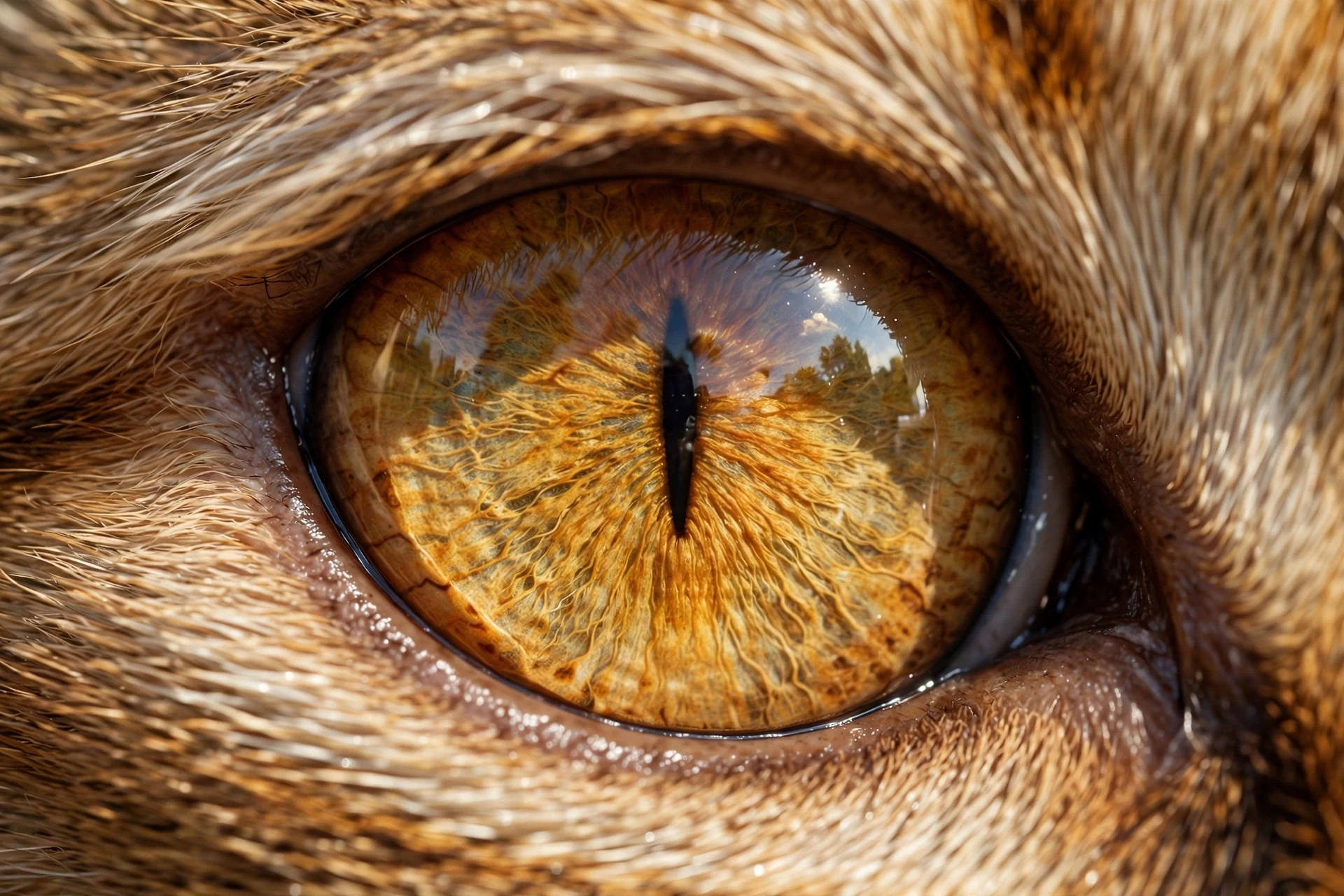
    Close-up of a cat's eye with a narrow vertical slit pupil and amber iris
    In bright light the pupil closes to a narrow vertical slit, cutting glare. In dim light it opens wide.

    What is still uncertain

    First, the headline number. “Six times better” is an estimate built on contrast-sensitivity measurements, and other sources give 5.5 to 7 times. The number changes with the test used, the light level, and the individual cat.

    Second, visual acuity. The commonly quoted range of 20/100 to 20/200 is an approximation drawn from several studies, and newer work has suggested some cats may see closer to 20/30. Acuity varies between individual cats, and the behavioral tests used to measure it are less precise than the eye charts used for people.

    Third, color vision. The dichromatic picture is the consensus of most overviews, but Merck’s caution that it is uncertain whether cats can see colors shows the evidence is thinner than the confident summaries suggest. Color is genuinely hard to test in an animal that cannot describe what it sees.

    The uncertainties are about the exact numbers, not the direction: cats see far better than people in dim light, and they cannot see in total darkness.

    What it means at home

    Understanding how a cat sees changes a few ordinary decisions.

    A night-light is optional for most cats, useful for some. A healthy cat using familiar rooms does not automatically need a night-light if some ambient light is available. A small, steady light can help when a route is unfamiliar, the room has changed, or a cat has known vision trouble. SnuggleSouls recommends safe, low-level lighting rather than shining a bright light directly into the cat’s eyes.

    Keep routes predictable. A cat may cross a known hallway at night yet pause when furniture has been moved or a new object blocks the route. Keep stairs, food and water bowls, and the litter-box path clear. In very dim conditions a cat leans on memory and other senses, so a changed layout is a genuine obstacle.

    Choose toys by motion and contrast, not color. Because cats see blues and yellows best and reds and greens as muted, a bright blue toy tends to stand out more reliably than a red one — but motion matters more than color either way. Toys that move or dangle stimulate hunting instincts more than color alone. Purrfect Grooming also advises using laser pointers sparingly and always ending a session by letting the cat “catch” a real toy.

    Dusk and dawn are the busy hours. Cats are crepuscular, meaning many are most active around dawn and dusk rather than only at night. That is when their eyes work best — and also when outdoor cats face the most traffic and predator risk.

    Ageing eyes deserve attention. Vision changes are often subtle at first, and a cat compensates by relying more on whiskers, memory, and hearing. Watch for new cloudiness, redness, persistent discharge, or a visible third eyelid, and for behavior changes such as misjudging jumps or hesitating on stairs.
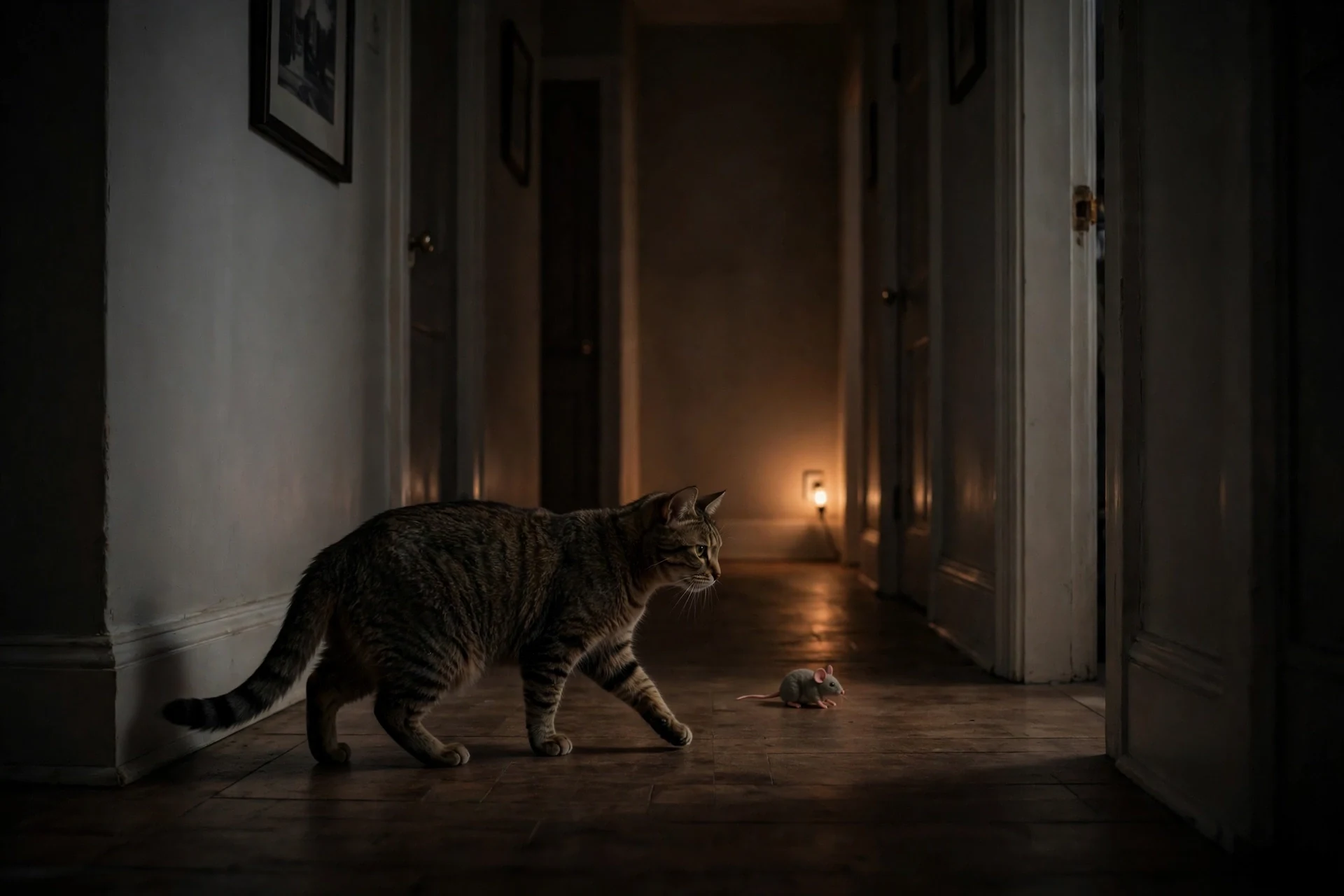
    Cat walking through a dim hallway at night toward a small toy mouse
    A dim hallway is navigable, not dark, to a cat — faint light from a window or clock is enough.

    When poor night vision is a reason to call the vet

    A change in how a cat sees in dim light can be an early sign of eye disease, and it should prompt a veterinary evaluation. Embrace lists cataracts — a clouding of the lens that blocks light from reaching the retina — and progressive retinal atrophy, where night blindness is frequently the first sign. Cornell’s Dr. Thomas Kern notes that most cats losing vision are middle-aged or elderly animals whose vision loss has been progressing for years, and that earlier diagnosis means more effective treatment.

    Contact a veterinarian if a cat begins bumping into familiar furniture, hesitates at stairs, misses food or water bowls, or struggles to find the litter box. Eye redness, cloudiness, squinting, or unequal pupils also need veterinary advice. Sudden vision loss is urgent: keep the cat away from stairs and outdoor hazards, leave the furniture in place, and call a veterinarian or an emergency clinic.

    One distinction is worth knowing for older cats: nuclear sclerosis — an age-related hardening of the lens — gives a cloudy, bluish look that is easy to mistake for cataracts, but it usually does not cause significant vision loss. A veterinarian can tell the two apart with an exam.
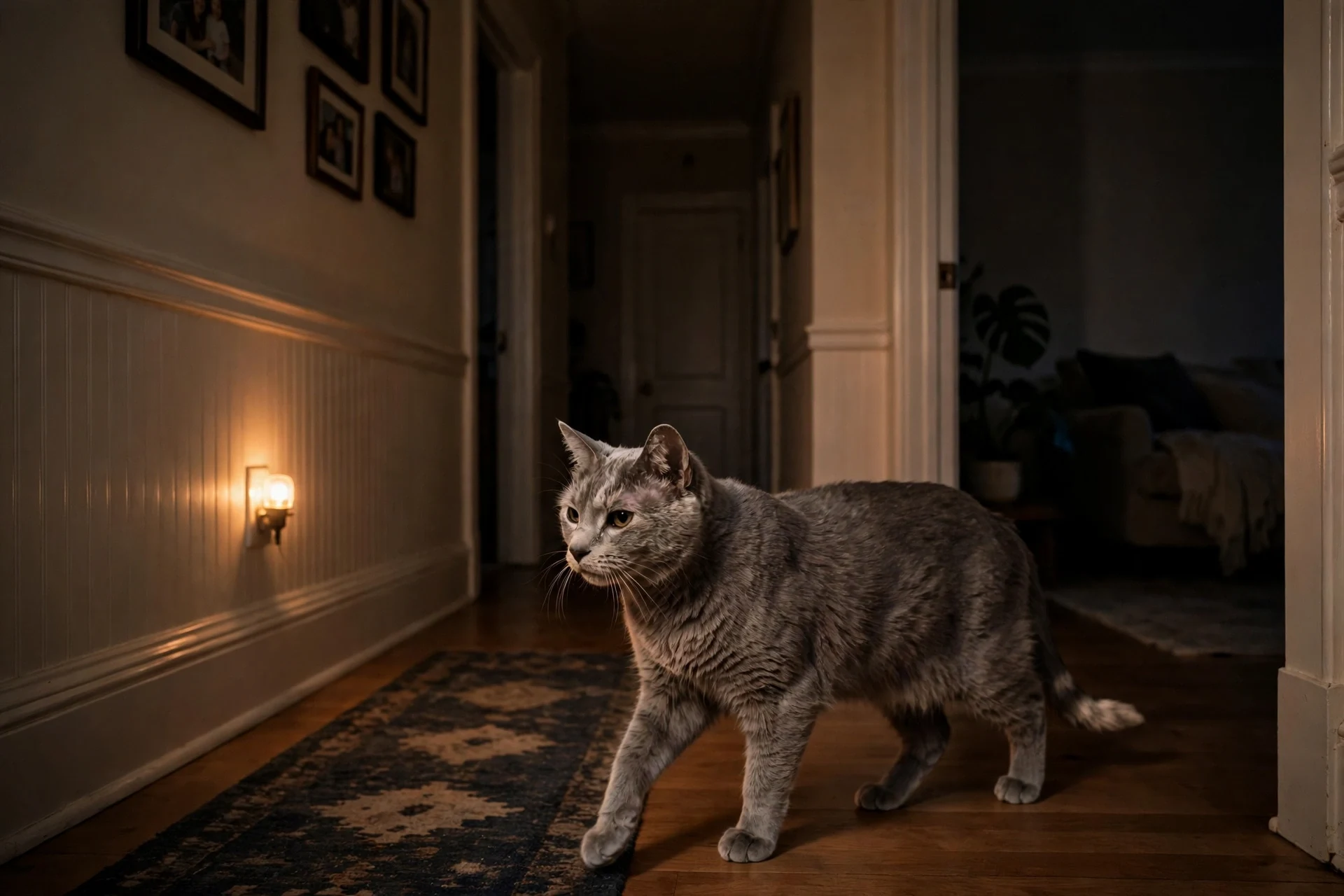
    Senior grey cat walking along a hallway at night beside a small warm night-light
    A small, steady night-light helps when a route is unfamiliar — or when ageing eyes need the extra light.

    Frequently asked questions

    Can cats see in total darkness?

    No. Cats need at least some light to form a visual image. In a familiar room they may still navigate using memory, hearing, smell, and whisker touch, but that is not vision. A room that seems completely dark may still contain faint light from a window, hallway, or clock.

    Why do cats’ eyes glow at night?

    The glow comes from the tapetum lucidum, the reflective layer behind the retina. It bounces incoming light back through the retina for a second pass, and some of that light escapes back out through the pupil — which is what a camera flash or headlights catch. It does not mean the eyes produce light, or that a cat can see in complete darkness.

    Are cats nocturnal?

    Not exactly. Cats are generally crepuscular, meaning many are most active around dawn and dusk rather than only at night. An indoor cat’s schedule also reflects feeding, play, and household routines. Nighttime play does not show that a cat can see in total darkness.

    Should I leave a light on for my cat at night?

    Not automatically. A healthy cat may manage familiar routes without a special light if the layout is safe and some ambient light is present. Gentle lighting can help in a new or unfamiliar space, or for a cat with diagnosed vision loss.

    Do cats see colour?

    Probably, but less than people do. Most evidence-based overviews describe cats as having dichromatic color vision — blues and yellows are distinguishable, while reds and greens look muted or greyish-brown. The Merck Veterinary Manual notes it is uncertain whether cats can see colors, so how much cats see is not as firmly established as confident summaries sometimes imply.

    A cat’s night vision is not a superpower. It is a careful stack of advantages: pupils that open wide, a retina tuned for rods and motion, and a tapetum lucidum that gives light a second pass. It is enough to make a dim room feel navigable — though never truly dark. The cat crossing your dark hallway is seeing a world that is a little brighter than yours.

  • The Tiny Whiskers on Your Cat’s Front Legs Are Doing a Job You Can’t See

    The Tiny Whiskers on Your Cat’s Front Legs Are Doing a Job You Can’t See

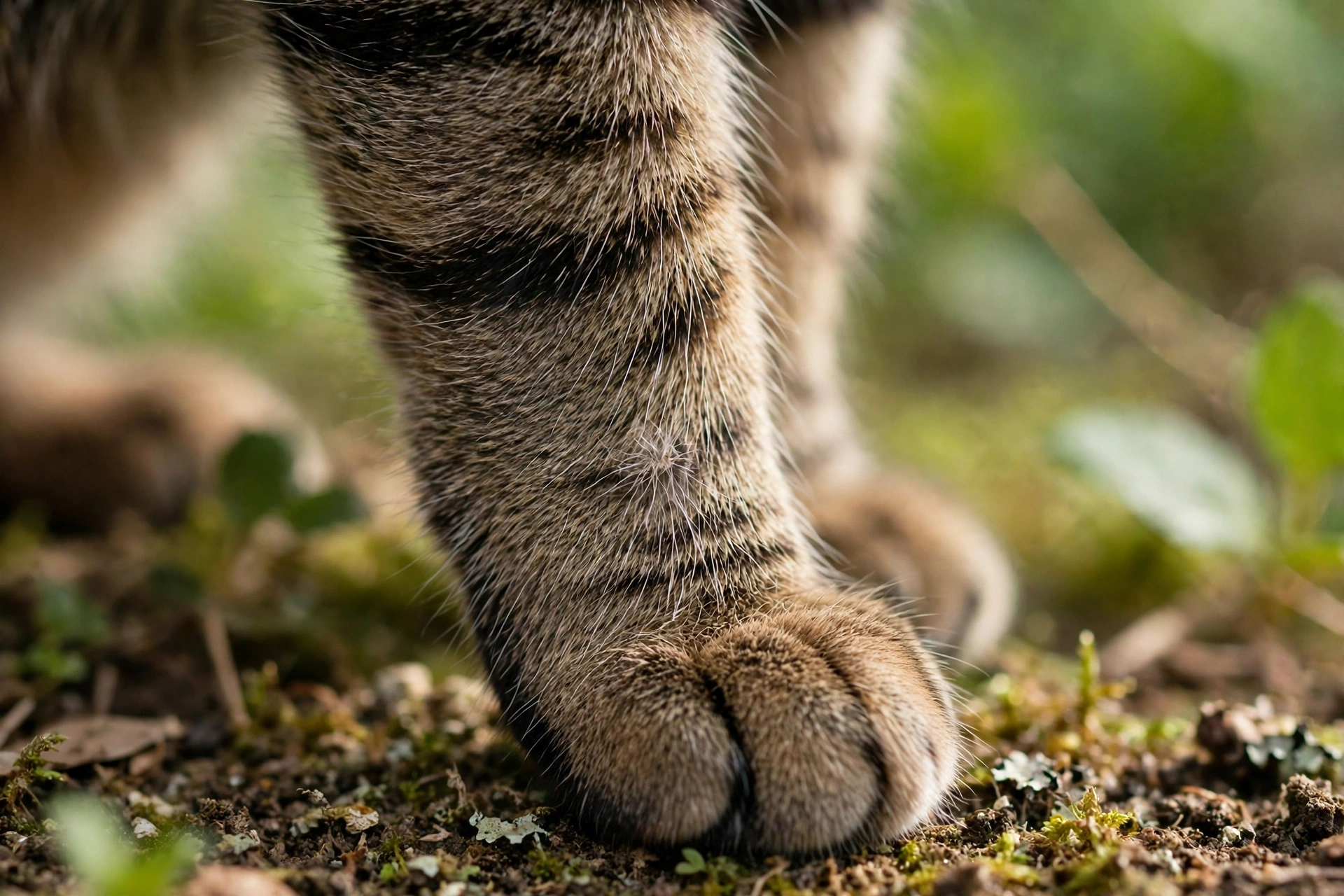
    Next time your cat is stretched out asleep, look at its front legs — not the paws, a little higher. On the back of each wrist, just above the paw, sits a small tuft of fine, stiff hairs, sticking out at an angle from the rest of the fur. Most owners have never noticed it, and plenty who have assumed it was just stray hairs.

    They are not stray hairs. They are whiskers — the same kind of sensory equipment as the long ones fanning out from your cat’s muzzle — and they sit in one of the most useful places on the whole animal. They are called carpal whiskers, and once you know where to look, you will never unsee them.

    Meet the wrist whiskers

    Carpal whiskers sit on the front legs only. The name comes from the carpus, the wrist joint, and the tuft grows on the back — or, as Litter-Robot puts it, the inner side — of each wrist, just above the paw. International Cat Care lists them with the better-known sets: about 24 on the cheeks, more above the eyes, and a set on the back of the forelegs.

    Every cat has them. Catster answers the question directly: yes, all cats have carpal whiskers on their front legs — if you have not seen them on your cat, you have not looked hard enough. They are usually longer and thicker than the whiskers above the eyebrows, according to Catster, but still short beside the muzzle whiskers, and on a long-haired cat they can vanish into the surrounding fur.

    There is nothing on the back legs to match them. The front paws do the close work — catching, holding, testing surfaces — and the wrist whiskers sit exactly where that work happens. Think of them as feelers for the paws, the way the muzzle whiskers are feelers for the face.

    What a whisker actually is

    A whisker is not a thicker ordinary hair. It is a different structure altogether, called a vibrissa, and it works more like a sensor than like fur.

    International Cat Care puts the difference in plain numbers: a cat’s whiskers are twice as thick as the normal hairs on its body and sit three times as deep within the skin. Live Science adds why that depth matters — at the root of each whisker is a follicle loaded with nerves. Catster goes further: whiskers are sensory organs, rooted in follicles filled with nerves and blood vessels, and those nerves connect to the brain’s sensory areas. Touch the tip of a whisker, and the signal travels straight into the part of the brain that maps touch.

    That wiring is why whiskers can do things ordinary fur cannot. The base of each whisker is packed with nerve endings, giving the cat what International Cat Care calls a highly sensitive navigational system. Whiskers detect slight changes in air currents, letting a cat sense an object it cannot see, and they report where objects sit relative to the head and legs — the muzzle whiskers are about the same width as the cat’s body, according to WebMD, so they work as a rough measuring device for gaps. The whiskers above the eyes trigger an automatic blink when something approaches the face.

    The full set is larger than most people realise: 24 muzzle whiskers, 12 on each cheek, per International Cat Care and Litter-Robot, plus smaller sets above the eyes, on the chin, and on the wrists. The carpal whiskers are the least famous of the set, but they are built from exactly the same hardware.

    Close-up of a grey tabby cat's face with long white muzzle whiskers fanned out on both sides
    The muzzle whiskers are the famous set — the wrist whiskers are built from the same hardware.

    The blind spot your cat lives with

    To understand why a cat would need whiskers on its legs, start with a surprise about cat eyes: they are terrible at close range.

    Most cats cannot form a clear, sharp image of anything closer than approximately 25–30 centimetres, according to CatAbroad — and Catster puts the same limit at about 10 inches, or 25 centimetres. Anything inside that range is blurry and indistinct. On top of that, cats have a specific blind spot directly below and in front of the nose, a cone-shaped zone extending roughly 10–15 centimetres from the face, again according to CatAbroad. Put a treat directly under your cat’s chin and it may sniff around in confused circles while standing on top of it — it genuinely cannot see it.

    This is not a defect. A cat’s eyes are built for hunting at a distance — spotting movement, judging the leap, tracking prey across a room. The trade-off is that fine detail up close was never the priority: most studies place feline visual acuity between 20/100 and 20/200, according to CatAbroad. What cats gain in return is a wide field of view — around 200 degrees, against about 180 in humans, per both Catster and CatAbroad — and superb motion detection in low light.

    So why do cats have whiskers on their front legs? Because there is a gap in the system, exactly where a hunt ends: the last few centimetres, when the prey is caught and under the paws. Vision has gone blurry by then, and smell is slow. Something else has to take over, and that something is touch — the whiskers, and the nerve endings packed into the paw pads. Catster puts it directly: between a cat’s whiskers and its paws, it does just fine when “seeing” its prey up close.

    What the wrist whiskers are believed to do

    So why do cats have whiskers on their front legs? Here is where honesty matters more than confidence. The jobs below are the leading explanations offered by veterinarians and cat-care writers — not findings proven by experiments designed specifically around carpal whiskers in cats. The anatomy is settled. The exact job list is not. With that said, here is what researchers believe these whiskers do.

    Feeling prey that is already caught. This is the explanation given most often, and it makes the most sense from the blind-spot problem. Litter-Robot describes it plainly: because cats cannot see fine detail at close range, the carpal whiskers help the cat situate its prey so it can position it for the fatal blow. The whiskers are sensitive enough to detect the slightest movement, so a mouse twitching between the paws is felt instantly, even though it cannot be seen. Watch a cat with a toy mouse and you can see the logic — the paws hold, the head dips, and the whiskers on the muzzle and the wrists are both in contact with the same small, moving object.

    Tabby cat holding a small grey toy mouse between its front paws on a living-room rug
    The paws hold, the head dips — and the wrist whiskers are in contact with the same small, moving object.

    Sensing the ground and the air. Catster says carpal whiskers help a cat get a better sense of the ground it is walking on, and that they can detect minute changes in air pressure and temperature, which helps the cat identify threats or prey nearby. International Cat Care says the same about whiskers in general: they detect air pressure and currents, which lets a cat locate objects even after losing sight of them.

    Climbing. WebMD states it simply: “Whiskers on the back of the legs help your cat climb trees.” The reasoning is that a climbing cat needs to know exactly where a branch or a trunk surface is relative to its paws, and the wrist whiskers report on contact and texture a fraction of a second before the paw commits its weight. It fits the placement — but WebMD states it in a single sentence without citing a study, and no carpal-specific climbing experiment is cited by any source used for this article.

    Grey tabby cat climbing a tall sisal scratching post with its front paws gripping the post
    A climbing cat needs to feel where a surface is before committing its weight — the leading explanation for the wrist whiskers’ role.

    Working in the dark. Cats hunt most at dawn and dusk, and their whiskers are part of why they can do it. Catster lists night hunting among the main functions of whiskers generally: the whiskers help a cat sense its prey and adjust its strike when light is too poor for vision to do the job alone. In a dark hallway, the muzzle whiskers map what is ahead of the face while the carpal whiskers map what is under the paws.

    Tabby cat walking down a dim hallway at dusk with its whiskers pushed forward
    In low light, the muzzle whiskers map what is ahead of the face while the wrist whiskers map what is under the paws.

    Reading mood — a side job worth knowing. Whiskers also signal how a cat is feeling, and the wrist whiskers are no exception to the general rule, though it is the face whiskers that owners can actually read. When a cat is curious or hunting, it pushes its whiskers slightly forward; when it is nervous or upset, it pins them back toward the face, according to both WebMD and Catster.

    What scientists still don’t know

    Most of what is written in answer to why do cats have whiskers on their front legs is inferred, not measured. That is the honest position, and it is the reason this article hedges its claims instead of repeating them as facts.

    First, most whisker research has focused on the face — and much of it on rodents, not cats. The muzzle whiskers have been studied in detail because they are large, obvious, and easy to test. The small tuft on the wrist has received far less direct attention, and none of the sources used for this article cites an experiment that isolated carpal whiskers in cats to test one function at a time.

    Second, the functions overlap. When a cat catches a toy, the muzzle whiskers, the carpal whiskers, the paw pads, and the sense of smell are all reporting at once. Saying which sensor did which part would need an experiment that switches one of them off — and nobody has published that experiment for carpal whiskers in cats.

    Third, some claims travel from source to source without getting stronger. A single sentence in a general whisker article gets repeated until it reads like settled science, even though the original carries no study behind it. That does not make the claim wrong. It makes it unproven.

    So the fair summary is this: carpal whiskers are real, wired like every other whisker, and the leading explanations — feeling caught prey, sensing the ground and the air, helping with climbing and movement in the dark — all fit the anatomy and the blind-spot problem. What is missing is cat-specific experimental proof that separates one job from the others. Until that work exists, “researchers believe” is the right phrase.

    How to find them on your cat — and how to look after them

    Finding carpal whiskers takes thirty seconds and a relaxed cat. Wait until your cat is resting, pick up one front paw gently, and look at the back of the wrist, just above the paw. Part the fur lightly with a fingertip: the tuft is a small cluster of fine, stiff hairs sticking out at a different angle from the surrounding coat. They are easiest to see on short-haired cats in good side light; on a long-haired cat, you may need to look twice. Check both front legs — and do not expect anything dramatic. The whole point of these whiskers is that they are small.

    Once you have found them, the care advice is simple: leave them alone. Never trim whiskers. WebMD is blunt — a cat with cut whiskers becomes disoriented and scared — and veterinarian Jane Brunt puts it memorably: cutting whiskers is “like blindfolding someone”. Catster warns that clipping whiskers can heavily compromise a cat’s abilities. If whiskers are accidentally cut, they do grow back, but slowly: Catster says several weeks to a few months, and Litter-Robot, citing PetMD, puts it at 6 weeks to 3 months.

    A whisker found on the floor is nothing to worry about — International Cat Care notes that shedding a whisker is a perfectly regular body process. Be careful when trimming the fur around the legs, though: Catster warns owners to avoid cutting or damaging the carpal whiskers during grooming.

    One exception is worth knowing: many hairless breeds have short, broken whiskers or none at all, according to Litter-Robot. Every other cat has the complete kit, including the small tuft on the wrists.

    Frequently asked questions

    Do all cats have whiskers on their front legs?

    Yes. According to Catster, all cats have carpal whiskers on their front legs. The main exception is some hairless breeds, which may have short, broken whiskers or none at all, according to Litter-Robot.

    Do cats have whiskers on their back legs?

    No. Carpal whiskers grow only on the forelegs, on the back of the wrists. There is no matching set on the hind legs — the front paws do the catching, holding, and close-range feeling, so that is where the extra sensors sit.

    Can I trim my cat’s carpal whiskers?

    No — never trim any whiskers, including the carpal ones. WebMD warns that a cat with cut whiskers becomes disoriented and scared, and veterinarian Jane Brunt describes cutting whiskers as “like blindfolding someone”. If they are accidentally damaged, they grow back in several weeks to a few months, but the cat is without that sense in the meantime.

    Do carpal whiskers help cats climb?

    That is the leading explanation, but it is not proven by a dedicated experiment. WebMD states that “whiskers on the back of the legs help your cat climb trees”, and the reasoning fits: a climbing cat needs to feel where a surface is relative to its paws before committing its weight. Treat it as a plausible, widely repeated explanation rather than a settled scientific finding.

    Why can’t my cat see a treat right under its nose?

    Because of the close-range blind spot. Most cats cannot form a clear image of anything closer than approximately 25–30 centimetres, according to CatAbroad, and they have a specific blind spot directly below the nose. A treat under the chin sits inside that zone, so the cat genuinely cannot see it and must find it by smell and touch — the range where the whiskers take over.

    Next time your cat is batting a toy mouse between its front paws, look at its wrists. The small tuft of hairs there is doing quiet work in a zone the eyes cannot reach — feeling what the paws are holding, in the dark, where vision has already given up. It is a small piece of anatomy, easy to miss for years. Now you know it is there.