Your Cat Meows at You, Not at Other Cats — and That Is No Accident
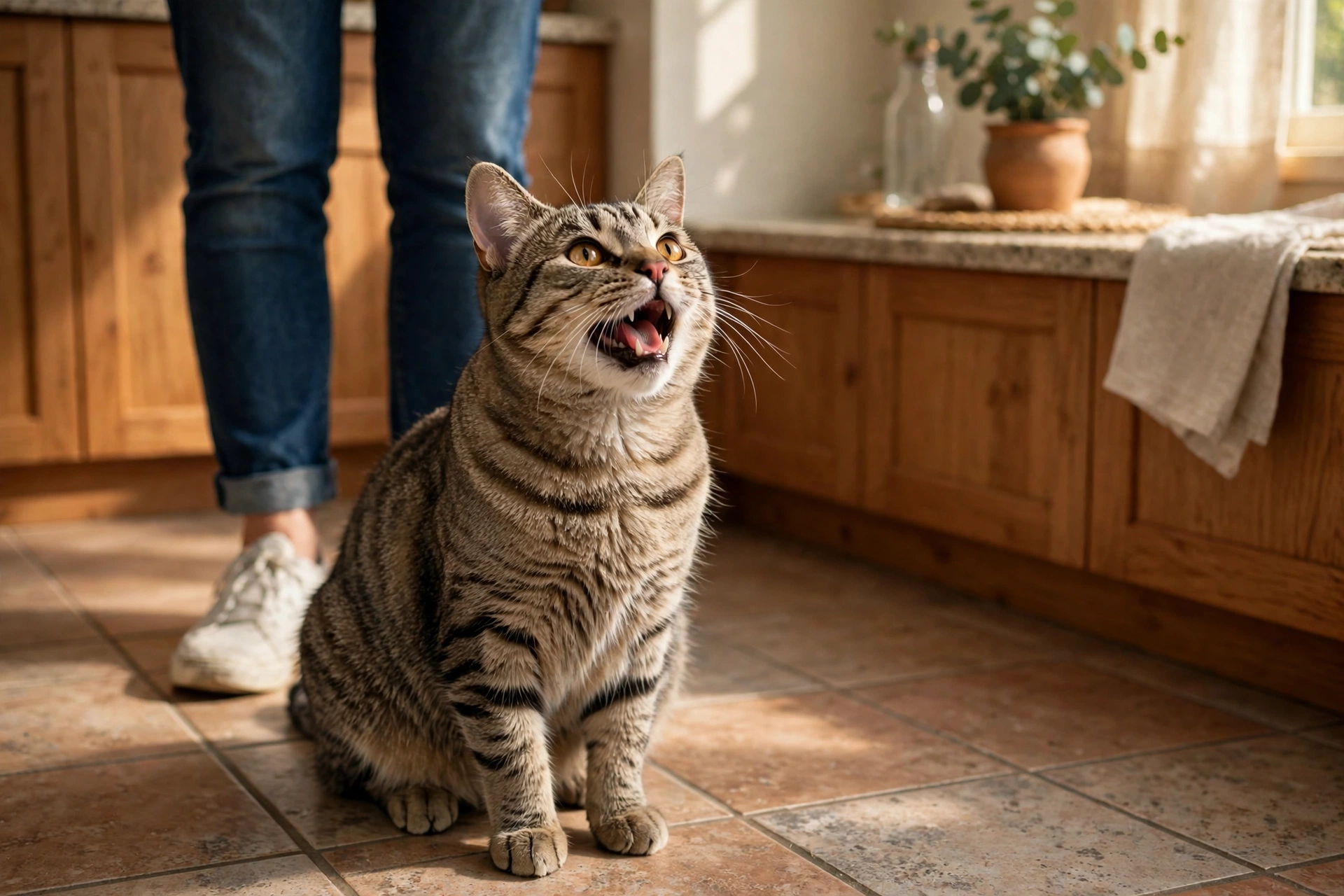
Five in the morning. The bedroom door is closed, the house is dark, and from the hallway comes a small, insistent sound: meow. Meow. Meow. You know what it wants — or at least, what it usually gets. The door opens, the bowl gets filled, the day starts an hour early. By breakfast your cat has meowed at you a dozen times.
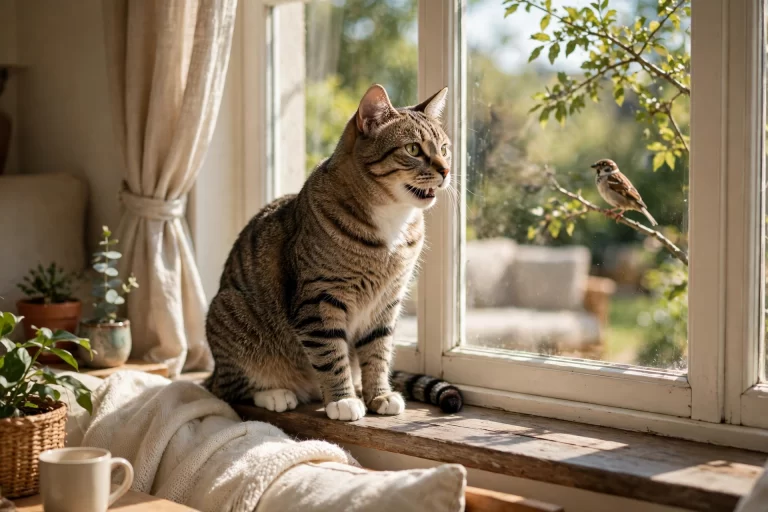
What it has not done, all morning, is meow at the other cat. The two of them have shared a hallway, a windowsill and a food bowl without a single meow passing between them — a look, a tail flick, a wide berth around the sofa, but never the sound your cat saves for you.
That is not a coincidence — it is the answer to why do cats meow at humans, and almost never at each other. The meow is the one sound in a cat’s repertoire that is mostly meant for people. The sound your cat uses on you is a kitten’s call that never switched off — kept, refined, and aimed at the one species that keeps answering it.
It starts with a kitten calling its mother
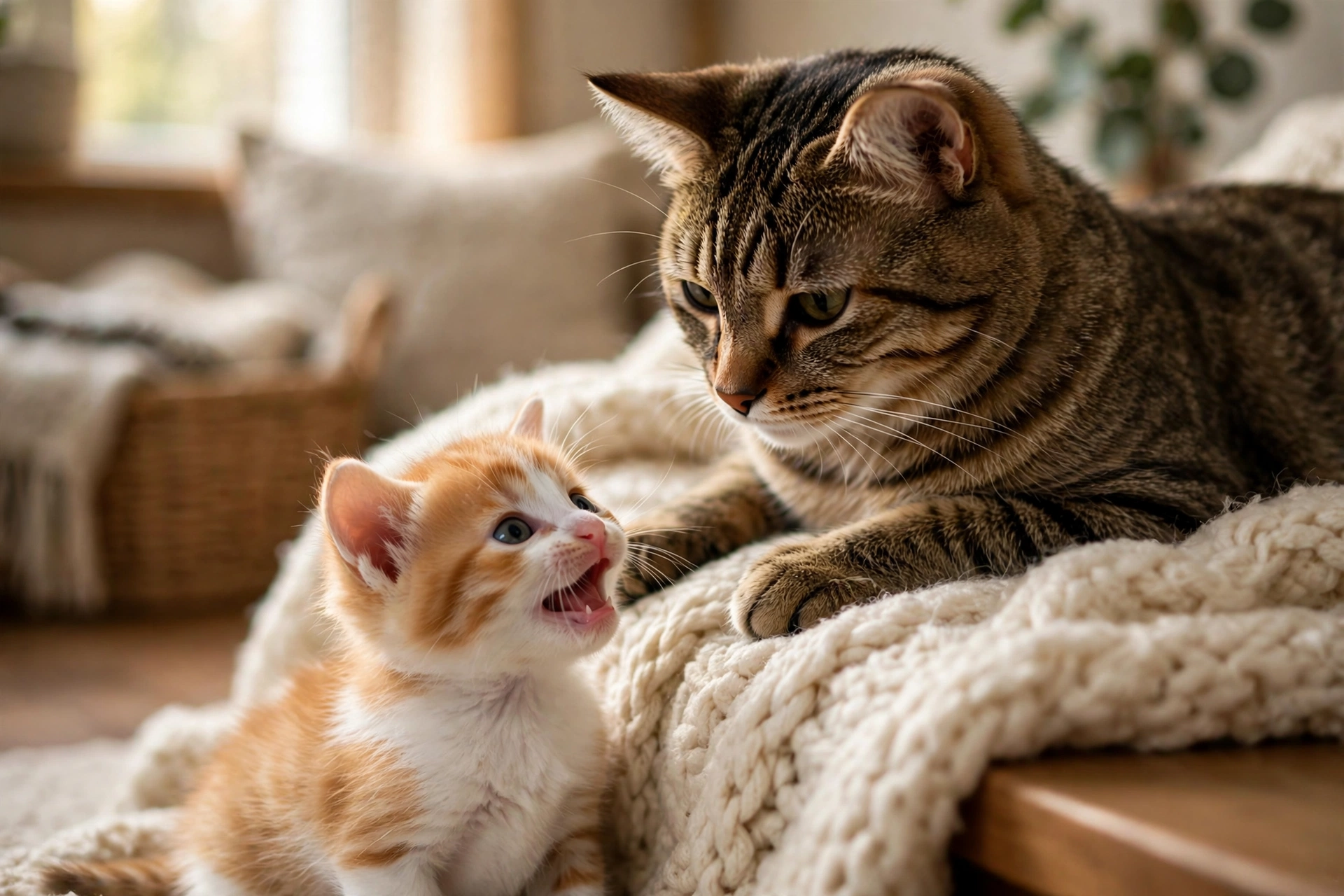
Kittens meow from their first days of life. A newborn kitten cannot see, cannot walk far, and cannot keep itself warm — but it can call: a high, thin mew when it is cold, hungry, or separated from its mother and littermates. The mother comes, finds the kitten, warms it, feeds it, and the calling stops.
That is the meow’s original job, and in the wild it is mostly a temporary one. As kittens grow up and are weaned, the meowing fades. The ASPCA puts it plainly: kittens meow to let their mother know they are cold or hungry, but once they get a bit older, cats no longer meow to other cats. The channel closes — an adult cat in the wild has no one to call, and no reason to call.
But they continue to meow to people throughout their lives. The kitten call did not disappear when the kitten grew up. It found a new audience: us.
How cats talk to each other instead
If adult cats do not meow at each other, what do they do instead? Plenty — just not with sound. A cat’s real first language is scent: cheek glands, paws and flanks leave marks on furniture, doorframes and other cats, carrying information no meow could — who was here, how long ago, whether this one is friendly.
After scent comes body language: ears forward or flat, tail up or lashing, pupils wide or narrow. Then touch: headbutting, grooming each other, sleeping pressed together. Adult cats also have sounds for each other — the hiss, the growl, the yowl of a mating standoff or a territorial dispute — but those are the loud exceptions, for when the silent language has failed.
Meowing fits nowhere in that system, because it was never part of it. As Purina explains it, a cat is dependent on its owner and quickly learns that humans are no good at picking up scent messages or body language. We miss most of the tail signals and cannot smell the cheek marks. So the meowing developed into a second language — one built for the only audience that needed it, and the only audience that answers it.
Domestication kept the kitten call
Cats began living alongside people roughly 10,000 to 12,000 years ago, when farming settlements drew in rodents, and rodents drew in cats. Unlike dogs, cats were not bred for specific jobs — they domesticated themselves, in effect, and the cats that did well around people were the ones that could get what they needed from them.
The meow was part of that bargain: feral cats, living without regular human contact, meow much less often than house cats do. The sound is not hardwired into adult cats. It is kept alive by use, and use means humans answering.
The clearest evidence comes from a 2004 study by Nicholas Nicastro, then at Cornell, in the Journal of Comparative Psychology. Nicastro compared domestic cat meows with the calls of the African wildcat, their closest wild relative. Domestic meows were shorter and higher-pitched — and people who listened to recordings of both rated the domestic meows as much more pleasant, whether or not they liked cats or had much experience with them.
The study does not prove people bred cats for a nicer voice, and Nicastro himself was cautious about that leap. But it fits an idea many researchers find plausible: over thousands of years, the cats whose calls people found appealing may have done a little better — fed sooner, tolerated longer, kept around the house rather than chased off. The meow may have been shaped by human ears, one generation at a time.
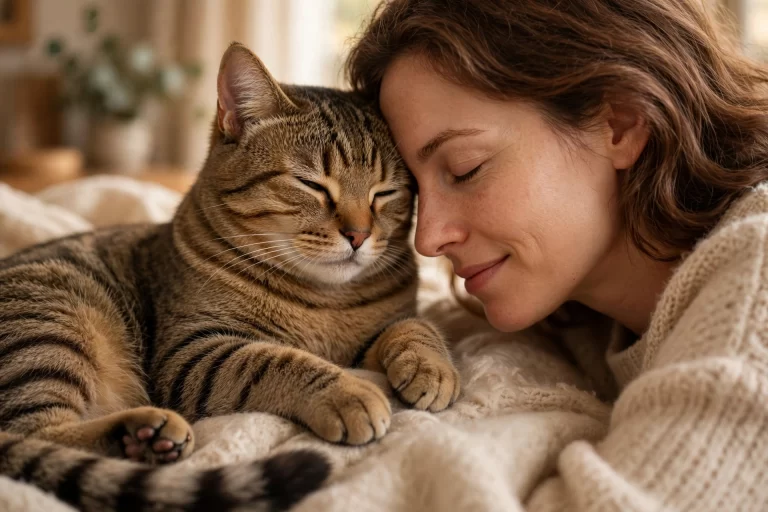
That is also why it is wrong to say your cat thinks you are its mother. Behaviour consultant Mikel Delgado puts it carefully: cats consider us part of their family, but it cannot be said whether they think of us as a parent or a friend. The meow is a kitten’s call aimed at a caretaker, and you are the caretaker — a fact about the sound’s history, not a claim about what your cat believes.
Your cat has trained you, too
Here is the part owners rarely notice: the meow works because you taught it to work. A cat meows by the door, and the door opens. It meows by the food bowl, and food appears. It meows at 5 a.m., and someone gets up and feeds it. From the cat’s point of view, meowing is a button that produces results — so the cat presses it again.
Each cat tunes its meows to its own household. One learns that a short, high meow gets a greeting; another that a long, drawn-out one gets the door opened. You probably already know the difference between your cat’s food meow and its door meow, even if you could not describe either one. The two of you have been practising on each other for years.
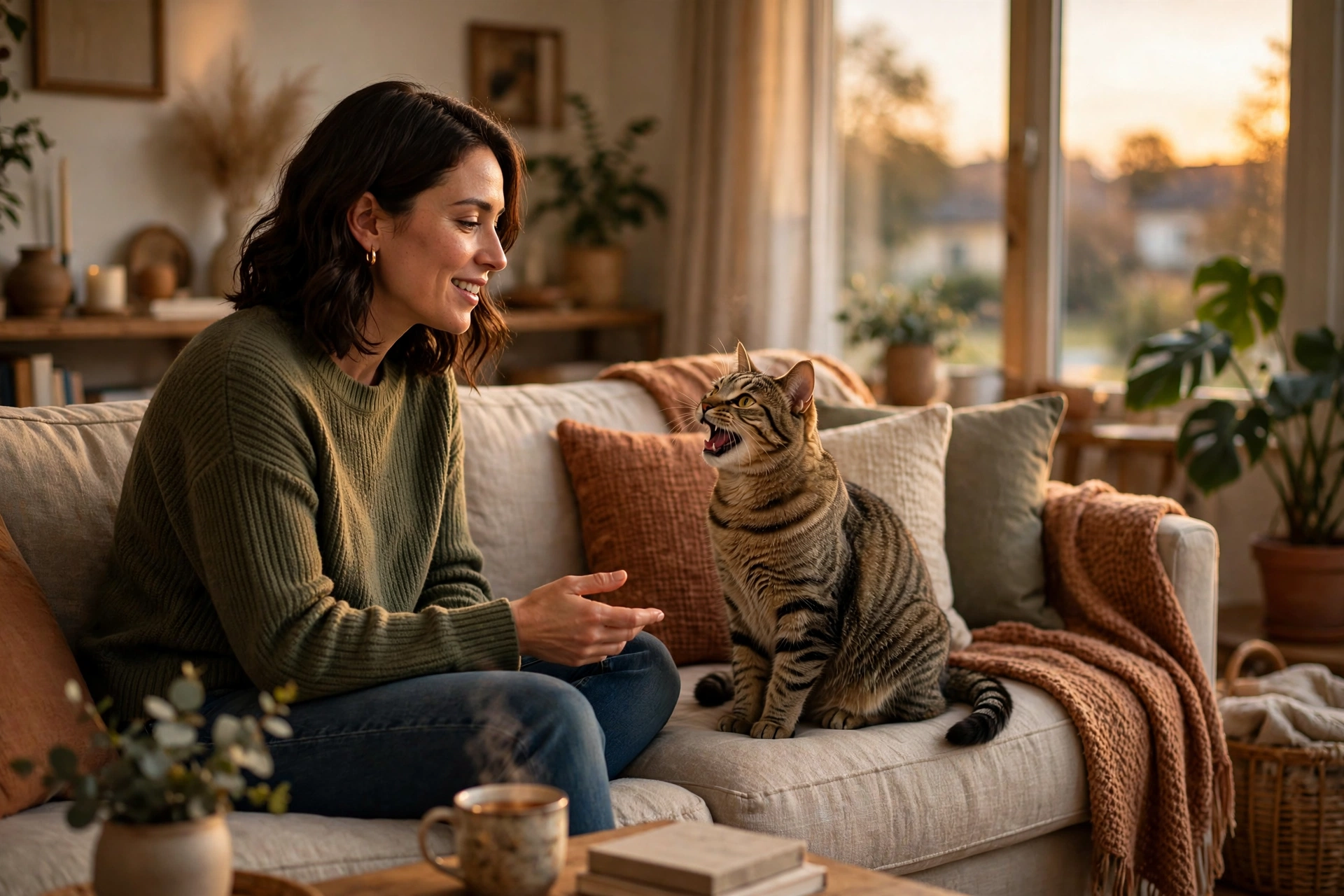
The result can look like a conversation — the cat meows, you answer with words, the cat meows back. You are not really talking, quite. But the cat is listening: research led by Charlotte de Mouzon, published in 2022, found cats responded differently when their owner used the high, sing-song voice reserved for them than when the owner spoke to another adult. Your cat knows when you are talking to it. It just answers in the only language it has that you understand.
The purr with a cry hidden inside
The meow is not the only sound cats have tuned to human ears. In 2009, a team led by Karen McComb at the University of Sussex published research in Current Biology on the “solicitation purr” — the purr cats use when they want food. Hidden inside the low rumble is a higher-frequency cry, roughly 220 to 520 Hz, acoustically similar to a human infant’s cry. People who heard recordings rated these purrs as more urgent and less pleasant than ordinary purrs, even people who had never owned a cat. National Geographic summarised it as “a cry embedded in a purr”. It is the same story as the meow, told in a different sound — and the full story of purring is in the site’s purring article.
What the common meows usually mean
No single meow has one fixed meaning. The sound is a tool, and the meaning comes from the context: where the cat is, what it is looking at, what its body is doing.
The greeting. A short, bright meow when you come home, often with the tail held high — the closest thing to “hello” a cat has.
The food meow. By the bowl, in the kitchen, at the usual feeding time — or an hour before it. Short, repeated, increasingly insistent. If it arrives at 5 a.m., it is not a new problem — it is an old one that worked.
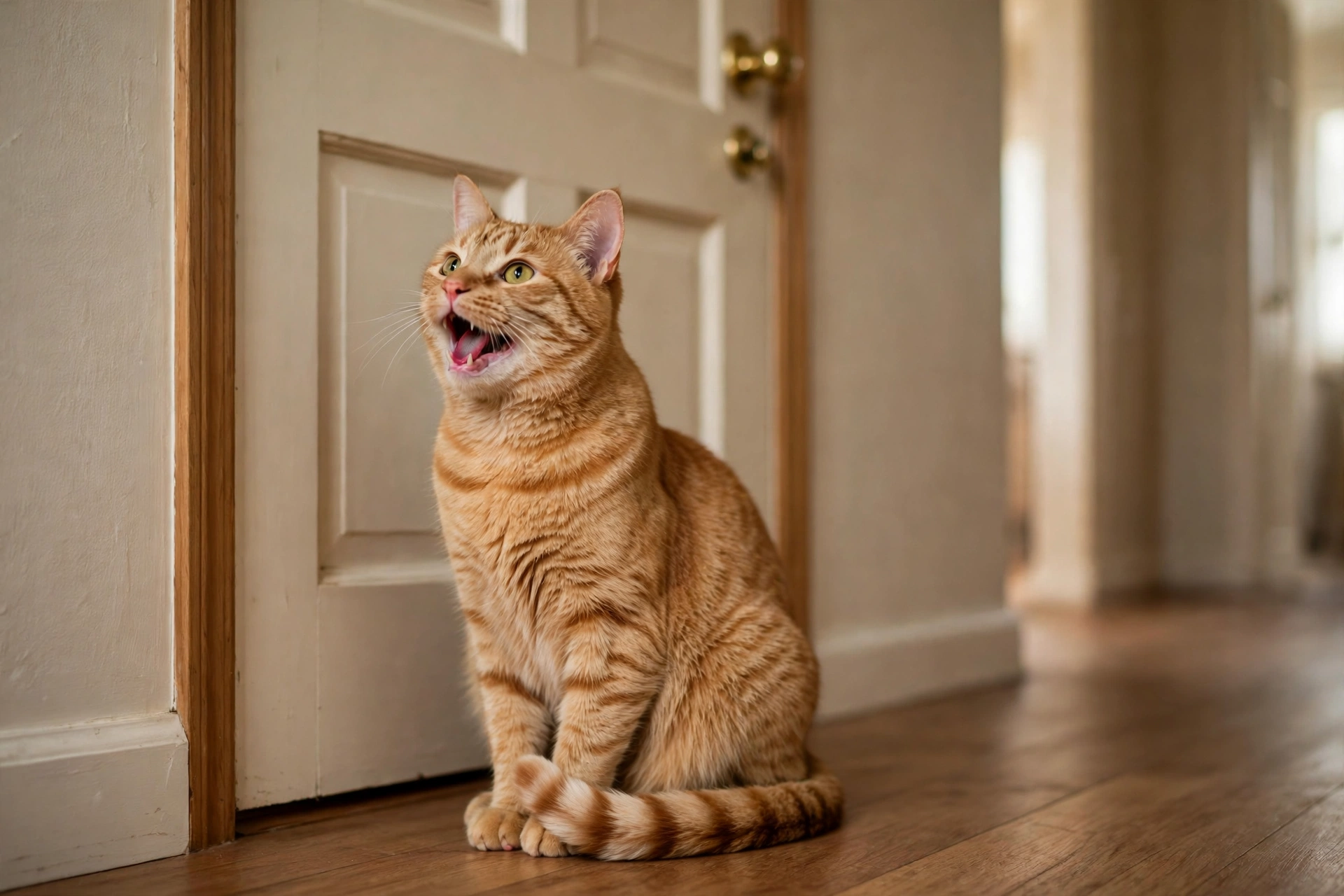
The door meow. By a closed door, looking up at the handle. The cat wants through and has learned meowing is faster than waiting. Open the door and the meow did its job — it will be used again tomorrow.
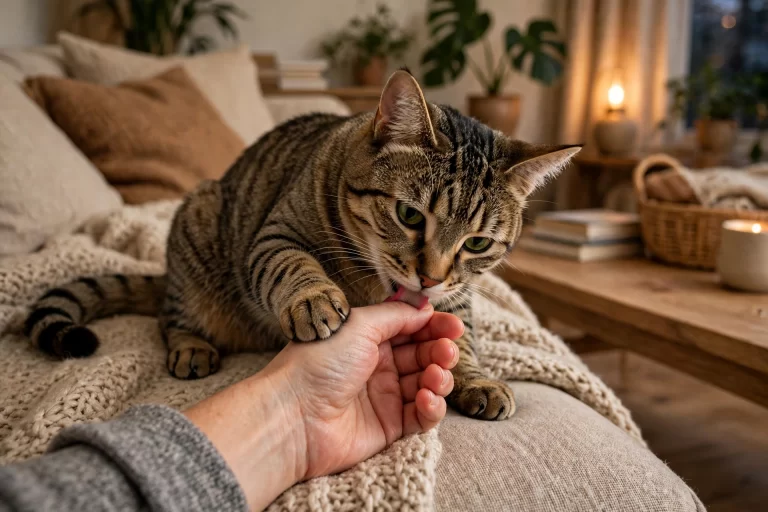
The attention meow. A meow with no obvious target — the cat is simply near you, asking for interaction, often with a headbutt, a knead, or a flop onto its side. The cat is not asking for a thing. It is asking for you.
The long, drawn-out meow. Louder, longer, harder to ignore — usually a demand or a complaint: the food is late, the door is still closed, the litter box is not clean enough. It is also the sound that most often means “something has changed”, which is why it is worth paying attention to, not just answering.
The yowl is not a meow. The long, loud wail of a cat in heat, in a territorial standoff, or in distress is a different sound with a different job. Chirps and trills — the short, bird-like sounds cats make at windows and during play — are a separate family too, covered in the site’s chirping article. If your cat’s sound has changed from a meow into something else, that change itself is information.
When a change in meowing is worth a vet visit
Most meowing is normal. Some of it is a message worth taking seriously, and the line between the two is change: a new sound, a new time, a new intensity, or a meow that comes with something else.
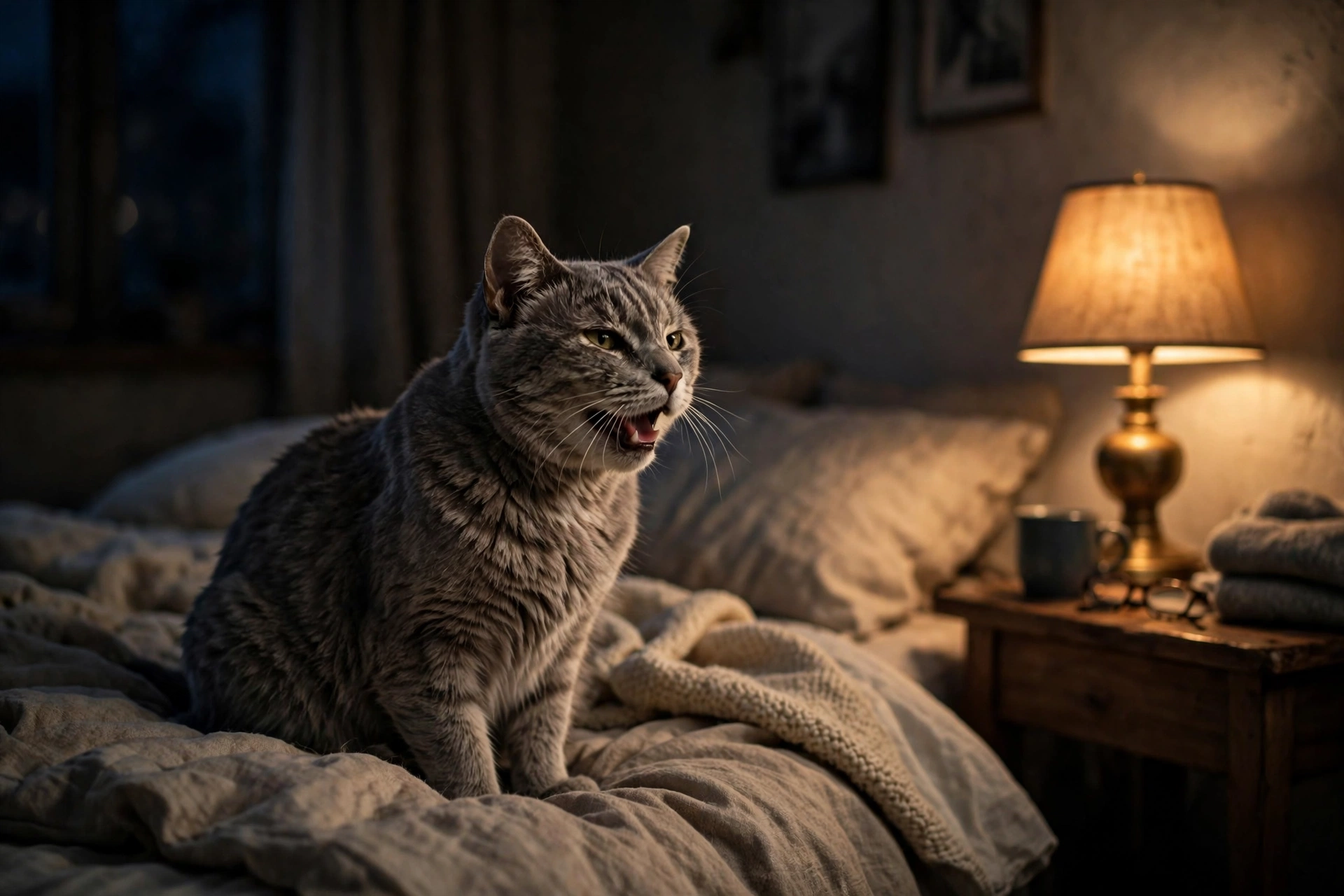
Book a vet visit if the meowing is suddenly much louder, longer or more frequent than usual — especially if it is new. The same goes for a cat that has started yowling at night, out of nowhere, particularly an older cat. Cats are very good at hiding illness, and a change in vocal habits can be among the few early clues you get; veterinarians link increased vocalising in older cats to medical causes such as hyperthyroidism and cognitive changes, which only a vet can check for.
Book a vet visit, too, if the meowing comes with other changes: eating less, drinking more, losing weight, hiding more, or straining in the litter box. Any one of those is worth mentioning on its own; together with a changed meow, they are worth a prompt appointment. Do not try to diagnose the cause at home — the point of the visit is to rule out medical causes first, before anyone talks about behaviour.
One situation is an emergency, not a routine visit. A cat straining in the litter box while meowing, and producing little or no urine, needs emergency veterinary care right away. A blocked bladder can become life-threatening quickly, and waiting to see if it improves is not an option. If you see straining with no urine, call a vet immediately — even in the middle of the night.
How to answer a meow
If the meowing is normal — and most of the time it is — start with the basics: the food bowl, the water bowl, and the litter box. Check whether anything has changed: a new piece of furniture, a visitor, a different schedule. Cats like consistency, and a changed routine is one of the commonest reasons for a changed meow.
If the basics are fine, look at what the meow is earning. A cat fed at 5 a.m. for meowing at 5 a.m. will meow at 5 a.m. tomorrow. The fix is not to punish the meow — never shout at, spray, or scold a cat for vocalising, because punishment adds stress and damages the trust that brings the cat to you. Make the meow stop working, gently: wait for a quiet moment, then feed, open the door, or give attention, and keep the routine steady with a good play session in the early evening. The cat will learn a new schedule soon enough, and it will be one you chose.
Frequently asked questions
Do cats meow at each other?
Rarely. Adult cats communicate with each other mostly through scent, body language, facial expression and touch. Meowing is mainly a kitten-to-mother call that domestic cats kept into adulthood and aimed at humans. Two cats in one house can spend all day together without one meow passing between them.
Does my cat think I am its mother?
Probably not. Behaviour consultant Mikel Delgado says cats consider us part of their family, but it cannot be said whether they think of us as a parent or a friend. The meow is a kitten’s call aimed at a caretaker, and you are the caretaker.
Why does my cat meow at 5 a.m.?
Because it worked once. Cats are most active at dawn and dusk, and they learn fast: if a 5 a.m. meow produced food, 5 a.m. becomes the schedule. Do not feed the meow itself — wait for a quiet moment, then feed.
Why does my cat meow when I come home?
It is a greeting — a short meow on your arrival, tail held high. It is also a prompt: now that you are home, the food, door and attention requests can begin.
When should I worry about meowing?
Book a vet visit if the meowing is suddenly much louder, longer or more frequent, if a cat has started yowling at night out of nowhere, or if it comes with eating less, drinking more, losing weight, hiding, or straining in the litter box. A cat straining in the litter box while meowing and producing little or no urine needs emergency veterinary care.
The meow is not cat language. It is a kitten’s call that domestic cats kept using because people kept answering it — and then, over thousands of years, shaped into something that works on human ears with remarkable precision. That is why do cats meow at humans, and almost never at each other: the other cat already understands the silent language. You do not. So your cat learned a second one, just for you. The least you can do is listen — and answer on your terms, not at five in the morning.