At 3 a.m., a cat in a studio apartment has exactly three jobs: sprint from the bed to the kitchen, knock something off the counter, and stare at the wall until it blinks first. The apartment is not the problem: a cat does not measure a home in square feet, but in things to climb, hunt, scratch, and places to hide. The fifteen ideas below are indoor cat enrichment for small apartments — most need no drilling, several cost almost nothing — organised around the five things a cat actually needs: to hunt, to climb, to scratch, to hide, and to watch.
What enrichment actually means
Enrichment is not a basket of toys. VCA describes it as support for hunting, play, exploration, exercise, mental stimulation, and social interaction — and every cat has its own preferences. The AAFP and ISFM feline environmental guidelines link a cat’s surroundings to health, wellbeing, behaviour, and stress. A peer-reviewed review puts it more plainly: enrichment starts with a predictable environment that minimises fear and gives the cat control over its routine. That is the starting point for indoor cat enrichment for small apartments: a stable base first, then the fun.
A small apartment has one genuine advantage: a smaller space is easier to make predictable. The challenge is floor area, so most good apartment ideas go up the walls and into the window — count surfaces, not square feet.
Hunt — let the cat catch something every day
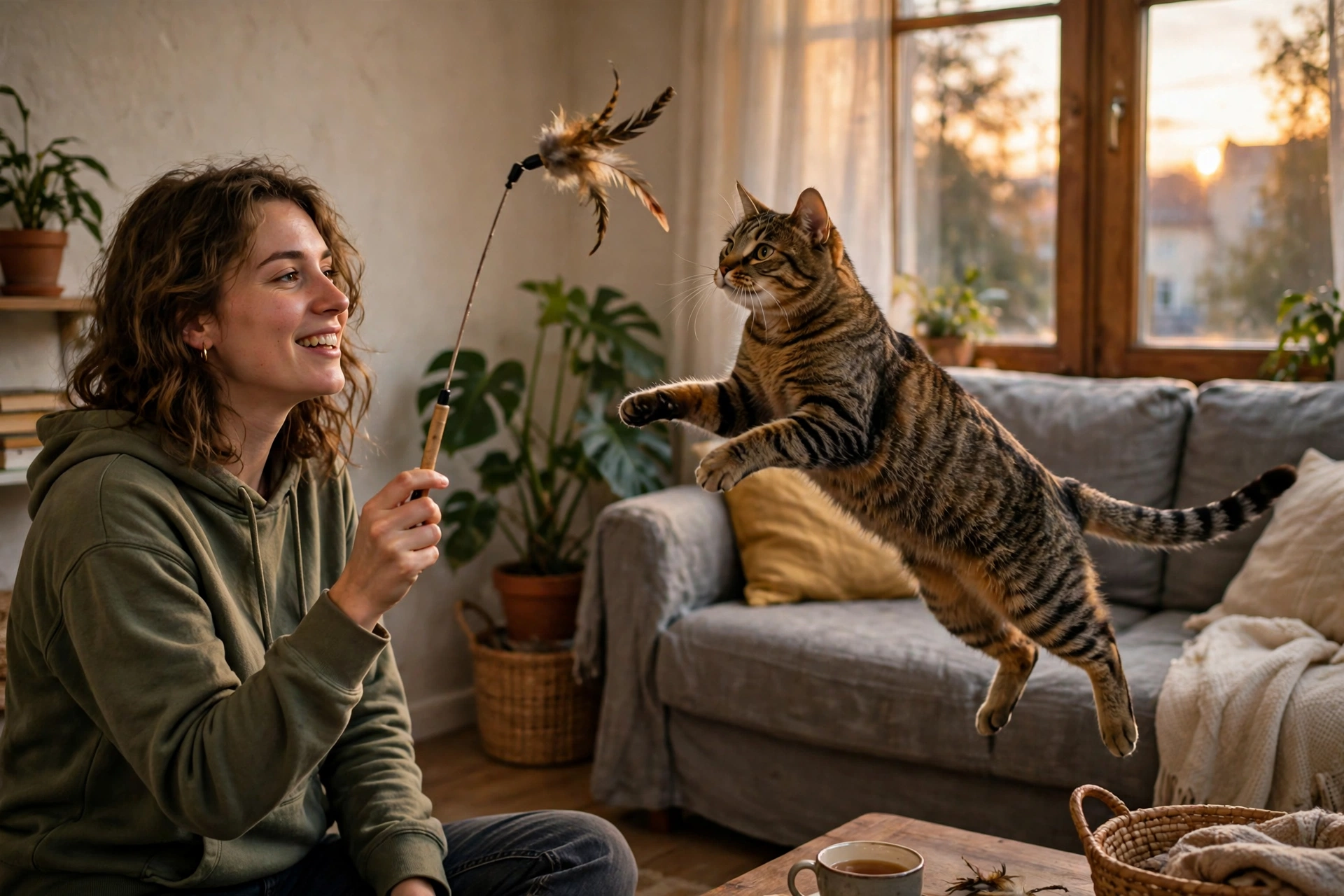
1. Two short wand-play sessions a day
The American Animal Hospital Association (AAHA) suggests about 15 to 20 minutes of interactive play a day, in two or three short bursts rather than one long session. Move the wand like prey — away from the cat, behind furniture, then a pause — and end every session with a catch: a treat, a small meal, or a toy the cat can grab and carry off. A hunt that never ends in a catch frustrates a cat. Put the wand away when the session is over.
2. A puzzle feeder from a toilet-roll tube
Fold the ends of an empty toilet-roll tube closed, cut a few small holes in the sides, drop in a few treats, and let the cat bat it to release them. It costs nothing and turns a handful of kibble into a five-minute hunt. Start easy, with big holes and treats that fall out quickly. If the cat gives up, the puzzle is too hard, not the cat too lazy.
3. Scatter feeding instead of a bowl
Once a day, skip the bowl and scatter a portion of the cat’s kibble in small piles around the apartment: on the cat tree, behind a chair leg, on a low shelf. VCA recommends hiding part of the daily food ration, and Best Friends Animal Society calls the same idea scatter feeding. Keep the total food the same — it is not extra food, just food that takes effort.
Climb and watch — go up the walls and into the window
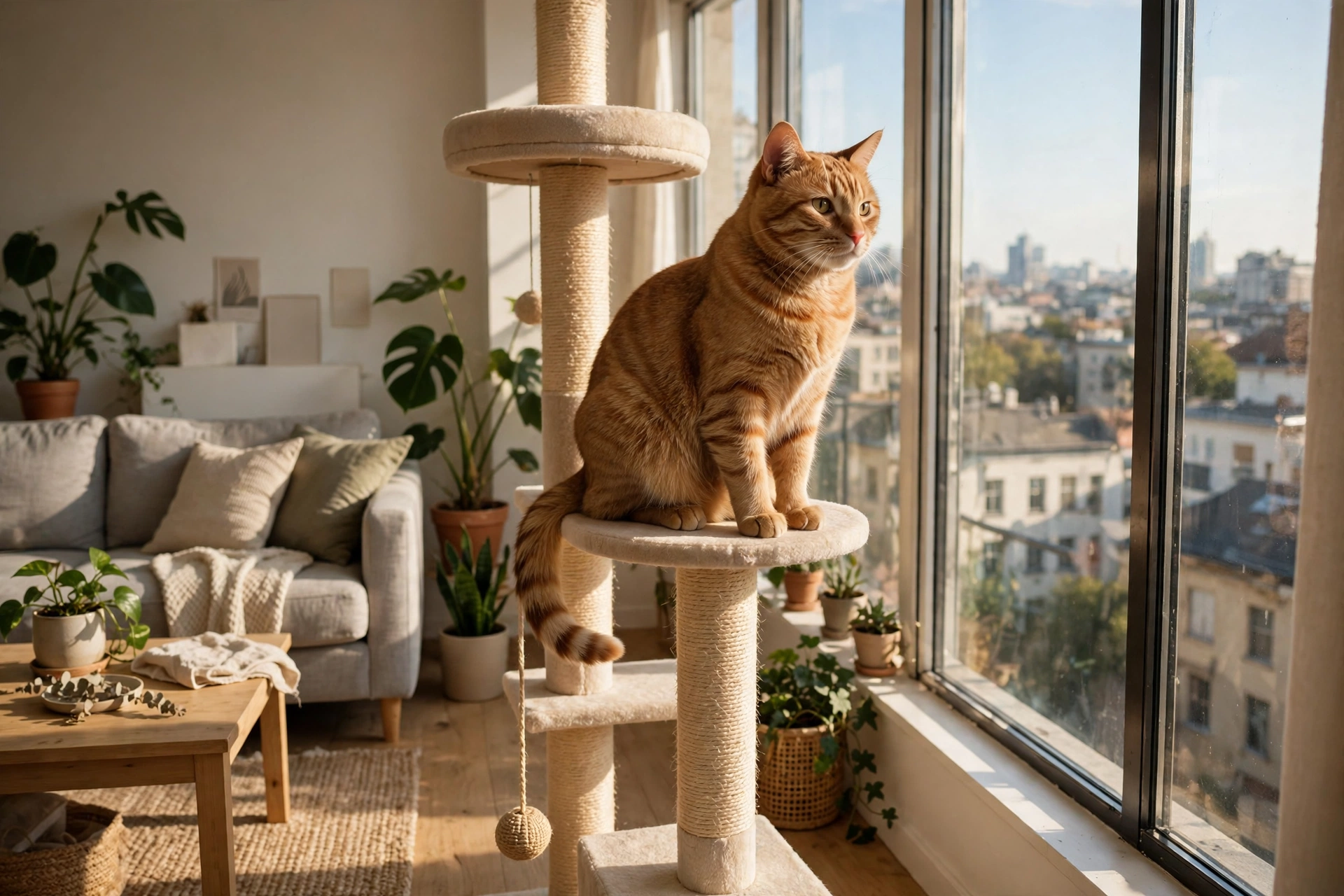
4. A tall, stable cat tree where people actually sit
If one change is made, this is the one. AAHA recommends vertical space such as cat trees or shelves, and VCA points to cat trees as spots for climbing, hiding, playing, and safe observation. Put the tree where the household spends time — beside the sofa or near the desk — because cats like to watch and be near their people. In a rental, a tall freestanding tree needs no drilling. Test it first: push the base with your own weight before the cat climbs it. A tree that wobbles is a tree the cat will not use twice.
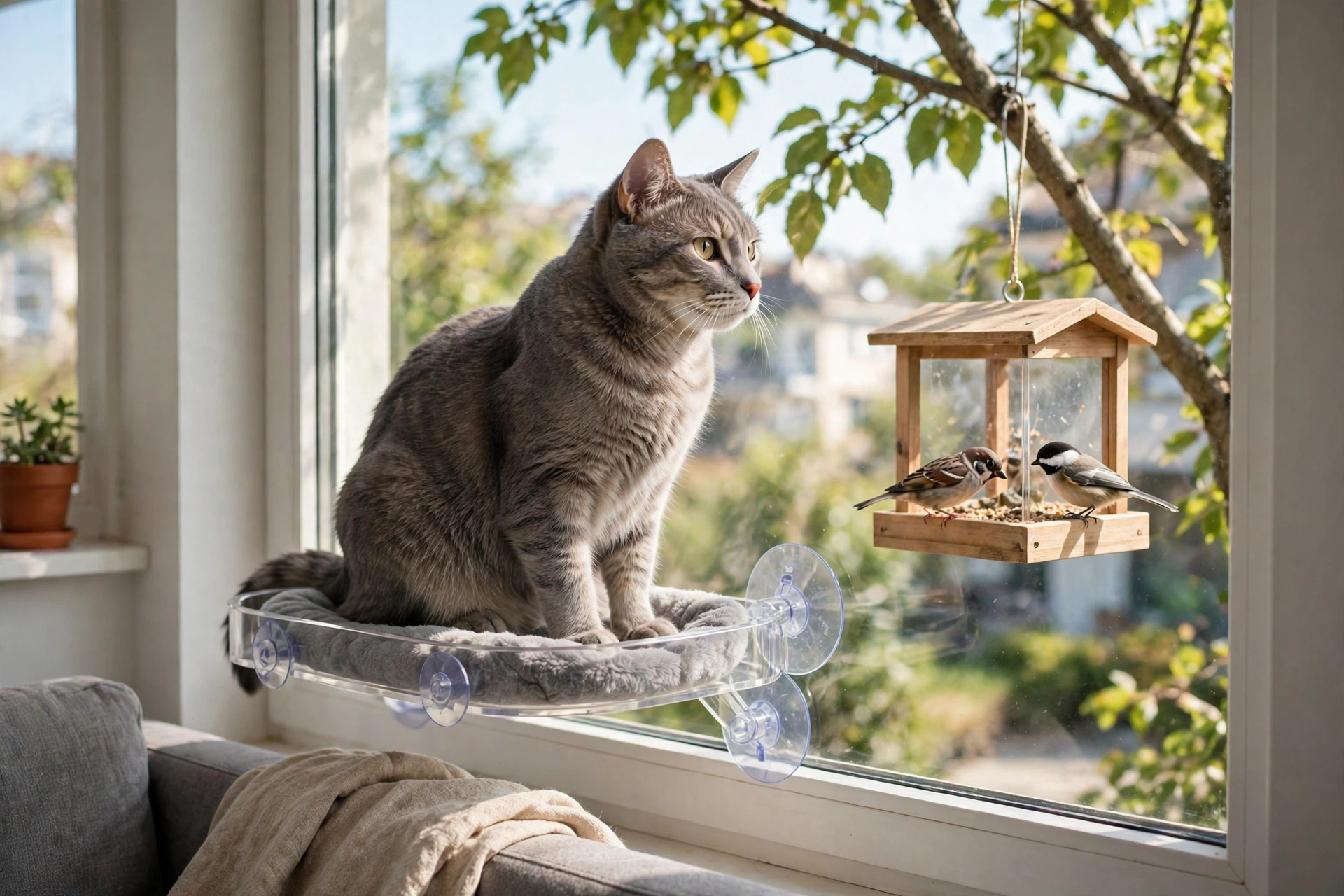
5. A window perch with something to watch
A window seat is the cheapest entertainment a cat can be given. The Ohio State University Indoor Pet Initiative lists window perches alongside scratching posts, daily play, toy rotation, and hidden treats. A suction-cup or sill-mounted perch needs no screws, and a bird feeder outside the window — if the building allows it — turns the view into a show. Keep the window securely closed when the cat is on the perch, and check the screen and latches first: a screen that holds against a breeze may not hold against a cat launching at a bird.
6. A cleared shelf or bookcase top as a lookout
A cat does not need a purpose-built shelf highway. Clear the top of one bookcase, or one shelf at head height, and put a folded blanket on it — that is a lookout post, and in a small apartment it is often the highest spot in the room. If the lease allows wall mounting, two or three staggered shelves make a climbing route; if not, a cleared wardrobe top reached from a sturdy chair does the same job. Keep breakables off any surface the cat can now reach.
Scratch — give the urge somewhere legal
7. A tall post by the main seating area
Scratching is a need, not a bad habit: the Ohio State initiative recommends posts in several locations, and cats often scratch after waking and near their sleeping spots. In a one-bedroom that usually means one tall post by the main seating area. It needs to be tall enough for a full stretch and heavy enough not to tip — a post that falls over once teaches the cat to use the sofa instead.
8. A cardboard scratcher by the nap spot
A flat cardboard scratcher costs very little, lies beside the cat’s favourite sleeping place, and doubles as a second station where there is room for only one tall post. Put it where the cat naps, because the first scratch of the day usually happens right after waking. When the cardboard is shredded, flip it over, then replace it. It marks no walls and leaves no holes.
9. Put the scratcher where the damage already is
If the cat scratches one corner of the sofa, move a scratching post to that exact corner, right against the arm the cat targets. Rub a little catnip on the post, and drape a washable throw over the sofa arm for a few weeks. The cat is not being naughty; it is marking a spot it has already chosen. Once the post is the easier option, the sofa usually gets left alone — the cheapest fix in the list, and the one most often skipped in favour of scolding, which does not work.
Hide — every cat needs a place nobody can reach
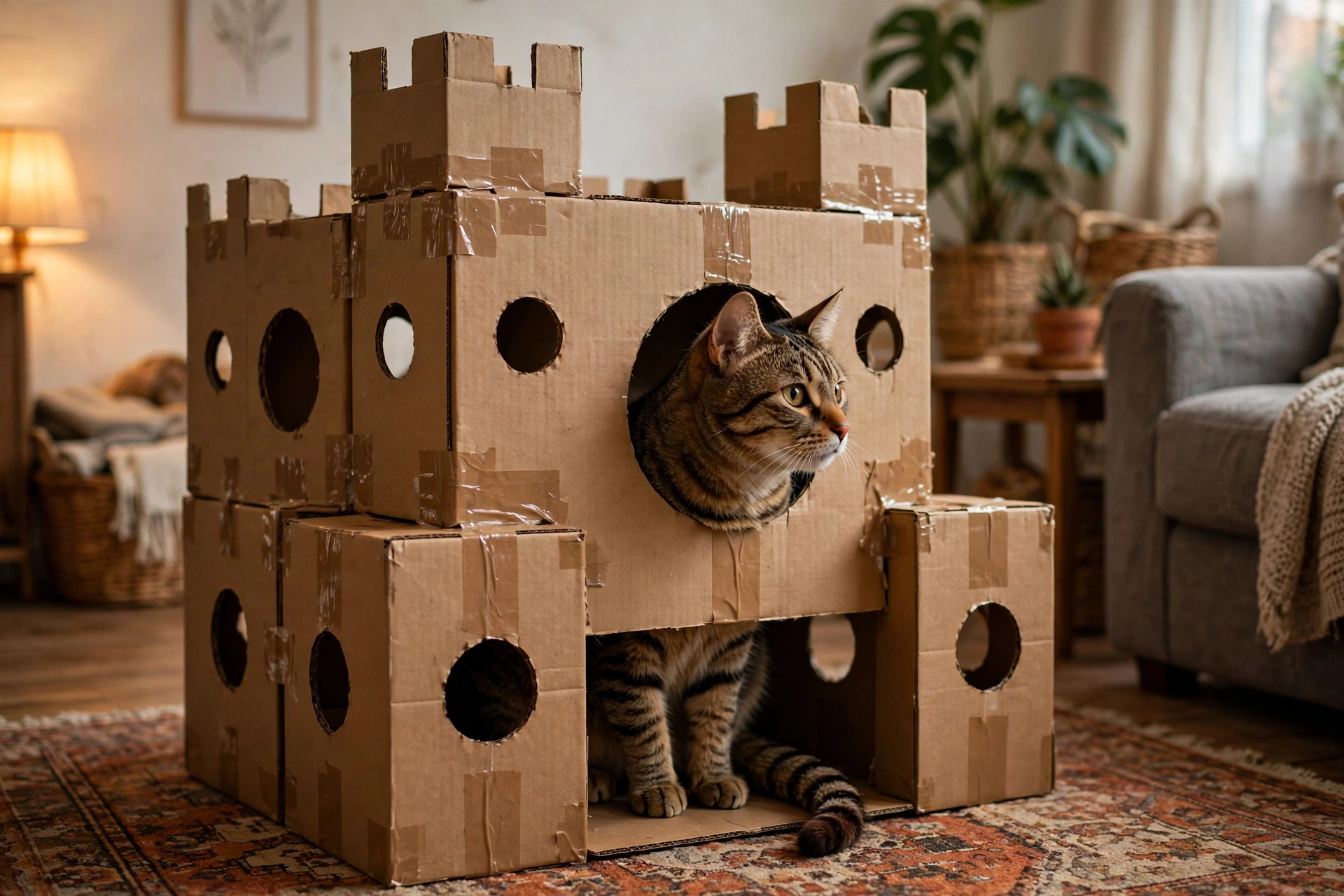
10. A cardboard box castle
Several boxes, a few holes in the sides, and tape make a hideout most cats prefer to any bought bed. Boxes are cheap, replaceable, and fold flat when guests come over. Cut two exits so the cat never feels cornered, and put a folded blanket inside. A cat that has somewhere to disappear to is a calmer cat in the rest of the home.
11. A paper-bag tunnel — with the handles cut off
A large paper grocery bag on its side becomes a tunnel, a hiding place, and a rustling toy in one. Cut the handles off first: a looped handle around a cat’s neck is a real strangulation risk, and it takes ten seconds to remove. The Ohio State initiative lists boxes and paper bags as hiding places; they suit a small apartment because they cost nothing and fold away. Never use a plastic bag — a cat can climb inside one and suffocate.
12. A covered bed in the quietest corner
Not every hiding place needs to be a game. A covered bed, or a box with a blanket draped over the entrance, gives the cat a place to sleep where nobody walks past. Put it in the quietest corner, away from the front door and the kitchen, and leave it alone: no reaching in, no lifting the blanket to check. A cat that can retreat properly comes out more, not less — and that matters most in a studio, where the cat cannot leave the room the owner is in.
Play and puzzle — keep it interesting for almost nothing
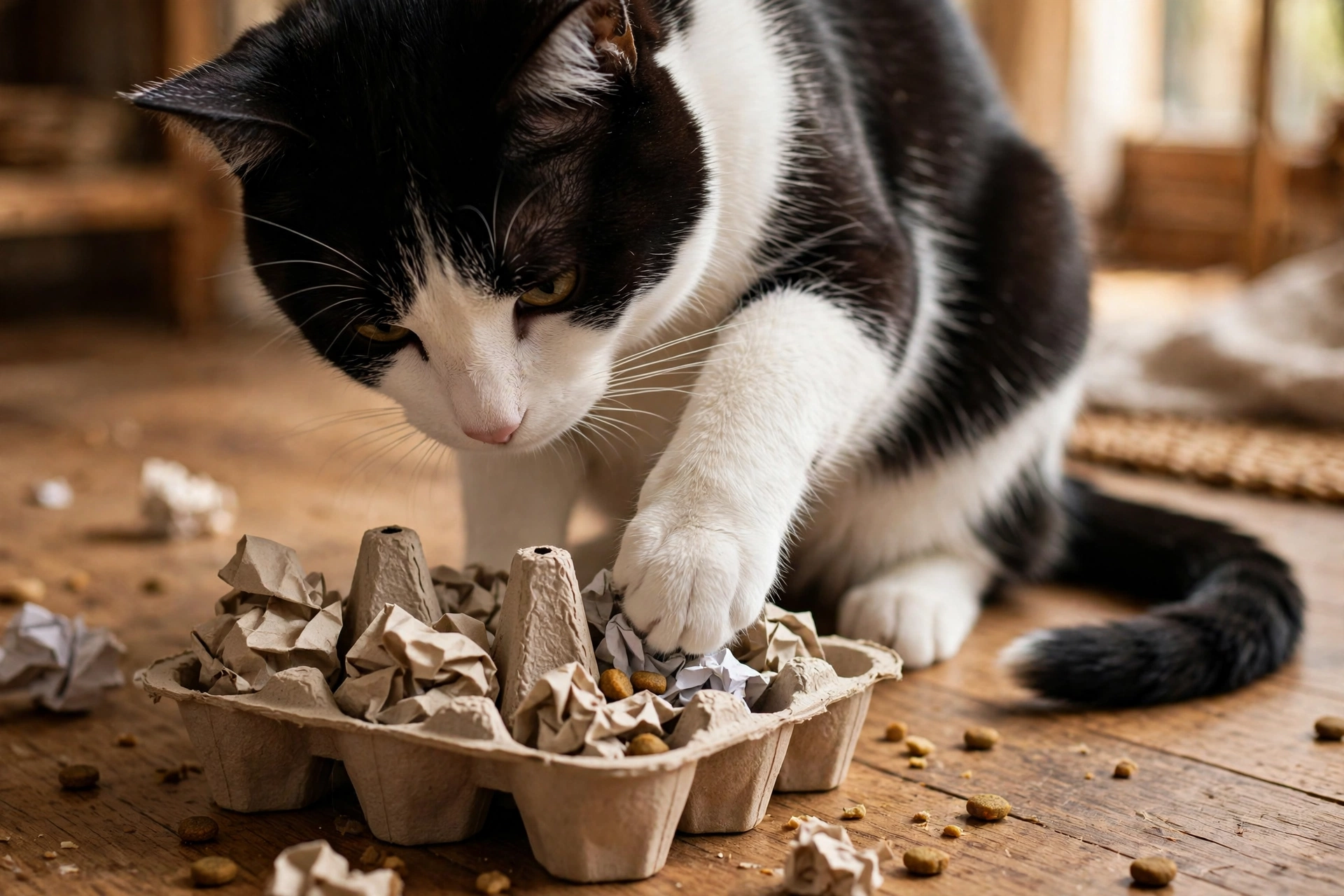
13. An egg-carton puzzle feeder
Put treats in the compartments of an empty egg carton and cover them with scrunched paper. The cat has to dig each one out. Same idea as the toilet-roll tube, but slower and messier — the point on a rainy evening. Start with the paper loose so the first treats are easy, then pack it tighter as the cat gets the idea. Use ordinary kibble, not extra treats, and replace the carton regularly.
14. Toy rotation: four or five out, the rest in a closet
A toy basket that is always open stops being interesting. Both the Ohio State initiative and the peer-reviewed enrichment review recommend rotating toys every few days: keep four or five out, store the rest in a closet, and swap them on laundry day. A toy that has been away for two weeks is a new toy when it comes back. Wadded-up paper, ping-pong balls, and plastic rings from milk jugs are often a cat’s favourites, according to Best Friends Animal Society; skip aluminium foil, which most cats dislike.
15. A bathtub ball pit for rainy days
On a restless day, drop a few ping-pong balls into a dry bathtub and let the cat chase them around the smooth surface. The peer-reviewed enrichment review lists balls in a box or bathtub as recommended play, and the enclosed space keeps the balls from disappearing under the sofa. Five minutes of this is often enough. Dry the tub first and keep the drain covered — never leave water in a tub a cat could fall into.
A 15-minute daily routine that fits a working day
Enrichment fails when it depends on a free afternoon. This routine takes about fifteen minutes: in the morning, scatter half the breakfast kibble or set out a puzzle feeder, and swap one toy from the rotation box. In the evening, one wand-play session after arriving home, ending with a treat, then put the wand away; a second short session before bed if the cat is still restless. Once a week, rotate the toys, check the posts, replace chewed cardboard, and move one hiding spot. Novelty is the enrichment; the same box in the same corner for a year is furniture. That is indoor cat enrichment for small apartments in its simplest form: a predictable day with a little hunting in it.
The safety rules most lists bury
Strings and ribbons. Never leave a wand toy, string, ribbon, yarn, or dental floss where a cat can reach it unsupervised. VCA explains why: swallowed thread can wrap around the tongue or anchor in the stomach, and as the gut moves it pleats the intestine like an accordion — a potentially life-threatening emergency that usually needs surgery. If a cat may have swallowed string, call a veterinarian at once, and never pull on a string sticking out of the cat.
Small parts and chewing. Before handing over any homemade toy, check for loose ribbon, staples, tape adhesive, or anything the cat could chew off and swallow. If a toy is coming apart, throw it away.
Plants. True lilies and daylilies are the one plant rule every cat owner should know: the FDA states the entire plant is toxic — stem, leaves, flowers, pollen, even the vase water — and a small amount can cause fatal kidney failure in less than three days. Check other plants against the ASPCA’s toxic and non-toxic plant list first. If a cat may have eaten part of a lily, call a veterinarian or the ASPCA Animal Poison Control Center at (888) 426-4435 immediately.
Windows and balconies. A window screen is not a safety barrier unless made for pets and properly latched. Never leave a cat unsupervised on a balcony, and an open balcony without netting or mesh is not safe — falls from height are a real risk in apartment blocks.
Laser pointers and glue. A laser is good exercise, but never the cat’s only play — finish with a real toy or treat the cat can grab, and never shine it into a cat’s eyes. If a DIY project uses glue or tape, let it dry fully, use non-toxic glue, and supervise the first few uses.
If hiding, withdrawal, lethargy, or litter-box changes continue, call a veterinarian — pain and illness can look like stress, and no enrichment idea fixes a medical problem.
Frequently asked questions
Do indoor cats really need enrichment, or is it just extra?
They need it. An indoor cat lives its whole life inside the owner’s four walls, and without things to hunt, climb, scratch, and hide in, those urges come out anyway — on the curtains, the furniture, or the owner’s ankles at 3 a.m.
How much play does an indoor cat need every day?
AAHA suggests about 15 to 20 minutes of interactive play a day, in two or three short sessions. Five focused minutes with a wand toy beats twenty minutes of a toy lying untouched on the floor.
My cat ignores every toy I buy. What now?
Try a different kind of toy before buying another one. Many cats ignore toys that do not move like prey, so a wand toy dragged away from the cat behind furniture often works where a ball does not. Try puzzle feeding, toy rotation, and play in the early morning and evening — and if a cat suddenly loses interest in play, call the vet, because unwell or stressed cats play less.
Is it cruel to keep a cat in a studio apartment?
Not if the apartment is set up for the cat. A cat measures a home in things to do, not square feet: height to climb, a window to watch, places to hide, something to hunt, and a predictable routine. If the cat hides constantly, will not eat, or shows litter-box changes that do not ease, that is a vet conversation, not a space problem.
A small apartment does not have to mean a small life for a cat. Pick one idea today — a puzzle feeder from a toilet roll takes two minutes — and add another next week. The cat will not notice the square footage — it will notice the shelf, the window, the box, and the ten minutes of play.