How to Cat-Proof Your Christmas Tree Before Your Cat Does It for You
It is 2 a.m., and the sound that wakes you is not the alarm. It is the sound of a Christmas tree falling over. Ornaments roll across the floor, the star lands under the sofa, water spreads from the stand, and in the middle of it all sits the cat, looking mildly surprised. Most of it is preventable — by building a tree setup that assumes the cat will climb it, bat at it, chew on it, and try to drink from it. This guide shows how to cat-proof your Christmas tree step by step — the base, the ornaments, the cords, the water, and the routine around it.
Why cats climb Christmas trees
To a cat, a Christmas tree is not a decoration. It is the tallest thing in the room, it smells like the outdoors, it moves when touched, and it is covered in small shiny objects that dangle at exactly batting height. Cats climb for height — a high spot is a safe spot, and a good vantage point for watching the room. Kittens are the worst offenders, but plenty of adults climb too, especially at night. None of this is bad behavior — it is a cat doing what cats do. The goal is not to win a battle with the cat, but to make the tree stable and safe enough that the cat’s interest does no damage.
1. Pick the right tree and the right spot
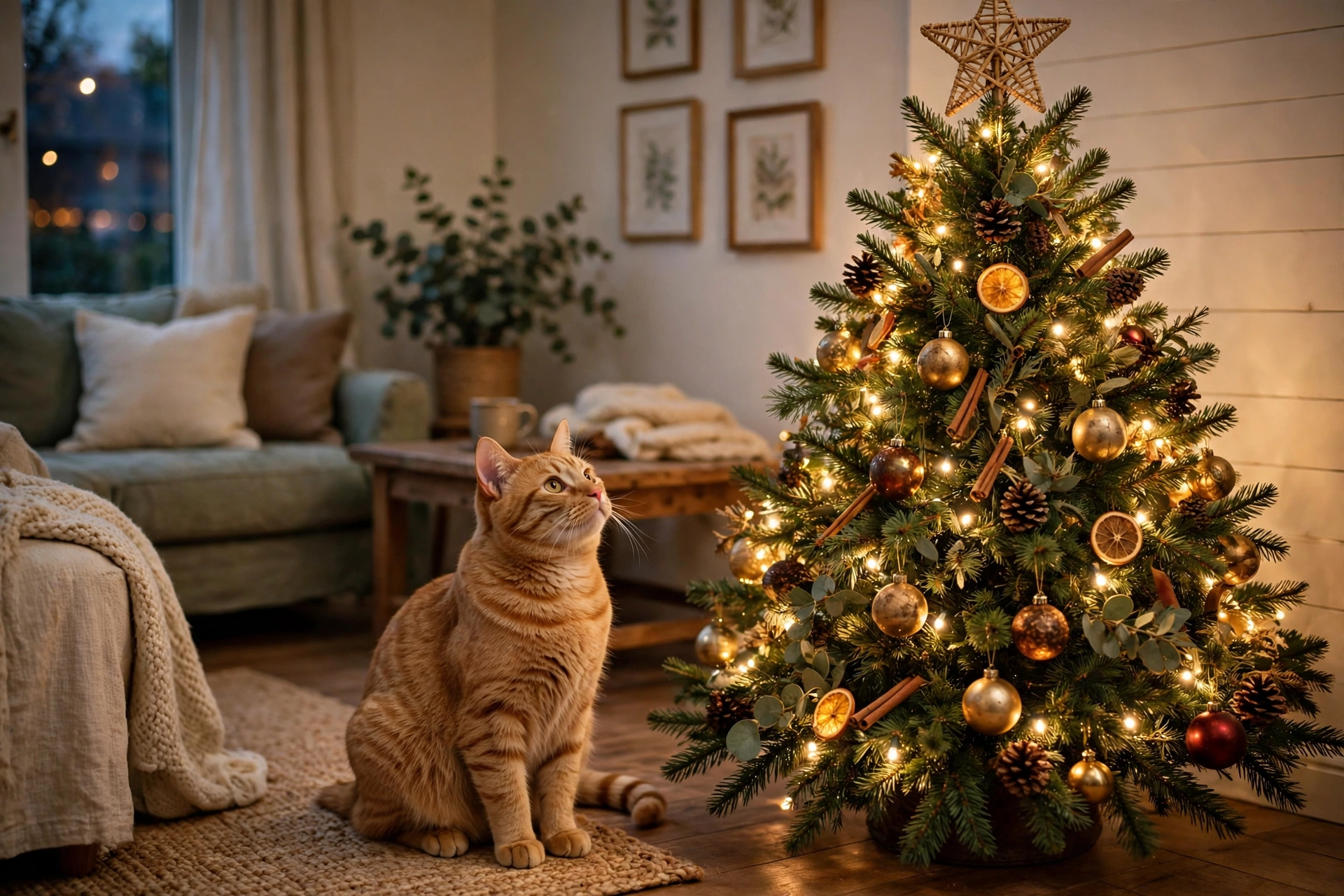
A smaller tree is a safer tree: a five-foot tree is much harder for a cat to topple than a seven-foot one. An artificial tree has an advantage — no pine needles to eat and no tree water to guard. A real tree is fine too, but needs more attention to water and needles, covered below.
A corner is better than the middle of a room: two walls limit the directions a cat can launch from, and one wall gives you something to anchor the tree to. Keep the tree away from sofas, shelves, and windowsills — anything the cat can use as a launchpad. If the only spot is near furniture, push it back a foot or two for December.
Let the tree stand bare for a day or two before decorating: the cat investigates it, gets bored, and moves on, and the ornaments get far less attention.
2. Secure it so it cannot topple
This is the most important step. A falling tree can injure a cat and break ornaments into sharp pieces. Assume the cat will climb to the top and lean out, and build for that.
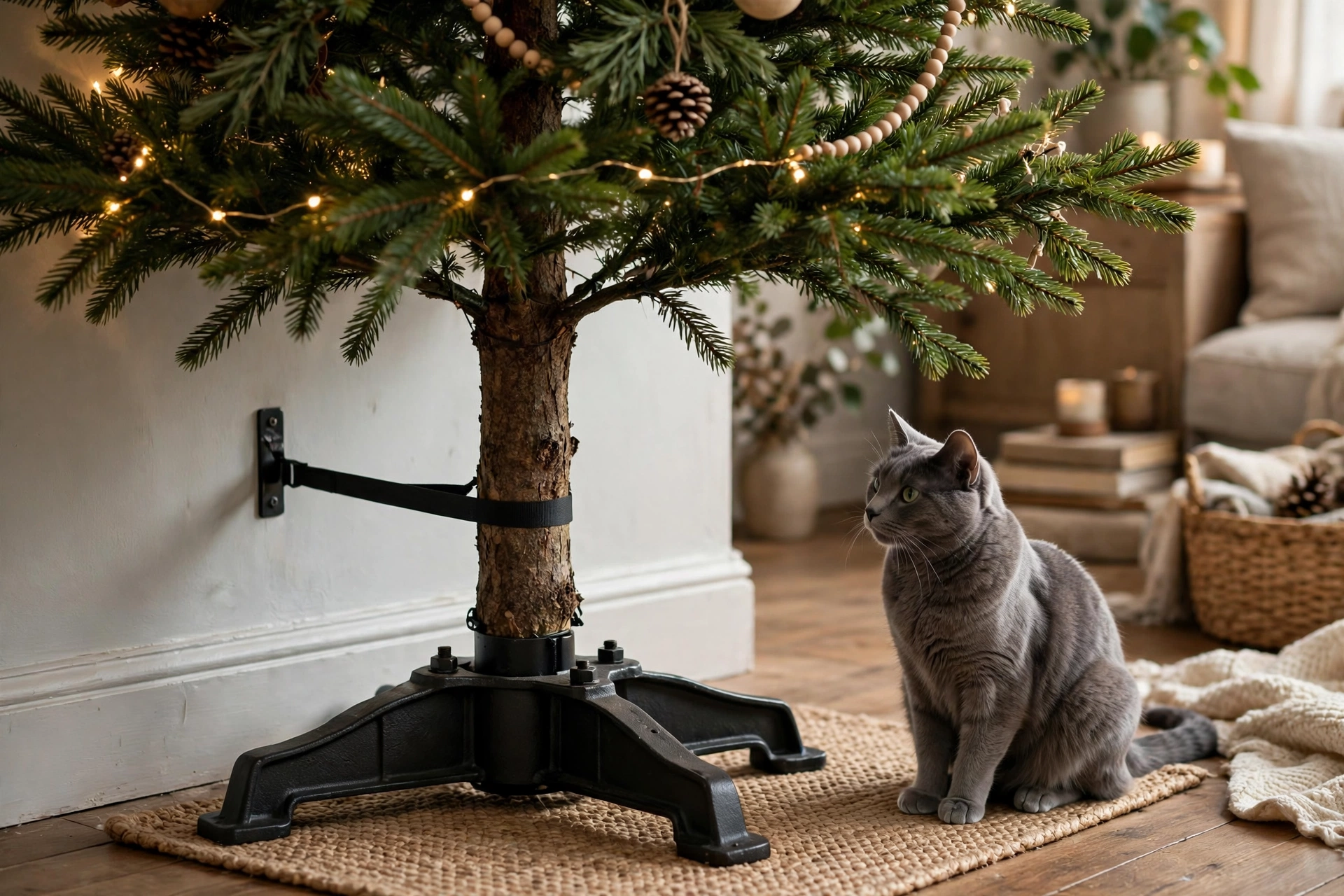
Use a heavy, wide stand. The light plastic stands sold with many trees are not enough for a cat household — a heavy cast-iron stand, or one weighed down with sandbags or bricks under a tree skirt, makes a real difference.
Then anchor the tree to the wall: screw a small hook into the wall stud behind the tree, about two-thirds of the way up, and run fishing line, twine, or a fabric strap from the trunk to the hook. Fishing line is nearly invisible; a strap is stronger. The tree should not move when you push it firmly at the top — if it wobbles, tighten the anchor or add a second line.
Keep the base skirted. A tree skirt hides the stand, the weights, and the water reservoir: a cat that cannot see the water is less likely to try drinking it, and one that cannot reach the anchor lines is less likely to chew them.
3. Ornaments: what goes where
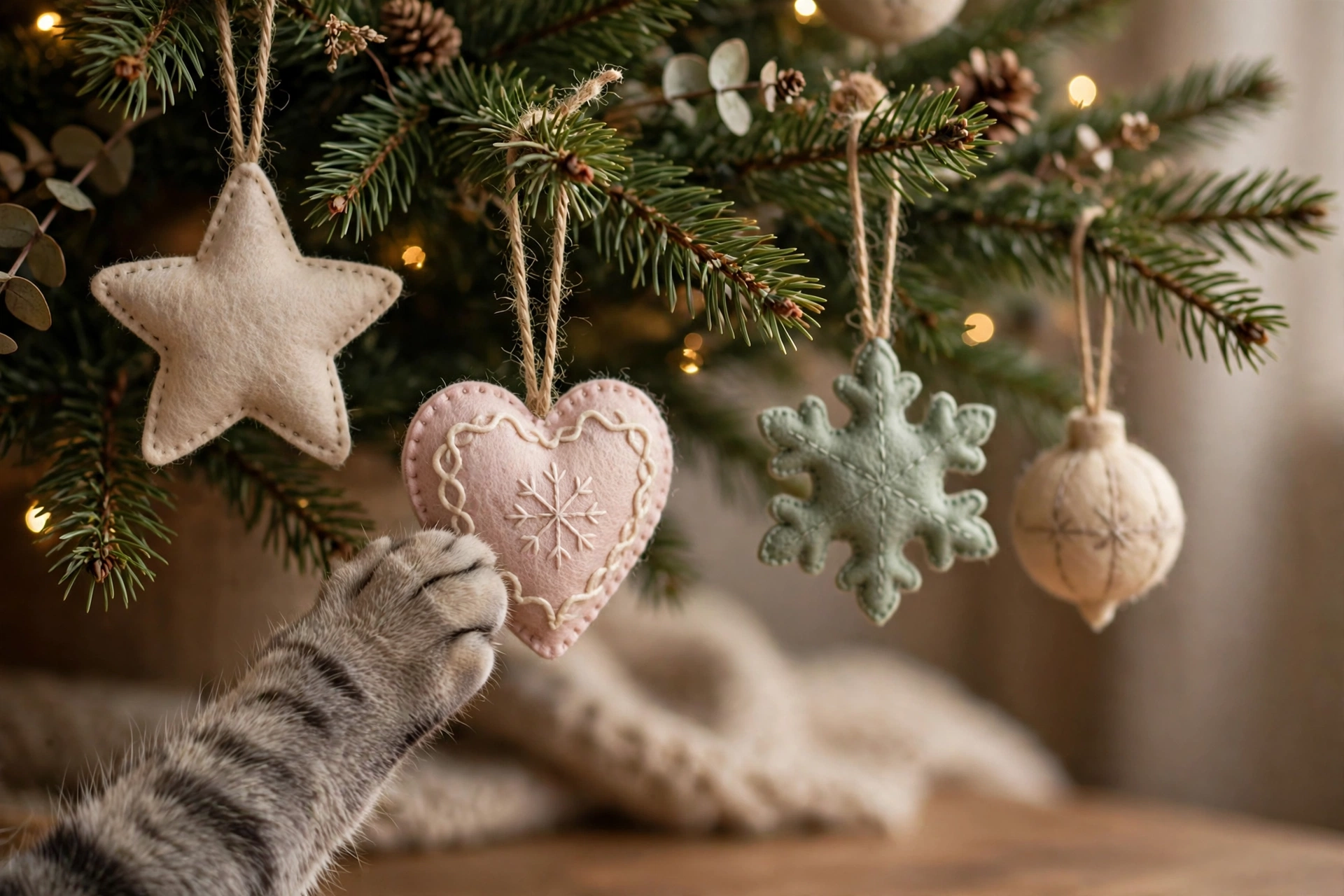
The rule is simple: anything breakable, valuable, or small enough to swallow goes high. Anything at the bottom of the tree should be soft, unbreakable, and boring to chew.
Hang shatterproof ornaments on the lower third — felt, fabric, wood, or plastic. Keep glass ornaments and heirlooms on the top half, well above the cat’s reach when standing on hind legs.
Skip thin wire ornament hooks: they bend open and slip off branches, and a cat that bats an ornament to the floor can end up with a hook in its mouth or paw. Tie ornaments on with short lengths of ribbon or twine wrapped firmly around the branch, or use ornament clips. Short ties matter — a long dangling loop is a string, and strings are the most dangerous thing on a tree.
Keep small ornaments off the tree entirely if the cat is a chewer: anything smaller than a golf ball can be a choking hazard or a blockage risk.
4. Lights and cords
The cords are the problem with lights: a cat that chews a live cord can get a burn in the mouth or an electric shock, and a tangled cord is a strangulation risk.
Use LED lights rather than old incandescent strings — LEDs run cool, so a cat that brushes against a bulb will not burn itself. Wrap the strings tightly around the branches rather than letting loops dangle. Run the cord to the outlet along the wall, not across open floor, and cover exposed cord with a hard cord protector or split tubing from a hardware store.
Turn the lights off when you leave the house and when you go to bed — a timer plug does it automatically. If the cat is unsupervised, the tree should be dark and unplugged. Battery-operated lights are a useful option for a small tree, since there is no mains cord to chew — just keep the battery compartment closed and out of reach, as button batteries are dangerous if swallowed.
5. Tinsel, ribbon, and garland: the one rule
If this guide has one non-negotiable rule, it is this: skip the tinsel. Tinsel, ribbon, and string garland are the most dangerous decorations on a tree.
A cat that swallows tinsel or ribbon can develop what vets call a linear foreign body: the string anchors somewhere in the gut while the rest travels on, and the intestines bunch up around it like fabric on a drawstring. It can cut off blood supply and tear the intestinal wall, and it usually needs surgery. PetMD lists it among the common intestinal blockages in cats.
A cat can swallow tinsel without anyone noticing. Cats love string, and a piece of tinsel on the tongue is hard to spit out — the tongue’s backward-facing barbs push it down the throat. By the time the cat is vomiting or off its food, the string may already be causing damage.
So the advice is simple. Do not put tinsel or ribbon garland on the tree. Do not leave gift ribbon, curling ribbon, or string anywhere the cat can reach it, including on presents under the tree. If a cat does swallow string, call a vet promptly — even if the cat seems fine. Do not wait to see what happens, and never pull a piece of string sticking out of the cat’s mouth or rear end, because pulling can cause serious internal injury.
If the tree looks bare without garland, use a wide fabric ribbon wrapped flat against the branches, or a garland of wooden beads.
6. Tree water: plain water, covered stand
A real tree drinks a lot of water, and a cat will try to drink from the stand. Tree water can be unsafe: it can contain pine sap from the cut trunk, bacteria growing in standing water, and anything added to it — fertilizers, preservatives, insecticides, or fire retardants. Catster’s veterinary guidance is to use plain water only and to cover the stand.
Use plain water, nothing added, and cover the reservoir with a tree skirt pulled tight. Check the water level daily — a full stand is also a heavier, more stable stand. A covered stand in a corner is much harder to drink from than an open one.
7. The plants and extras around the tree
Lilies are the real emergency. Every part of a true lily — petals, leaves, stem, pollen, even the water in the vase — can cause acute kidney failure in cats, according to the U.S. Food and Drug Administration. If a cat has chewed a lily or licked pollen off its fur, that is a veterinary emergency. The safest choice is not to bring lilies into a house with a cat.
Poinsettias are the opposite of what most people think: only mildly toxic. The milky sap irritates the mouth and stomach, and a cat that chews one may drool or vomit, but the effects are generally self-limiting, according to the Pet Poison Helpline. Still, put poinsettias up high or skip them.
Holly and mistletoe are toxic to cats, and yew — sometimes used in wreaths — is genuinely dangerous. Keep wreaths and garlands out of reach or choose artificial ones. Keep chocolate, sweets, and gift ribbon out from under the tree: a cat that opens a present is usually after the ribbon, not the gift.
The ASPCA Animal Poison Control Center can be reached at (888) 426-4435. Save the number in your phone now, before the holidays, rather than searching for it in a panic.
8. Keep the routine, and give them something better to climb
A bored cat climbs the Christmas tree. A cat that has just played, eaten, and napped looks at the tree and decides it is not worth the effort.
Keep the cat’s routine the same through December: same feeding times, same playtimes, same sleeping spots. The house is changing in December, and routine keeps a cat calm. Add a play session in the early evening, so the cat is tired when the tree is most tempting.
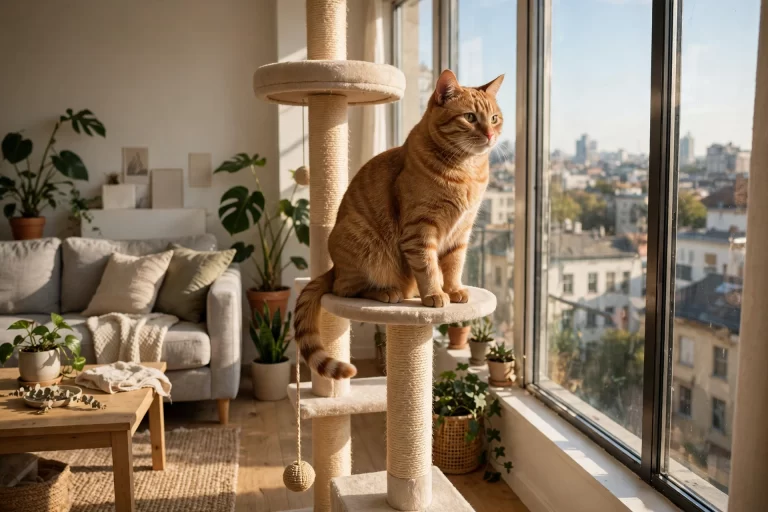
Give the cat a legal alternative. A tall cat tree or a window perch near the Christmas tree works better than one in another room, because the cat wants to be where the action is. A few treats placed on the cat tree the first few days help the cat discover it.
If the cat does climb the tree, stay calm. Do not shout, chase, or spray — a frightened cat in a tree is more likely to fall or knock the tree over. Wait for the cat to come down, or lure it down with a treat or a toy, then fix whatever let the climb happen.
Deterrents like citrus spray or foil around the base are passed around online every December, and results vary from cat to cat. None of them replaces the steps above: a secured tree with safe ornaments beats a sprayed tree every time.
9. The alternative: a cat-safe mini tree
For some households, a full-size tree and a determined cat do not mix — a kitten’s first Christmas, several young cats, or a cat that has already brought the tree down twice. The alternative is a small tree of the cat’s own.
A tabletop tree, two or three feet tall, decorated with felt ornaments and battery lights, gives the household a tree without giving the cat a climbing frame. Put it on a sturdy table the cat cannot easily reach, or in a room with a door that closes when the cat is unsupervised. The cat gets to look, the tree stays upright, and nobody is up at 2 a.m. picking ornaments off the floor.

10. When it happens anyway
Even a well-proofed tree can come down. If it happens, check the cat first, then the room. Look for broken glass before walking through in bare feet, and keep the cat out while you clean up. Check the cat for cuts, anything in its mouth, and signs of distress — hiding, not eating, vomiting, or straining in the litter box. If you find a chewed cord, unplug the lights before touching anything. If the cat swallowed tinsel, ribbon, or an ornament, or chewed a lily, call a vet promptly and say exactly what happened.
Then fix the weak point before the tree goes back up: a heavier stand, a tighter anchor, ornaments moved higher, or the tree moved to a corner.
Frequently asked questions
Can I put a Christmas tree up with a cat in the house?
Yes. Millions of cat owners put up trees every year. The tree needs to be secured so it cannot topple, the lower ornaments need to be shatterproof, the cords covered, and tinsel and ribbon skipped. That is how to cat-proof your Christmas tree: a normal tree with a few deliberate choices.
How do I keep my cat from climbing the Christmas tree?
You cannot reliably train a cat not to climb a tree, but you can make the tree less attractive: put it in a corner away from launchpad furniture, let it stand bare for a day or two so the novelty wears off, keep the cat’s routine steady, and give the cat a tall cat tree or window perch nearby. A tired cat with a legal high spot is much less interested in the tree.
Is tinsel really dangerous for cats?
Yes. A swallowed length of tinsel or ribbon can cause a linear foreign body, where the intestines bunch up around the string and can tear. It usually needs surgery. The safest choice is to skip tinsel and ribbon garland entirely, and to call a vet promptly if a cat swallows string — never pull a visible string out yourself.
Are poinsettias poisonous to cats?
Only mildly. The milky sap can irritate the mouth and stomach, and a cat that chews one may drool or vomit, but the effects are generally self-limiting, according to the Pet Poison Helpline. Lilies are the real danger — every part of a true lily can cause acute kidney failure, and a cat that has chewed one needs a vet right away.
What should I do if my cat knocks the Christmas tree over?
Check the cat first, then the room. Keep the cat away from broken glass while you clean up, and look for cuts or anything stuck in its mouth. If the cat swallowed tinsel, ribbon, or an ornament, or chewed a lily, call a vet promptly. Before the tree goes back up, fix whatever failed.
A cat-proof Christmas tree is not a perfect tree. It is a tree that survives December with the cat healthy, the ornaments mostly intact. Secure the base, keep the bottom soft, hide the cords, skip the tinsel, and give the cat something better to climb. Then enjoy the tree — the cat already is.