50 Grey Cat Names for a Cat Who Wears Silver
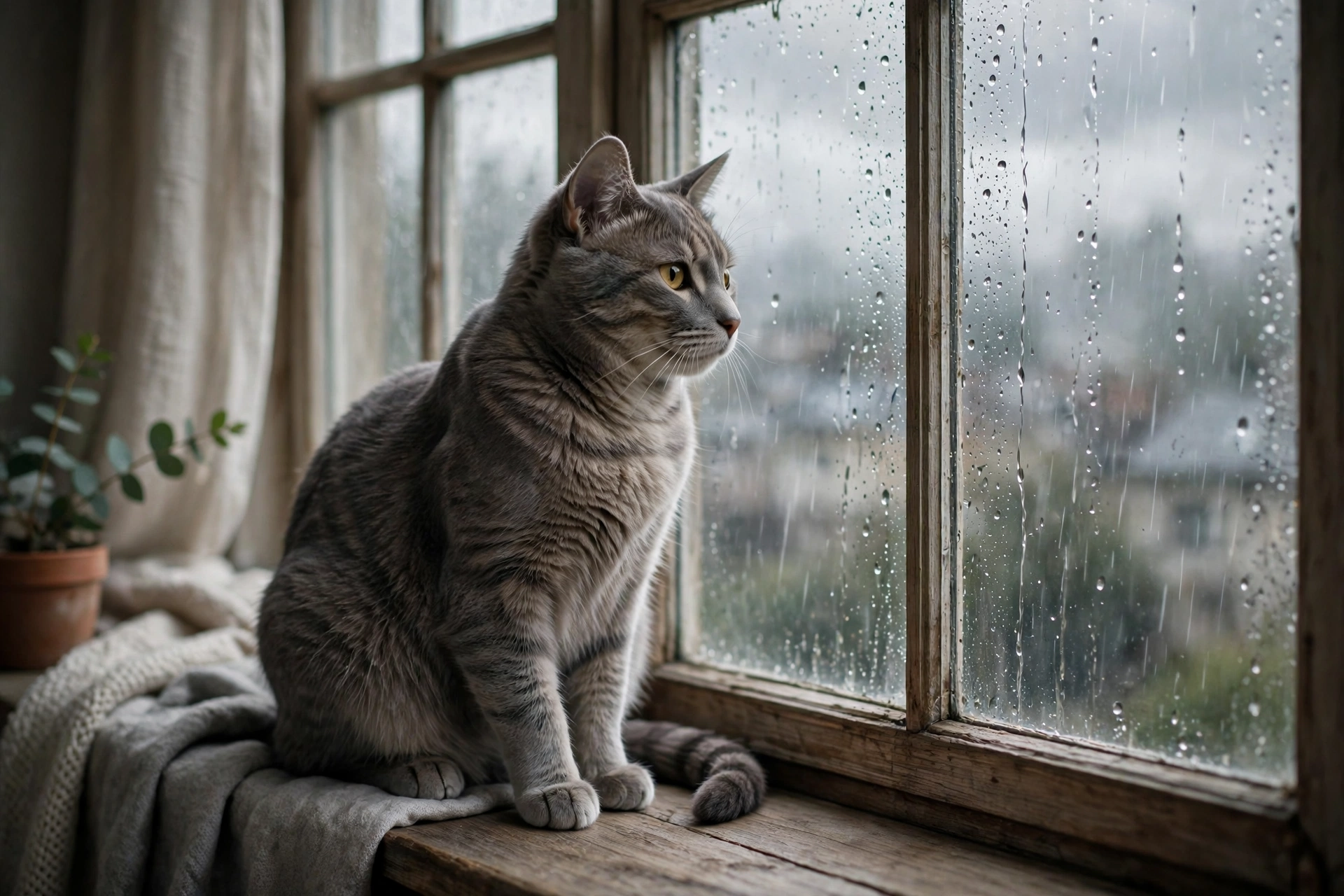
There is a particular kind of morning light that belongs to grey cats. Rain on the window, a silver-grey cat on the sill, and a coat that changes colour as the light moves across it — silver at the edges, charcoal in the folds, blue-grey in the shade. Grey is not one colour on a cat. It is a whole weather system. That is what makes naming one so satisfying, and so difficult. A plain name slides right off a coat like that. These fifty grey cat names do not: words for grey from ten languages, weather, stone, storybook cats, and the moon.
What makes a grey cat grey
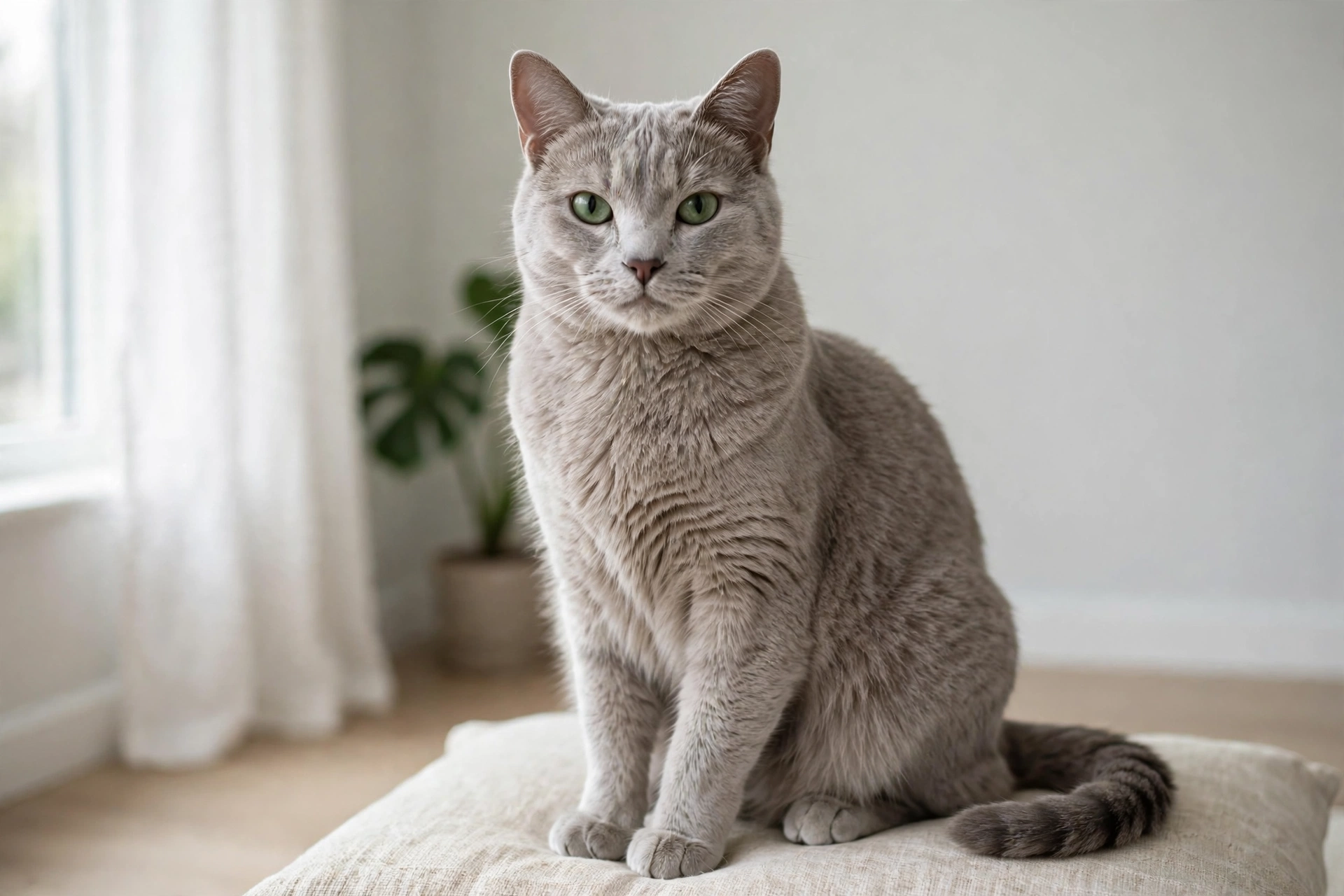
First, the fact that surprises most people: a grey cat is not a breed. Grey is a colour, and it can turn up on almost any breed — and on ordinary shelter cats too. Breeders call a solid grey coat “blue”, which is why the most famous grey of all is the “British blue”. The grey itself comes from the dilution gene: black pigment diluted is grey. The University of California, Davis Veterinary Genetics Laboratory puts it plainly — black pigment diluted is grey, and red diluted is cream. Some breeds are fixed for that dilution and come in grey alone: the Russian Blue, the Chartreux, the Korat and the Nebelung. Others, like the British Shorthair, come in grey among many colours.
Most grey cats are not solid grey at all. Many are grey tabbies, with the tabby pattern showing through the grey in darker stripes — the “M” on the forehead, the rings on the tail. A grey kitten’s coat can also change as it grows, lightening in summer and darkening in winter, so a name that suits a pale silver kitten may suit a darker adult even better.
One thing the colour does not do is decide the personality. There is no peer-reviewed evidence that coat colour drives personality, and grey cats are as varied as any others — some aloof, some clingy, some chatty, some silent. Judge the cat in front of you, not the coat.
Grey cats often have striking eyes, and the combination is part of the appeal. Green eyes are the classic pairing for a solid grey coat — the Russian Blue is known for vivid green eyes — while the British blue is known for copper or deep gold eyes. A grey tabby may have green, gold, or hazel eyes. The eye colour does not change the name, but it can sharpen it: a green-eyed grey cat suits Mist or Selene; a copper-eyed one suits Slate or Sery.
Words that mean grey
Grey has a word in every language, and some of them make better cat names than the English word does. Every meaning below is verified — real words for grey, not guesses.
Gris — French (and Spanish) for “grey”. Short, elegant, and the most natural grey name there is.
Grau — German for “grey”. Strong and single-syllabled — a name that sounds like the cat it belongs to.
Grigio — Italian for “grey”. Softer than Gris, with a musical ending.
Cinza — Portuguese for “grey” — and also the word for ash. A warm name for a warm grey cat.
Harmaa — Finnish for “grey”. Unusual in English, and it suits a cat with a pale, almost silver coat.
Liath — Irish and Scottish Gaelic for “grey”, pronounced roughly “LEE-ah”. A gentle name for a gentle cat.
Llwyd — Welsh for “grey”, pronounced roughly “LLOO-id”. Short, old, and distinctive.
Szary — Polish for “grey”, pronounced roughly “SHA-ri”. A name nobody else at the vet will have.
Sery — Russian for “grey”, from серый, pronounced roughly “SYE-ree”. A quiet, serious name for a quiet, serious cat.
Haiiro — Japanese for “grey”, from 灰色, “ash colour”, pronounced roughly “HAH-ee-roh”. The longest name on this list, and the most poetic.
Weather and sky
A grey cat’s coat is the colour of weather — rain, mist, cloud, dusk. These names borrow from the sky the coat already belongs to.
Mist — the word itself. For a pale grey cat who appears and disappears around the house.
Fog — the word itself. A heavier name than Mist, for a darker grey cat.
Cloud — the word itself. Soft, white-grey, and always moving.
Rain — the word itself. Grey skies, grey coat — the simplest weather name there is.
Haze — the word itself. A soft, blurred grey, for a cat whose coat has no hard edges.
Dusk — the word itself. The grey hour between day and night.
Thunder — the word itself. Dark grey skies, and a name for a cat with a big personality.
Frost — the word itself. Pale grey-white, for a silver-coated cat.
Sleet — the word itself. Cold, grey, and quick — a name for a fast, sharp cat.
Drizzle — the word itself. Light grey rain, and a sweet name for a small grey kitten.
Stone, metal and silver
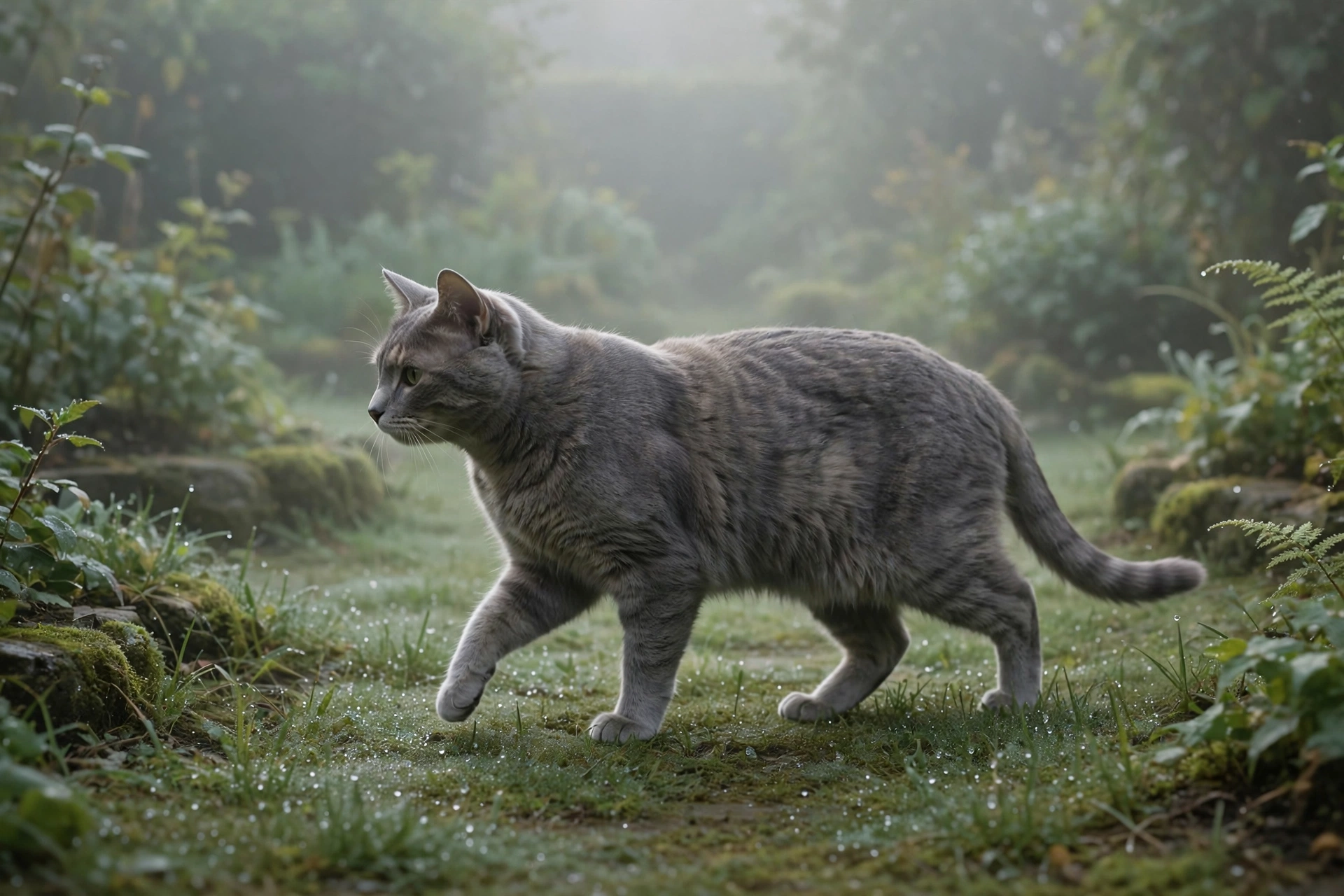
Grey is also the colour of stone and metal — the hardest, oldest grey things there are. These names are solid, and they suit a solid cat.
Slate — the word itself. Dark blue-grey stone, and one of the best grey cat names there is.
Flint — the word itself. Grey stone that sparks — a name for a cat with a sharp streak.
Granite — the word itself. Speckled grey stone, and a strong name for a big grey cat.
Pewter — the word itself. A soft grey metal, duller than silver and warmer than steel.
Steel — the word itself. Cool, hard grey — a name for a cat who does not fuss.
Silver — the word itself. The lightest grey, and the most elegant name on this list.
Platinum — the word itself. Paler than silver, rarer than silver — a name for a very pale grey cat.
Nickel — the word itself. A grey-white metal, and a small, bright name.
Charcoal — the word itself. The darkest grey there is, for the darkest grey cat.
Graphite — the word itself. The grey of a pencil lead, smooth and dark.
Grey cats of story and myth
Grey cats have been turning up in stories for centuries — and grey wizards, grey-eyed goddesses and grey-bearded gods beside them. These ten names come from the ones the world already knows.
Cheshire — the Cheshire Cat of Lewis Carroll’s Alice’s Adventures in Wonderland, drawn grey-striped in John Tenniel’s original 1865 illustrations.
Graymalkin — the grey cat, the first witch’s familiar in Shakespeare’s Macbeth, who calls out “I come, Graymalkin!”
Norris — Mrs. Norris, Argus Filch’s dusty-grey cat, who patrols the corridors of Hogwarts in Harry Potter.
Greebo — Nanny Ogg’s huge, battle-scarred, mottled grey tomcat in Terry Pratchett’s Discworld novels.
Berlioz — the grey-furred kitten in Disney’s The Aristocats (1970), named after the French composer Hector Berlioz.
Tom — the blue-grey cat of Tom & Jerry, the most famous grey cat on screen.
Gandalf — “Gandalf the Grey”, the wizard of The Lord of the Rings.
Merlin — the grey-bearded wizard of Arthurian legend.
Athena — the grey-eyed goddess of Greek myth; Homer calls her “grey-eyed Athena”.
Odin — the grey-bearded All-Father of Norse myth, who gave an eye for wisdom.
Moon and silver
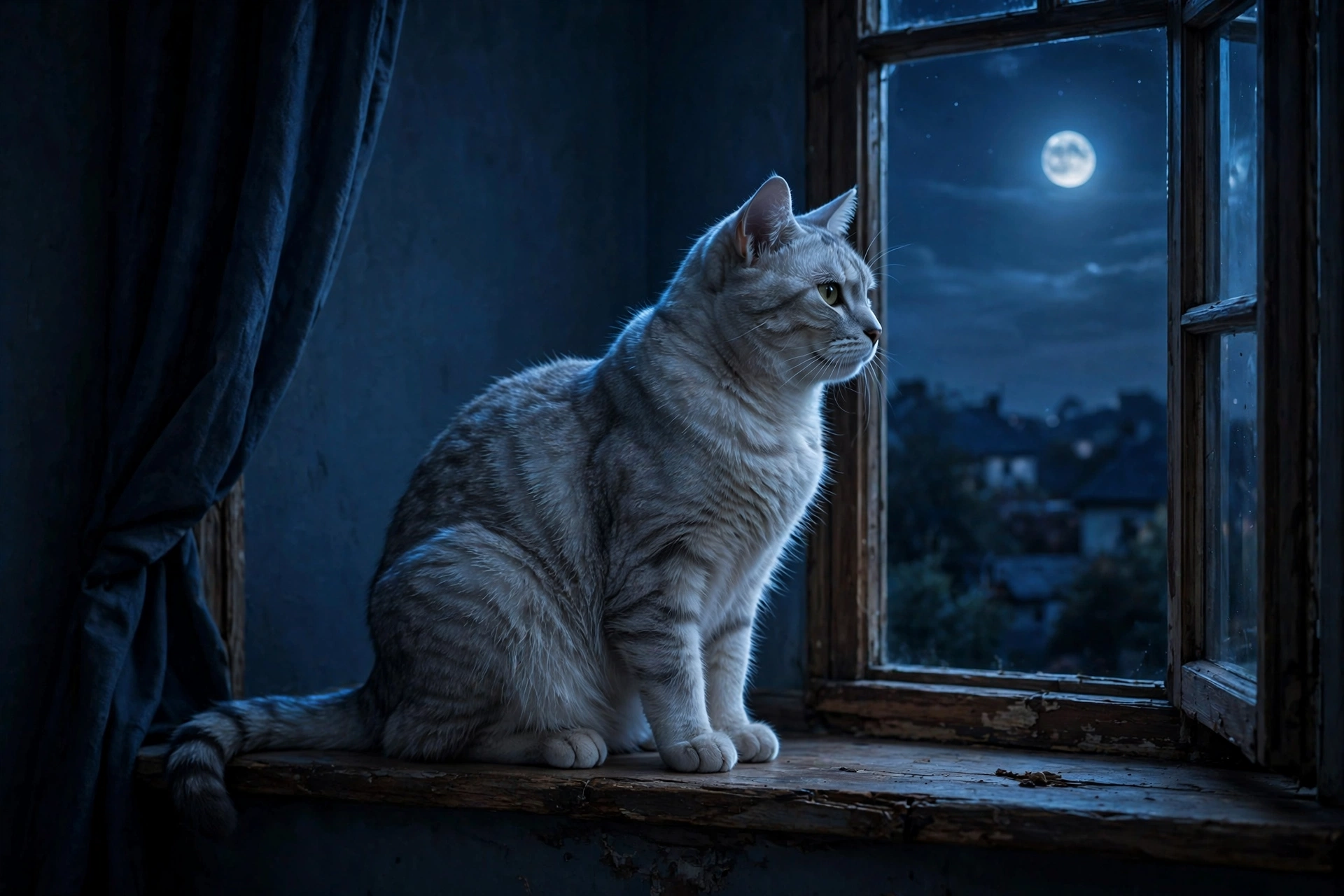
The moon is silver, and silver is grey. These names borrow from the night sky — the moon, the stars, and the dawn.
Moon — the word itself. The silver disc in the night sky, and a calm name for a calm cat.
Selene — Greek for “moon”, and the name of the Greek moon goddess, a Titan.
Artemis — the Greek goddess of the moon, who carries a silver bow.
Diana — the Roman goddess of the moon.
Phoebe — a Titan associated with the moon, and grandmother of Artemis.
Cynthia — an epithet of Artemis, from Mount Cynthus, where she was born.
Astra — Greek for “star”.
Lyra — the constellation of the lyre, a small harp of stars.
Vega — the brightest star in Lyra.
Aurora — the Roman goddess of the dawn, when the sky turns grey and pink.
Match the name to the shade
Not every grey is the same grey, and the best name fits the shade in front of you. A pale silver cat and a dark charcoal cat are different cats to name.
Pale silver coats. If your cat is almost white-silver — the palest grey there is — look at Silver, Platinum, Mist, Moon, Frost, and Haiiro. These are light names for a light coat, and they sound as soft as the cat looks.
Blue-grey coats. The classic grey — the Russian Blue shade, the British blue — sits in the middle: not pale, not dark, with a cool blue undertone. Slate, Steel, Grigio, Liath, and Graphite fit here, along with Gris and Grau.
Dark charcoal coats. If your cat is the darkest grey, nearly black in dim light, go darker: Charcoal, Thunder, Flint, Sery, and Fog. These names have weight, and a dark grey cat can carry them.
Then run the survivors through two quick tests. Say the name out loud, ten times, the way you would call the cat in from the garden — if it feels silly on the tenth try, it will feel worse on the hundredth. And say it the way you would say it to a vet receptionist: “This is Slate, here for his check-up” should sound like a cat’s name, not a joke you have to explain. The name you enjoy saying is the one the cat will learn fastest, because cats learn a name by hearing it attached to food, play, and attention.
Why grey cats photograph so well
Grey is a photographer’s colour. A grey coat reflects light evenly, so the texture of the fur shows in a photograph where a black coat would swallow the detail and a white coat would blow out to pure white. Grey works against almost any background — a pale wall, a dark sofa, green grass, a grey sky — which is why grey cats fill so many Pinterest boards. If the cat in the photographs is yours, the name on the caption matters as much as the picture: a name like Silver or Moon reads as well in a caption as it sounds across the room.
Frequently asked questions
Is grey a breed?
No. Grey is a colour, not a breed. The same grey coat can appear on many breeds — the Russian Blue, the British Shorthair, the Chartreux, the Korat and the Nebelung are all grey breeds — but most grey cats are ordinary domestic cats with no paperwork at all.
Why do breeders call grey cats “blue”?
“Blue” is the breeder’s word for a solid grey coat. The most famous example is the “British blue” — the grey form of the British Shorthair. A blue-grey cat and a grey cat are the same thing; only the word changes.
Are grey cats rare?
No. Grey is one of the most common cat colours, in pedigree cats and shelter cats alike. A solid grey coat is less common than a grey tabby — most grey cats carry some tabby striping — but a grey cat is never hard to find.
Do grey cats have a specific personality?
No. There is no peer-reviewed evidence that coat colour decides personality, and grey cats are as varied as any others — some aloof, some clingy, some chatty, some silent. Judge the cat in front of you, not the coat.
What is a good name for a grey kitten?
Short names work best: Mist, Gris, Slate, Moon and Tom are all easy to call and easy for a cat to learn. A kitten’s coat can also change as it grows, so pick a name that will suit the adult cat too — a pale silver kitten may darken, and a dark charcoal kitten may lighten.
A grey cat does not need a loud name. The coat is quiet, and the best names for it are quiet too — a word for grey, a piece of weather, a stone, a story, a moon. Say them out loud, and keep the one you enjoy saying. It is the one the cat will hear most, attached to food, play, and attention.