The Maine Coon Chirps Instead of Meowing — and Takes Four Years to Grow Up
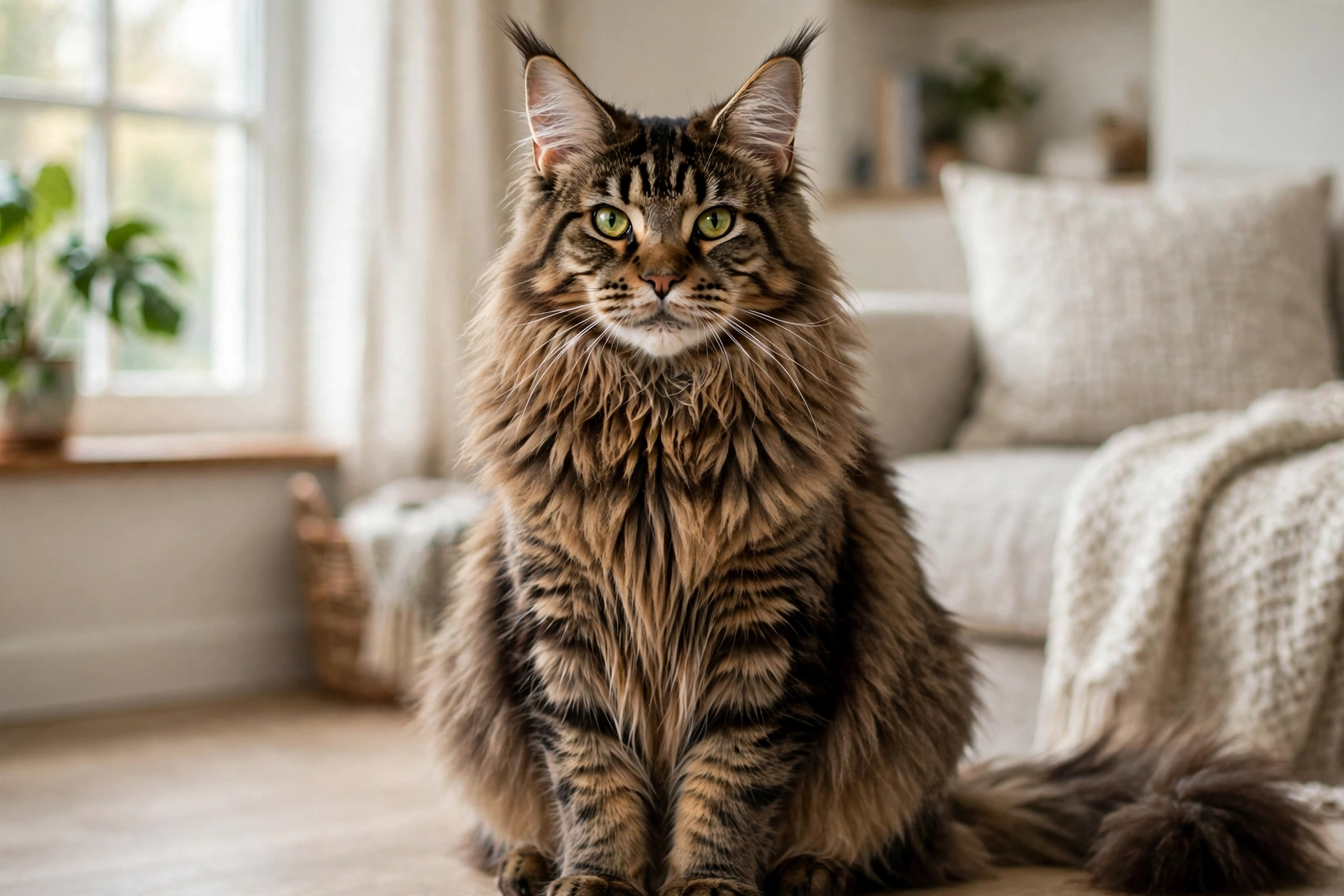
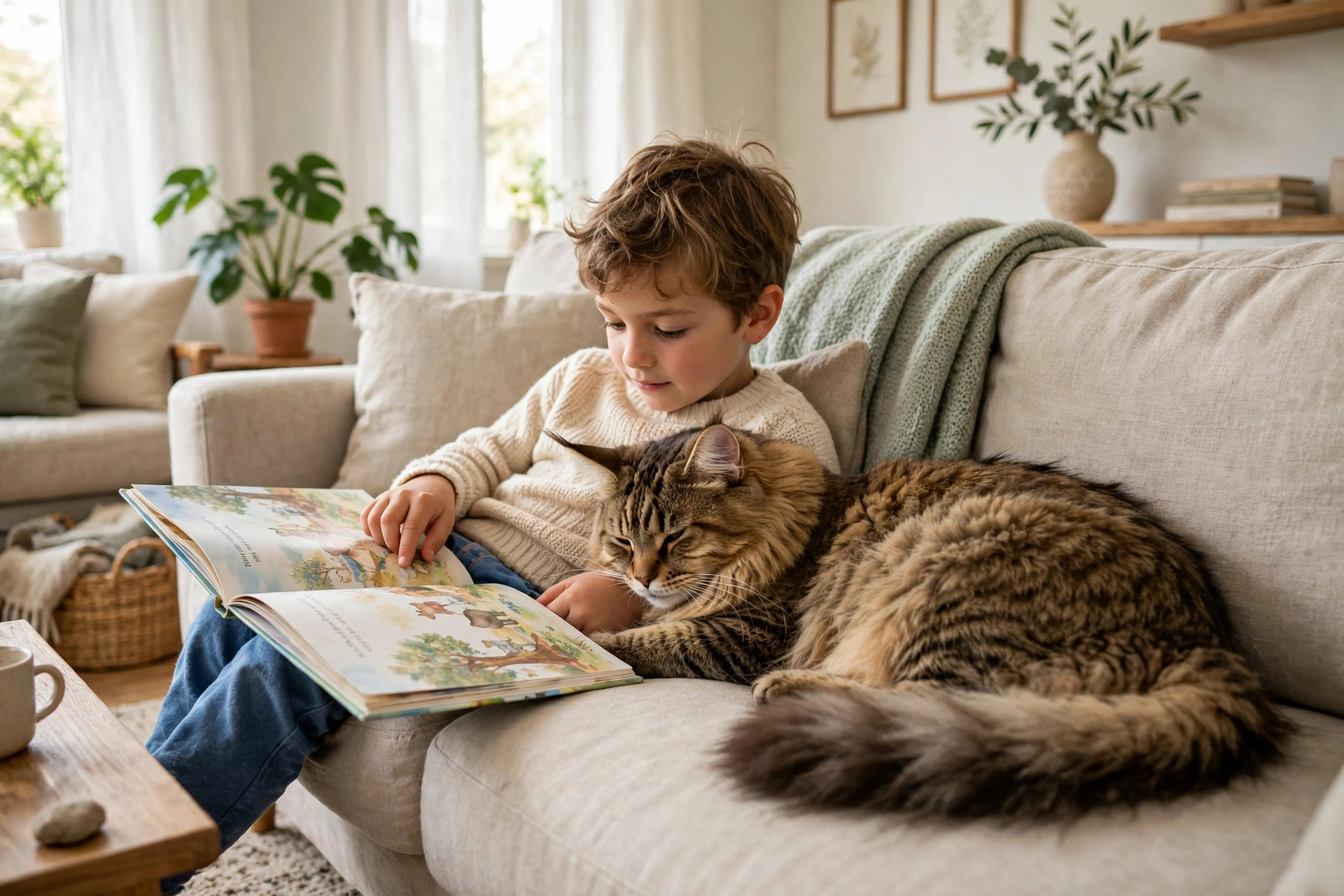
The dog bed is empty, and so is the cat bed. The Maine Coon is asleep on the sofa, stretched out impossibly long, with a feather-duster tail and a lion’s-mane ruff. It weighs as much as a small dog, follows you like a dog, and plays fetch like a dog — and then it opens its mouth and makes a sound no dog has ever made: a soft little chirp, or a trill that is half meow and half purr, in a voice far too small for an animal that size. That is the Maine Coon: the gentle giant, four years growing up, talking in a language of its own. This is what the Maine Coon cat personality is really like.
What a Maine Coon actually is
The Maine Coon is the only native longhaired breed among pedigreed cats in the United States, and one of the oldest natural breeds in North America. It has been Maine’s official state cat since 1985 — fitting, since the breed grew up in New England’s cold winters. The coat is long, shaggy, and water-resistant, with a heavy ruff, a long flowing tail, and tufts between the toes. The ears are large and wide-set, often tipped like a lynx’s, and the body is long, hard-muscled, and rectangular, with a broad chest and large feet — sometimes with six toes, extra toes believed to act as natural snowshoes.
Size is the first thing people notice. The International Cat Association (TICA) puts adult males at 13–18 lbs and females at 9–13 lbs, noting that females typically reach 12–15 lbs. PetMD notes that adult males can reach 25 lbs and females 10–14 lbs. Either way, the Maine Coon is one of the largest domestic cat breeds. And it does not get there quickly: full maturity comes at around four years of age, and full size between three and five years. Most cats are grown by their first birthday. A Maine Coon is still a teenager at two and still filling out at three.
The breed comes in almost every color and pattern, including calico.
The personality: a gentle giant who follows you everywhere
The words the registries use are the same words owners use: sweet-tempered, gentle, friendly, and clown-like. TICA describes a cat willing to help its owner with whatever they are doing, yet not demanding about it — a cat that follows people from room to room as a constant companion, even if it is not always a lap cat. It will hang out with you and wait outside a closed door until you come back out. It is relaxed and easy-going, and it gets along with children, dogs, and other cats, which is why so many families choose the breed.
That easy-going nature does not mean the Maine Coon is a quiet decoration. Kittens are more active than adults, but most Maine Coons stay playful their whole lives. They play fetch, walk on a leash, and learn simple commands — PetMD notes they can be clicker-trained for tricks such as fist-bumping and recall. They would rather chase a toy across the floor than climb a bookshelf, but they still need a tall, sturdy cat tree. They are, in the usual phrase, dog-like cats: loyal, social, and happiest in the same room as their people. That dog-like streak is the heart of the Maine Coon cat personality — a cat that wants to be with you, not just near you.
There is one thing a Maine Coon usually is not: a lap cat. It will sit beside you and sleep next to you, but a 20-pound cat does not curl up on a lap. If what you want is a small cat that lives on your knees, a Maine Coon will disappoint you.
The voice: chirps and trills, not meows
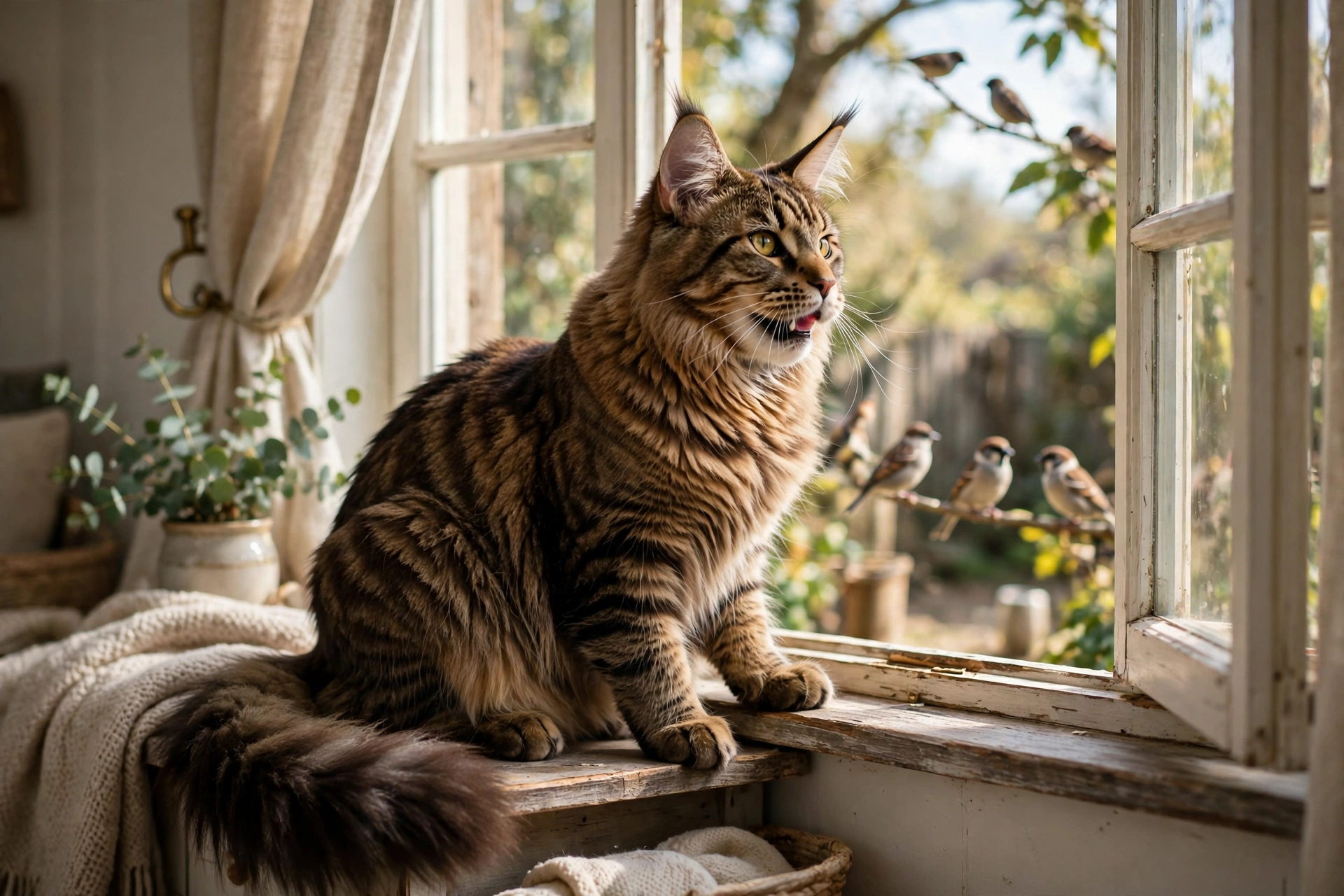
A Maine Coon rarely meows. Instead, it chirps and trills — two sounds that are easy to recognise once you have heard them and almost impossible to describe to someone who has not. A trill, according to TICA, is a mixture of a meow and a purr. A chirp is the short, sharp sound a cat makes when it spots prey, usually a bird through a window, and a trill is the sound it makes when it is happy, often as a greeting when you come home. The result is a cat that talks constantly and never quite meows, in a tiny voice that does not fit a cat of that size.
The voice is one of the best ways to tell whether a Maine Coon is content: a trill when you walk in means a cat glad you are home, and a chirp at the window means a cat that has found something worth watching. If you want a cat that talks back, in its own language, a Maine Coon will talk to you all day.
The slow grow-up: four years of kittenhood
Most cats are adults by twelve months. A Maine Coon is not: full maturity comes at around four, and full size between three and five years. For its first few years a Maine Coon is a kitten in a body that keeps getting bigger, and that long childhood shapes everything about living with one.
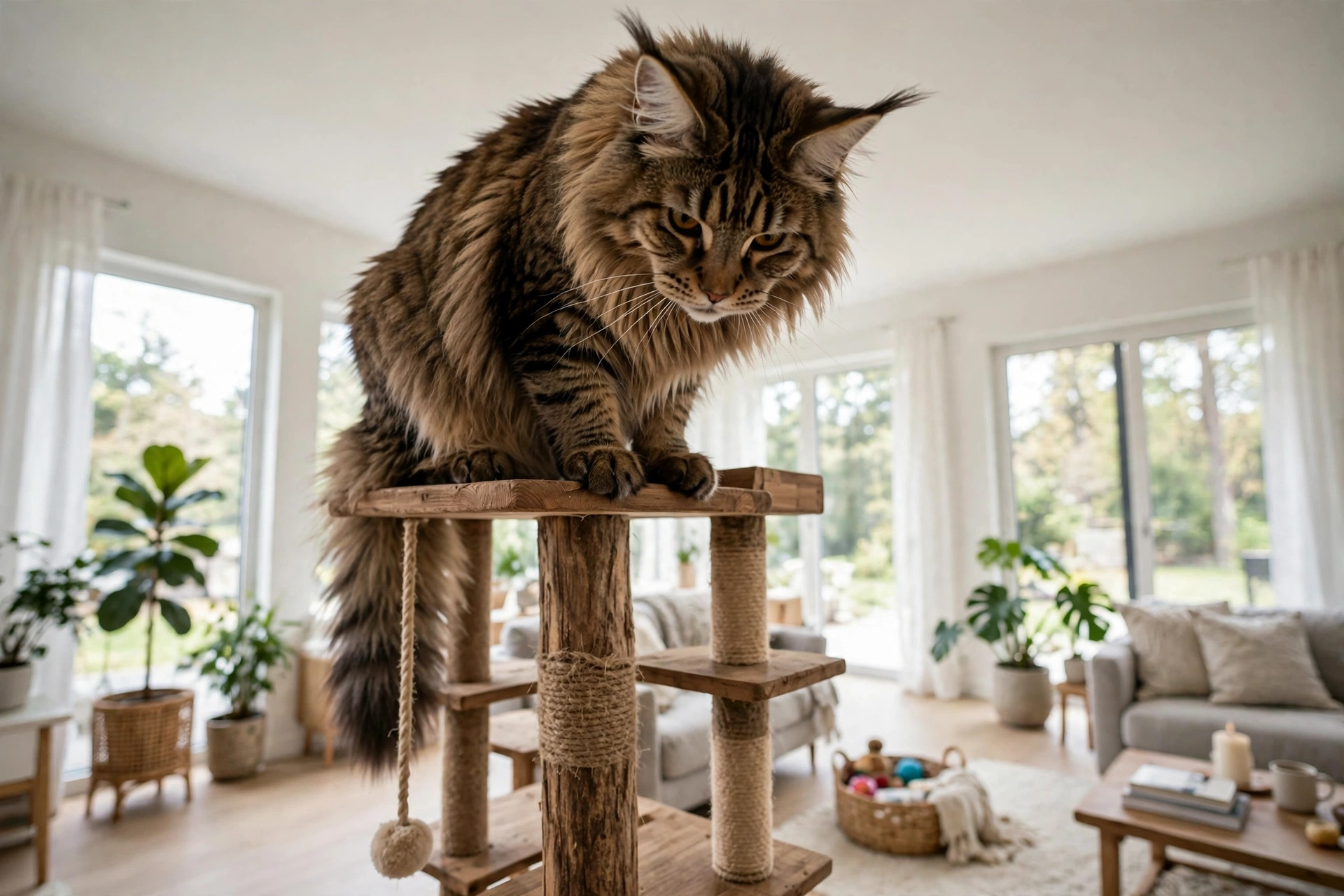
It shapes the appetite first: a growing Maine Coon eats like a cat that is still building itself, because it is. It shapes the energy, too: a two-year-old Maine Coon still plays like a kitten and still wants a game of fetch at ten at night. And it shapes the size of everything you buy — a Maine Coon needs a very large, tall tree, at least six feet high, with a sturdy base.
The payoff is a cat that stays playful and kittenish for four years, and most Maine Coons keep some of that playfulness for life.
Daily care: grooming, play, food, and a house built for a big cat
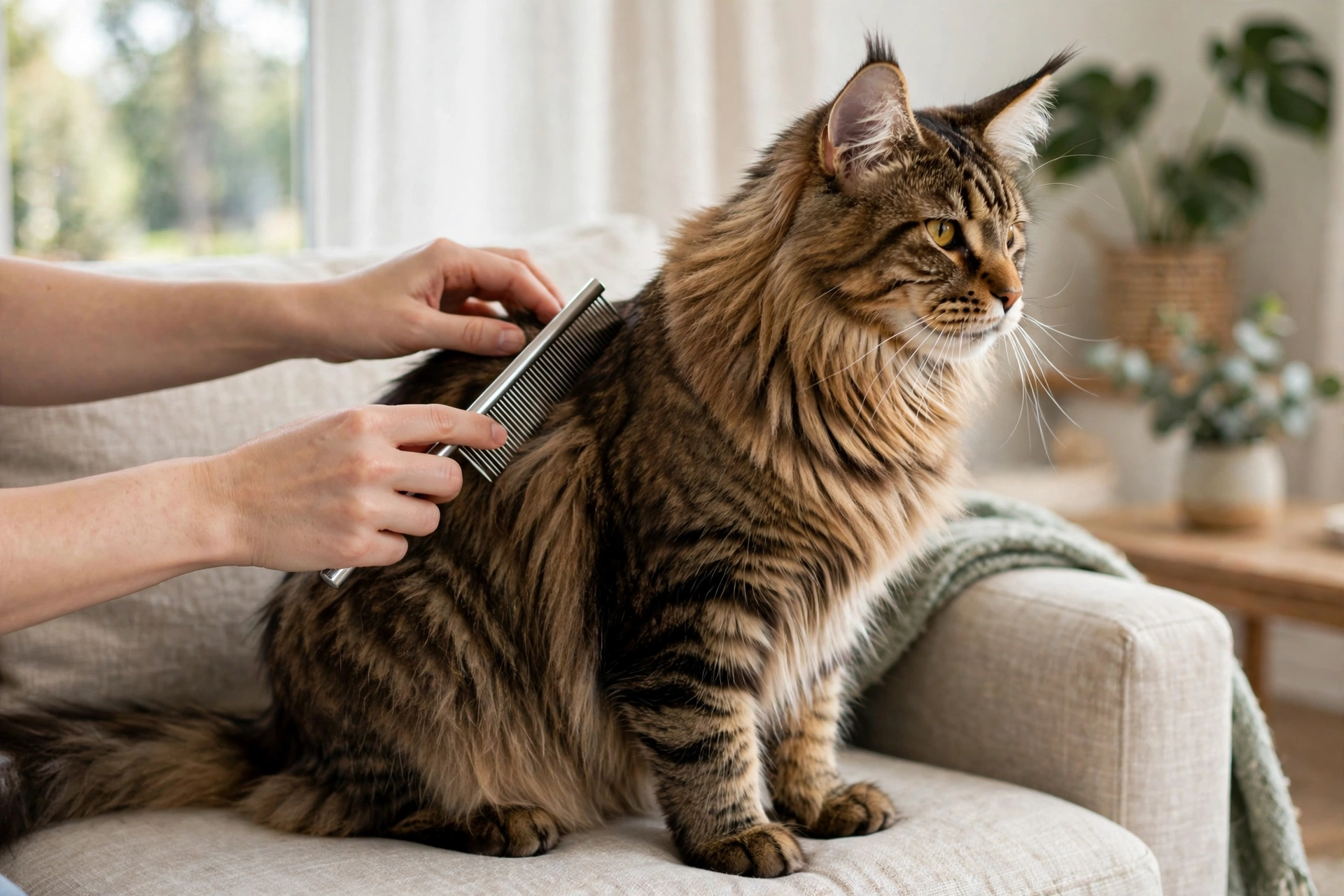
A Maine Coon is not a high-maintenance cat, but it is a big cat with a long coat. The thick double-layered coat needs regular brushing — two to three times a week, according to PetMD, while TICA notes that a weekly combing is usually enough. A steel comb through the coat, paying attention to where mats form first — behind the ears, under the legs, and around the ruff — is the whole job. Start young and it becomes a habit the cat enjoys. Most Maine Coons are open to an occasional bath, and TICA notes that most actually like water.
Play is not optional. PetMD recommends two to three play sessions of 10–15 minutes a day, and a Maine Coon will happily take more. Fetch is the classic Maine Coon game, and many of them will bring a toy back again and again. Window perches, catios, puzzle toys, and harness walks all suit a curious, social, clever breed, and clicker training works well — PetMD notes Maine Coons can learn tricks such as fist-bumping and recall.
Food is straightforward. PetMD advises a food with an AAFCO nutritional adequacy statement, a growth or all-life-stages food for kittens and an age-specific food for adults, and supplements only if a vet recommends them.
And the house needs to be ready for a big cat: everything should be a little bigger than you think — litter boxes, beds, food and water bowls, cat tree. Nails need trimming every four to six weeks, according to PetMD. A tall, sturdy cat tree — at least six feet high, with a wide, heavy base — is not a luxury.
Health to discuss with your vet or breeder
None of this is a diagnosis, and none of it is a reason to avoid the breed — it is the conditions the breed is predisposed to, exactly as reported by PetMD, so you know what to ask your vet or breeder about.
Hypertrophic cardiomyopathy (HCM) is the most common heart disease in cats, and Maine Coons can carry a mutation in two genes associated with it. An annual echocardiogram — an ultrasound of the heart — is the gold standard for screening, according to PetMD, and at-home DNA tests can check for the mutations. Ask a breeder whether HCM runs in the lines and what screening they do.
Spinal muscular atrophy (SMA) affects the muscles. Signs typically appear at three to four months old: decreased muscle tone, weakness, a wobbly walk, and tremors. It affects physical abilities, not cognitive function, and PetMD notes that cats with SMA can live long, happy lives with care.
Polycystic kidney disease (PKD) is the most common inherited disease in cats. Fluid-filled cysts form in the kidneys and can lead to kidney failure over time. DNA test kits can check for it.
Hip dysplasia shows up as a change in movement: a cat avoiding stairs, no longer jumping to a favourite perch, or no longer squatting in the litter box. PetMD notes that it is managed with weight management and a joint-healthy diet, and with surgery in severe cases. Keeping a Maine Coon at a healthy weight matters more than for most breeds — there is more cat to carry.
Chronic gingivitis is also worth knowing about: Maine Coons may develop feline juvenile gingivitis as young as six months old. Brushing the teeth daily and routine vet exams are the way to stay ahead of it, according to PetMD.
PetMD puts the typical Maine Coon lifespan at around 13 years. Ask the breeder what screening they do, and ask your vet what to watch for.
A short history
The Maine Coon’s history is mostly legend, and two of the legends are wrong in interesting ways. The oldest story says the breed came from a mating between a cat and a raccoon — which is biologically impossible, and the breed’s name does not come from raccoons at all. The second says the breed descends from six longhaired cats that Marie Antoinette sent to Wiscasset, Maine, when she tried to flee France. It is a popular theory, and a romantic one, but it is not established fact.
What is established is that the Maine Coon is one of the oldest natural breeds in North America, already shown in the nineteenth century. The breed was first recorded in cat literature in 1861, in a mention of a cat called Captain Jenks of the Horse Marines, and in 1895 a brown tabby female named Cosie won Best Cat at the Madison Square Garden cat show. The breed’s championship status with the Cat Fanciers’ Association dates to 1976, according to a breed profile, though that date comes from a secondary source rather than the CFA itself. The truth is simpler: the Maine Coon grew up in the cold of New England, shaped into a large, shaggy, water-resistant, snowshoe-footed hunter — and kept as a companion because it turned out gentle as well as tough.
Who a Maine Coon suits — and who it doesn’t
A Maine Coon suits a household that wants a companion, not a decoration. It suits families with children, because the breed is patient and relaxed, and households with dogs and other cats, because it is social and easy-going. It suits someone who is home a lot, because a Maine Coon follows its people from room to room and does not do well left alone all day — and someone who enjoys a cat that participates, one that plays fetch, learns tricks, and talks back in chirps and trills.
It does not suit everyone. It does not suit a small apartment with no room for a six-foot cat tree and a cat the size of a small dog, or someone who wants a cat that stays small, stays on a lap, and stays quiet. It does not suit someone who will not brush a long coat two or three times a week, or play for half an hour a day. And it does not suit a tight budget without planning: PetMD puts the cost from a breeder at $400–$2,000, and a large cat eats more, needs bigger equipment, and costs more at the vet.
If that sounds like your household, a Maine Coon is one of the best companions a cat can be. It is a lot of cat.
Frequently asked questions
How big do Maine Coon cats get?
Big. TICA puts adult males at 13–18 lbs and females at 9–13 lbs, while PetMD notes that males can reach 25 lbs. They are one of the largest domestic cat breeds, reaching full size only at three to five.
Do Maine Coon cats meow?
Rarely. Maine Coons usually chirp and trill instead of meowing. A trill is a mixture of a meow and a purr, and a chirp is the short sound a cat makes when it spots prey, usually a bird through a window. They use these sounds constantly — as greetings, requests, and commentary — in a voice surprisingly small for a cat of their size.
Are Maine Coon cats good with children?
Yes. The breed is known for being relaxed, easy-going, and patient, and TICA and PetMD both note that Maine Coons get along well with children, dogs, and other cats. As with any cat, children should be taught to be gentle, and the cat should always have a quiet place to retreat to.
How often should I groom a Maine Coon?
Two to three times a week with a steel comb, according to PetMD; TICA notes that a weekly combing is usually enough. Pay attention to where mats form first: behind the ears, under the legs, and around the ruff. Most Maine Coons tolerate an occasional bath. Nails should be trimmed every four to six weeks.
Do Maine Coon cats like water?
Most of them do, which is unusual for a cat. TICA notes that most Maine Coons actually like water and will happily take a bath, and their fur is water-resistant — a trait from a breed shaped by New England’s cold, wet climate. Not every individual will love water, so introduce it gently and let the cat decide.
2 Comments