$ USD
$ USD





















Some cats seem to carry a quiet wisdom — the kind that doesn’t need instruction or explanation. They simply knowwhen another soul needs comfort.
At a small foster-based rescue, one calm orange cat proved that motherhood doesn’t always end when the kittens grow up. Sometimes, it waits patiently… until the right little life comes along.
And this time, that life looked very different from the rest.
A Cat Who Never Truly Retired from Being a Mom
The orange cat — let’s call her Marigold — had already lived many chapters before this story began.
She was once a street cat, surviving day by day, until she was brought into safety through a routine trap-neuter-return effort. But instead of going back outside, Marigold stayed. Something about her gentle temperament made it clear she belonged indoors.
At the rescue, Marigold quickly earned a reputation.
“She’s steady. Calm. Unshakable,” one foster volunteer shared.
“Nothing rattles her.”
Those traits made her a natural caregiver. Over time, Marigold helped raise kitten after kitten — not just her own, but many who arrived without mothers. She cleaned them, slept beside them, tolerated their clumsy play, and seemed to understand exactly what each one needed.
Eventually, her caretakers assumed her “mom days” were over.
She had done more than enough.
She deserved rest.
But Marigold, it turns out, wasn’t finished.
A Cry That Echoed Somewhere Else
Across town, at a small wildlife rehabilitation center, a very different rescue was unfolding.
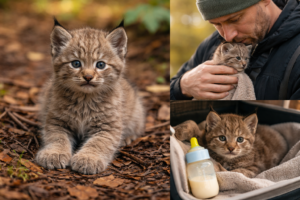
A six-week-old wild kitten — a bobcat baby — had been found alone, with no sign of her mother. She was small, fragile, and unmistakably wild.
The team at the center knew their mission clearly:
Rehabilitate her carefully.
Avoid human bonding.
Prepare her for eventual release back into the wild.
But there was one problem they couldn’t solve easily.
The little bobkitten was lonely.
She cried constantly — not from hunger or pain, but from the deep need for companionship. Wild kittens are social creatures, and without a mother or siblings, the silence felt overwhelming.
“We can provide food, medical care, and a safe habitat,” one of the caregivers explained.
“But comfort is different. Comfort usually comes from another animal.”
Too much human interaction wasn’t an option. The goal was always independence, not attachment.
So the team asked a bold question:
What if she needed a surrogate mother — not a human one, but another cat?
An Unusual Idea Takes Shape
That question led them to reach out to a nearby foster rescue — the same one where Marigold lived.
They explained the situation carefully.
A wild kitten.
Temporary companionship only.
A calm, maternal cat who could offer comfort without encouraging dependence on humans.
Almost immediately, one name came up.
Marigold.
“She’s raised so many kittens already,” a coordinator said.
“And she’s incredibly gentle. If any cat could handle this, it would be her.”
The idea was unusual.
A domestic cat and a wild bobcat kitten don’t often cross paths.
But sometimes, the best solutions are the ones that feel a little unconventional.
The First Meeting
The introduction was done slowly and thoughtfully.
Marigold sat quietly inside her carrier, relaxed and observant. Her body language was open — ears forward, posture loose, eyes calm.
The bobkitten, however, needed no warming up.
The moment she saw Marigold, something shifted.
She rushed forward with unfiltered enthusiasm, her tiny body buzzing with excitement. She sniffed Marigold’s nose, rubbed her face against her, and immediately began purring — loud, rumbling purrs that filled the room.
It was as if she had finally found what she’d been searching for.
Marigold didn’t flinch.
She didn’t pull away.
She simply stayed still and let the baby come to her.
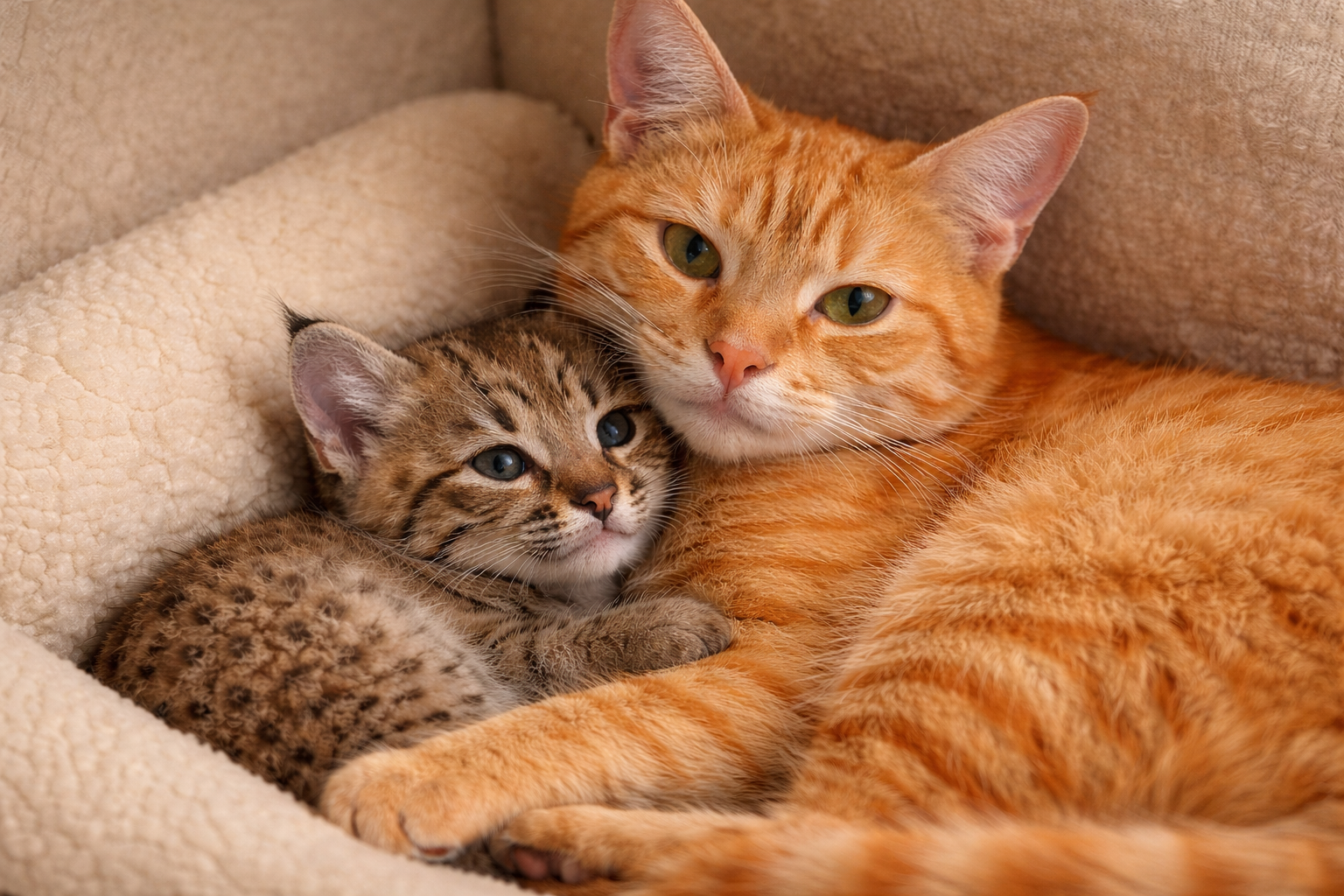
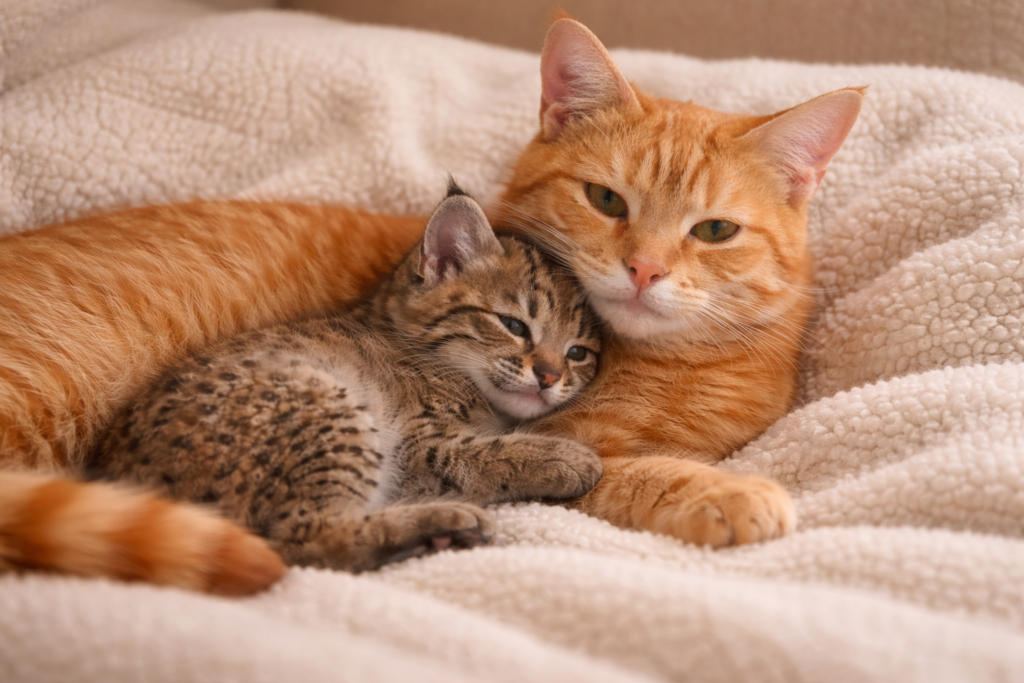
Within minutes, the bobkitten curled against Marigold’s side, wrapping her small paws around her like she belonged there all along.
Love Without Labels
There was no confusion.
No hesitation.
No sense of difference.
To the bobkitten, Marigold was a mother figure.
To Marigold, this tiny creature was just another baby who needed warmth.
The bobkitten purred endlessly, nuzzling Marigold’s neck and ears, offering clumsy little love bites the way kittens do. Marigold responded with quiet tolerance — the same patience she’d shown so many times before.
It was a bond formed not by instinct alone, but by choice.
Learning by Watching
Over the next few days, the bobkitten began to change.
She cried less.
She slept more peacefully.
She started observing.
She watched how Marigold groomed herself.
How she ate.
How she settled down after play.
Sometimes she tried to imitate those behaviors — awkwardly, imperfectly, but with determination. And Marigold allowed it all, even when play got rough or paws landed where they shouldn’t.
“She has endless patience,” one foster noted with a smile.
“She lets the baby be a baby.”
Something important had shifted.
The bobkitten no longer cried out in loneliness.
Instead, the room filled with gentle purrs, playful tumbles, and quiet moments of rest.
For now, that was enough.
A Bond That Quietly Changed Everything
As the days passed, the difference in the little wild kitten was impossible to miss.
She no longer paced the room calling out into empty space.
She no longer startled awake, confused and searching.
Instead, she followed Marigold everywhere.
When Marigold stretched, the kitten stretched.
When Marigold settled down, the kitten tucked herself close.
When Marigold groomed her face, the kitten leaned in, eyes half-closed, absorbing every gentle motion like a lesson.
It wasn’t loud or dramatic.
It was calm.
Grounding.
The kind of comfort that doesn’t draw attention — it simply works.
Learning What It Means to Be a Cat
The little bobkitten didn’t just need warmth.
She needed guidance.
Marigold became her silent teacher.
She demonstrated how to clean paws properly instead of chewing on them.
How to pause between play sessions instead of crashing from exhaustion.
How to eat slowly, deliberately, without panic.
The kitten watched closely, trying to copy what she saw — sometimes clumsily, sometimes hilariously off-balance. Marigold never corrected her sharply. She let the lessons unfold naturally.
There was no rush.
No pressure.
Just a steady presence showing her how to exist without fear.
Patience That Can’t Be Taught
Playtime could get rough — as it often does with kittens who haven’t learned their own strength yet. The bobkitten pounced hard, tugged ears, wrapped her paws around Marigold’s neck like a tiny wrestler.
Marigold accepted it all.
She shifted gently when she needed space.
She redirected with a slow paw instead of a swat.
She never raised her voice.
Anyone watching could see it:
This wasn’t tolerance.
It was understanding.
Marigold knew this phase would pass — and she was willing to carry it.
Quiet Nights, Peaceful Days
The biggest change came at night.
Before Marigold arrived, the bobkitten struggled after sunset. The quiet made everything louder — every unfamiliar sound, every shadow.
Now, nights were different.
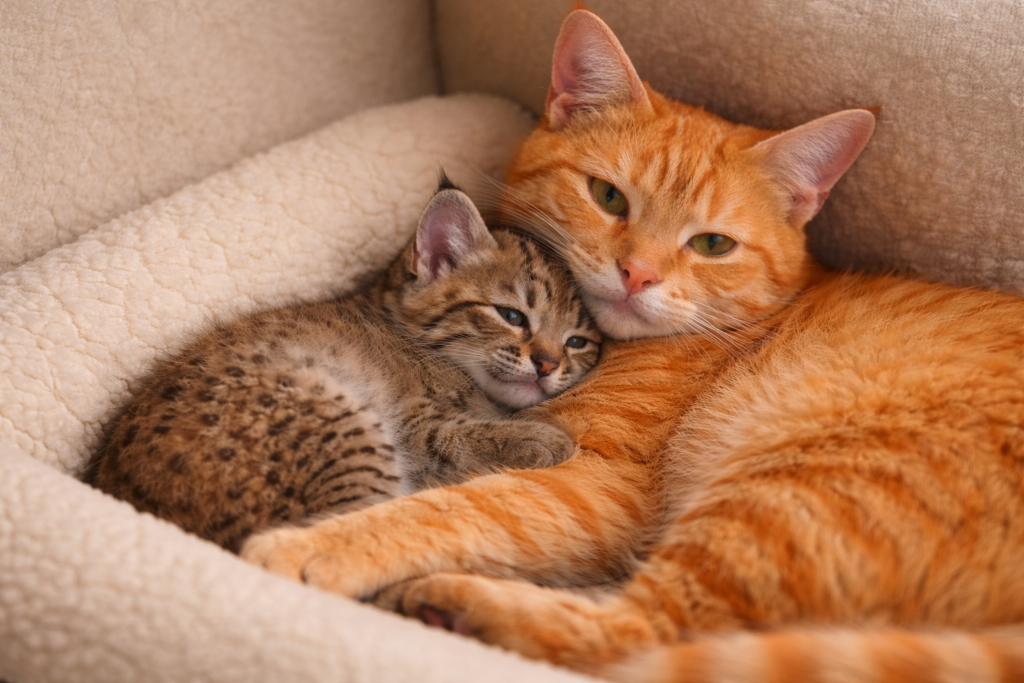
The kitten curled against Marigold’s side, her breathing syncing to the steady rhythm beneath her. Sometimes she kneaded the blanket. Sometimes she tucked her head under Marigold’s chin.
The cries disappeared.
In their place came sleep.
Deep, uninterrupted rest — the kind that allows growing bodies and minds to heal.
The Bigger Picture
Everyone involved understood this arrangement was temporary.
The bobkitten was wild.
She was never meant to stay forever.
The goal remained the same:
Rehabilitation.
Independence.
Release.
But before any of that could happen, she needed a foundation — emotional stability, confidence, and a sense of security that didn’t come from human hands.
Marigold provided exactly that.
She offered companionship without dependency.
Guidance without interference.
Comfort without confusion.
It was the perfect balance.
A Lesson in Thinking Differently
This experience reminded everyone involved of something important:
Sometimes the best care doesn’t come from doing more — it comes from doing differently.
Instead of forcing solutions, they listened.
Instead of insisting on human involvement, they trusted animal instincts.
And in doing so, they gave a wild kitten what she needed most — not training, not attention, but presence.
When Two Worlds Met, Gently
Marigold never questioned why this “kitten” looked different.
She didn’t care about spots or ear shape or wild instincts.
She saw a baby who needed warmth.
And the bobkitten didn’t care that Marigold wasn’t her species.
She recognized calm.
She recognized safety.
Together, they created something simple and powerful — a space where healing could happen quietly.
Conclusion: Love That Knows No Categories
This story was never about rescue statistics or success rates.
It was about a moment when one animal answered another’s need without hesitation.
A cat who had already given so much chose to give again.
A wild kitten found comfort without losing her wildness.
And somewhere in between, a reminder emerged:
Sometimes, the best caretakers don’t need instructions.
They just need the chance.
FAQs
1. Can domestic cats safely interact with wild kittens?
Yes, when done under professional supervision and with careful boundaries, surrogate companionship can be beneficial.
2. Why avoid too much human interaction with wild kittens?
Wild animals need to remain cautious of humans to survive after release.
3. Do cats naturally take care of other species’ young?
Some cats with strong maternal instincts will care for any young animal that signals need.
4. Will the wild kitten remember the surrogate cat after release?
Possibly, but the goal is confidence and independence — not long-term attachment.
5. Why was this approach successful?
Because it met emotional needs without interfering with natural development.