50 Calico Cat Names for a Cat Who Wears Three Colors at Once
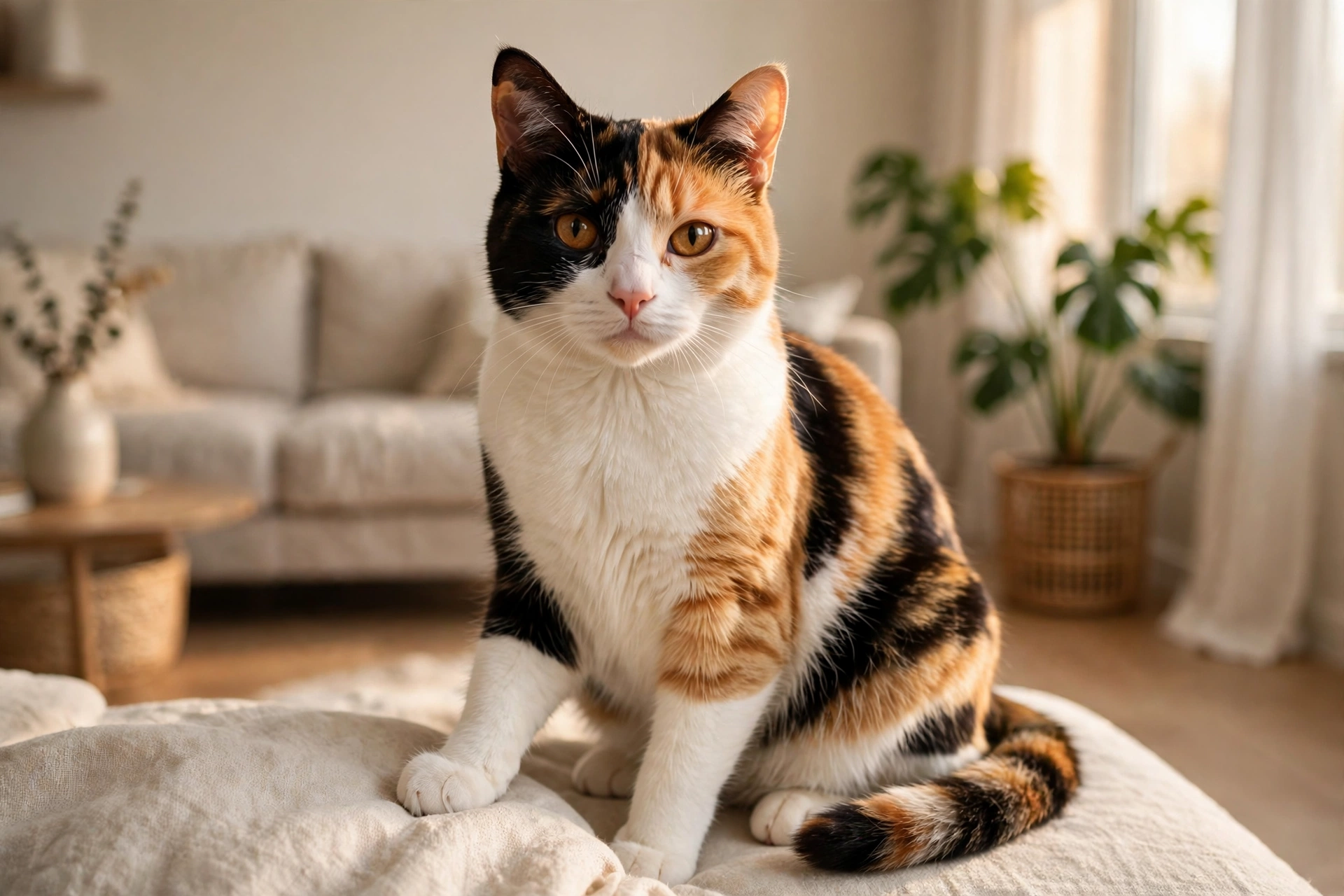
Some cats wear one color. A calico wears three, in patches that look like someone cut up three different cats and sewed the best pieces together. Black, orange, and white — no two calico coats are the same. Naming a cat like that is a different kind of problem. A plain name slides right off a coat this bold. The name has to keep up with the patches. These fifty calico cat names do keep up: patchwork, Japanese, autumn, sweet, and famous calico names.
What makes a calico a calico
First, the fact that surprises most people: a calico is not a breed. A calico is a coat pattern — a tricolor coat of black-based and red-based pigments with white — and it can turn up on many breeds, from the Maine Coon to the Japanese Bobtail. The name comes from calico fabric, the printed cotton cloth once imported from Calicut in India, because the cat’s coat looks like a piece of that patterned cloth. Outside North American English, the same coat is usually called tricolor or tortoiseshell and white.
The genetics explain the patchwork — and why nearly all calicoes are female. The gene for orange fur sits on the X chromosome. A female cat has two X chromosomes, and in each cell one switches off at random early in development, a process called X-inactivation. Some patches follow one X chromosome and come out orange, others follow the other and come out black, and a separate white spotting gene adds the white. A male cat has only one X chromosome, so he cannot carry both colors. Male calicoes exist only through rare conditions such as chimerism or Klinefelter syndrome (XXY), and they are almost always sterile — roughly one in ten thousand calicoes is male.
A calico is not the same thing as a tortoiseshell. A tortoiseshell is bicolored — black and orange with no white at all. Add white, and the same cat becomes a calico. When the colors are softer — grey or blue instead of black, cream instead of orange — the coat is a dilute calico, sometimes called a calimanco or clouded tiger. Add tabby stripes to the patches and you get a caliby, or tabico.
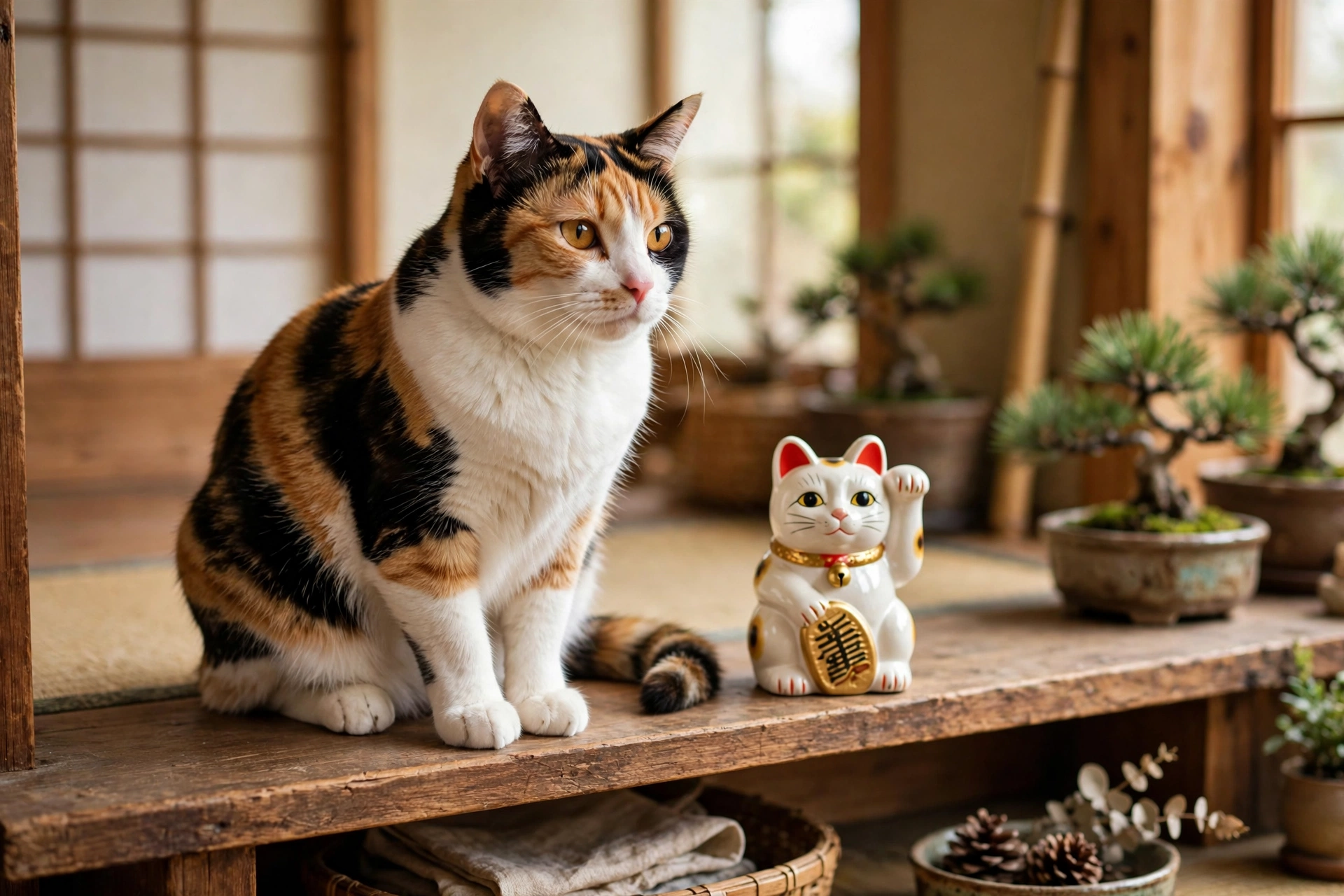
Calicoes carry good luck with them. In Germany they are called Glückskatze, lucky cats; in the United States they are sometimes called money cats. In Japan, the maneki-neko figures that beckon good fortune into shops are almost always calicoes, and Japanese sailors once kept calico cats aboard their ships for luck. The calico is the official state cat of Maryland, a title it has held since 1 October 2001, its colors matching the Baltimore oriole and the Baltimore checkerspot butterfly. A name for a calico can borrow from any of that: the patchwork, the luck, or the famous calicoes themselves.
Names for a patchwork coat
Start with the coat itself — names that describe what you see when a calico walks into the room.
Patches — the word itself, and the most natural name a calico can have.
Mosaic — the word itself. A calico coat is a mosaic: small pieces of color fitted together, never arranged the same way twice.
Harlequin — the word itself, the diamond-patterned character of the old stage, with the same bold geometry as a calico’s patches.
Domino — the word itself, the black-and-white game piece, for a calico whose patches are large and sharply divided.
Confetti — the word itself. For the calico whose patches are small, scattered, and everywhere.
Marble — the word itself. A calico’s colors swirl together the way colors do in marbled stone.
Speckles — the word itself. For a calico whose coat is more freckled than patched.
Patchwork — the word itself. The most literal name on this list, and one of the most honest: a calico is a patchwork cat.
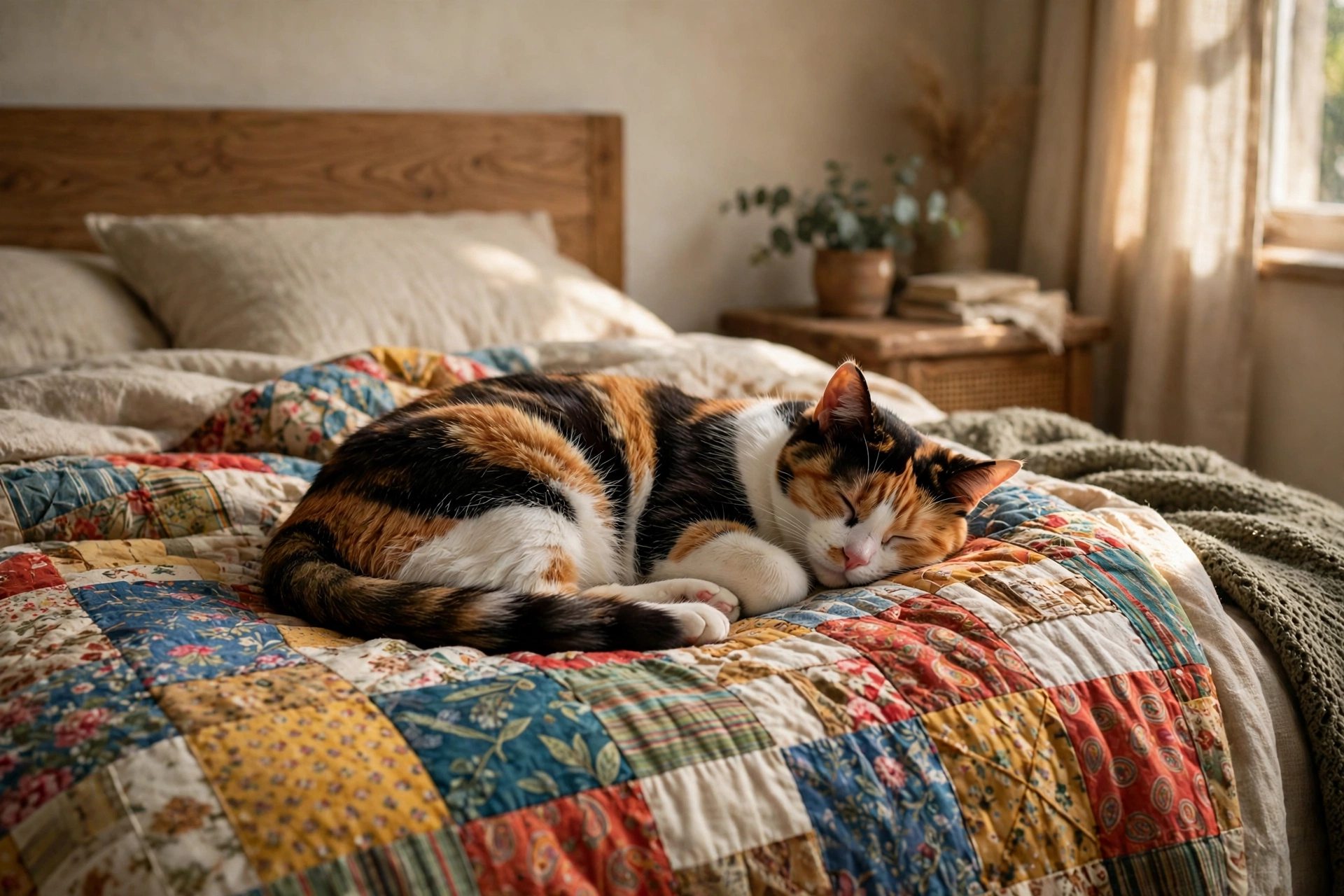
Quilt — the word itself. Warm and handmade — a soft name for a cat who sleeps on the bed.
Jigsaw — the word itself. Every calico coat looks like a puzzle solved differently.
Japanese names for a calico
Japan has loved calicoes longer than almost anywhere else, and Japanese names suit them beautifully. Every meaning below is verified — real Japanese names with real meanings, not guesses.
Sakura — Japanese for “cherry blossom”. The pale pink of a cherry blossom sits well against orange patches.
Yuki — Japanese for “happiness” or “snow”. The snow meaning suits a calico with a lot of white; the happiness meaning suits any calico.
Hana — the Japanese word for “flower” — simple, short, and pretty.
Momo — the Japanese word for “peach” — the warm orange of a calico’s orange patches.
Akira — Japanese for “bright” or “clear” — a strong name for a calico with a bold personality.
Emi — a Japanese name meaning “favour, benefit” or “picture, painting” combined with “beautiful” — a name about beauty.
Rin — Japanese for “dignified, severe, cold” — delicate-sounding, but steely, for a calico who runs the house.
Yumi — a Japanese name meaning “archery bow”, or combining “reason, cause” with “beautiful”. Short and elegant.
Ume — the Japanese word for “plum blossom”. Plum blossom is one of Japan’s earliest spring flowers.
Suzu — the Japanese word for “little bell”. A bright, light name for a small calico.
Autumn and harvest names
A calico’s colors are the colors of autumn — orange leaves, brown earth, pale sky. These names borrow from the season her coat already belongs to.
Harvest — the word itself. The season when the fields turn orange and gold — a warm name for a cat who arrived in the fall.
October — the word itself, the month when the leaves turn — for a calico born or adopted in autumn.
Ember — the word itself, a glowing piece of coal — orange and black, exactly a calico’s colors.
Sorrel — the word itself, a reddish-brown herb and horse color, for a calico whose orange patches lean toward brown.
Topaz — the word itself, the golden-brown gemstone. It catches the light the way a calico’s orange patches do in the sun.
Carnelian — the word itself, the orange-red gemstone. A richer name than Topaz, for a calico with deep orange patches.
Russet — the word itself, a reddish-brown color — the darker orange patches on a calico coat.
Tawny — the word itself, a warm brownish-orange, for a calico whose patches blend softly together.
Chestnut — the word itself, the brown nut and the brown horse color. A solid, warm name that suits a sturdy calico.
Acorn — the word itself, the small nut that becomes an oak. A small, sweet name for a kitten who will grow into a big personality.
Sweet names
Calicoes are sweet cats, and these names are sweet in the most literal way — they are all foods, and every one of them is the color of something in a calico’s coat.
Cookie — the word itself. Golden-brown, warm from the oven, and the color of a calico’s orange patches.
Muffin — the word itself. Soft, warm, and brown — a comfort name for a lap cat.
Toffee — the word itself, the golden-brown sweet, for a calico whose orange patches run deep.
Caramel — the word itself — smooth, golden, and sweet, the color of a calico’s lighter orange patches.
Cupcake — the word itself. A small, pretty thing — a good name for a small calico with a lot of personality.
Truffle — the word itself, the dark chocolate sweet. It suits a calico whose black patches are the boldest part of her coat.
Cocoa — the word itself, the brown powder and the warm drink — a cozy name for a cat who sleeps in warm places.
Mocha — the word itself, coffee mixed with chocolate, for a calico with brownish-orange patches.
Fudge — the word itself, the dense chocolate sweet. A soft, rich name for a soft, rich-colored cat.
Taffy — the word itself, the pulled candy. A playful name for a playful calico.
Names of famous calicoes
These ten names come from real calicoes — the ones the world already knows. Their stories are in the next section.
Tama — the calico stationmaster of Kishi Station in Japan, the most famous calico who ever lived.
Nitama — Tama’s successor as stationmaster, whose name means “Tama the Second”.
Yontama — the third feline stationmaster at Kishi Station, appointed in January 2026.
Gotama — a stationmaster on the same railway line, at Idakiso Station.
Rokutama — the line’s newest recruit, a stationmaster candidate.
Chibi — Tama’s sister, who served as an assistant stationmaster alongside her.
CC — short for CopyCat, the first cloned pet, whose genetic donor was a calico.
Rainbow — the calico who was CC’s genetic donor, a domestic longhair.
Maneki — short for maneki-neko, the beckoning cat that brings good luck, almost always shown as a calico.
Lucky — the word itself — what calicoes are called in Germany, the United States, and Japan alike.
The stories behind the famous calico names
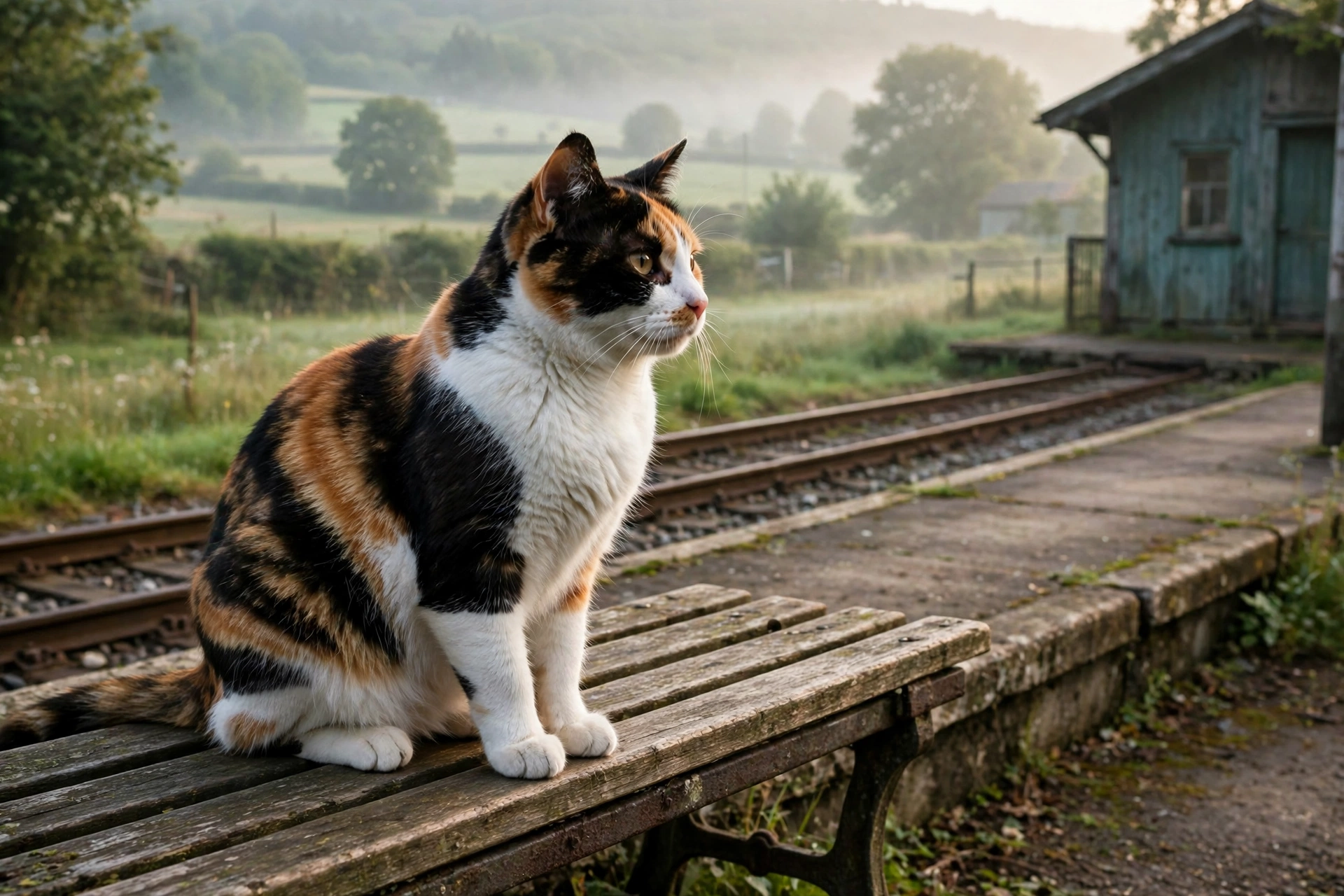
The most famous calico who ever lived was a stationmaster. Tama was a female calico at Kishi Station in Kinokawa, Wakayama, Japan, appointed the station’s official stationmaster on 5 January 2007. The line was losing money and about to close; Tama, in her little stationmaster’s hat, drew visitors from all over Japan, and the station survived. She was paid in cat food, and her custom-made hat took more than six months to make. She died on 22 June 2015, aged 16, of heart failure, and was succeeded at Kishi by Nitama, who served until November 2025, and then by Yontama, appointed the third feline stationmaster in January 2026. Gotama holds a stationmaster post at Idakiso Station on the same line, and Rokutama is the line’s newest recruit, a stationmaster candidate. Her sister Chibi and her mother Miiko, an orange tabby, served as assistant stationmasters. A cat who saved a railway line is a name worth borrowing.
The second famous calico is a scientific one. CC, short for CopyCat, was the first cloned pet, born on 22 December 2001 at Texas A&M University. She lived to 18, dying on 3 March 2020. Her genetic donor was a calico domestic longhair named Rainbow — but CC herself did not come out calico. She was a brown tabby and white, because the same X-inactivation that makes calico coats patchy meant the copied cells switched off different X chromosomes. It is the neatest proof that a calico’s coat is a pattern her genes paint, one cell at a time.
And then there is the luck. Calicoes have been called lucky cats for centuries: Glückskatze in Germany, money cats in the United States, and in Japan the maneki-neko — the beckoning cat with one paw raised — is almost always a calico. Japanese sailors once kept calico cats aboard their ships for good fortune. A name like Lucky or Maneki is the oldest naming tradition a calico has.
How to pick from the shortlist
Fifty calico cat names is too many to choose from at once. Pick five you like the sound of, then run them through four quick tests.
Say it out loud, ten times. A name you will shout down a hallway and say to a vet has to survive being said. If it feels silly on the tenth try, it will feel worse on the hundredth. One and two syllables work best: cats hear the sound before the meaning.
Check it against the coat. A calico’s coat is the first thing anyone notices about her, so the name should sit well on it. Patches suits a heavily patched cat; Ember suits one whose orange patches glow in the sun; Sakura suits a pale, delicate calico.
Try the vet waiting-room test. Say the name the way you would say it to a receptionist. “This is Mosaic, here for her check-up” should sound like a cat’s name, not a joke you have to explain.
Live with the top three for a day. Use each one for a few hours and watch which one you keep reaching for. Cats learn a name by hearing it attached to food, play, and attention, so the name you enjoy saying is the one the cat will learn fastest.
Frequently asked questions
What is a good name for a calico girl cat?
Almost any name on this list, because nearly all calicoes are female — so a name guide for calicoes is, in practice, a name guide for girl cats. Short names work best: Sakura, Momo, Yuki, Patches, and Ember are all easy to call and easy for a cat to learn.
Are calico cats always female?
Almost always, but not quite. Around one in ten thousand calicoes is male, and male calicoes exist only because of rare genetic conditions such as chimerism or Klinefelter syndrome, where the cat carries two X chromosomes. Male calicoes are almost always sterile.
Is a calico cat a breed?
No. A calico is a coat pattern, not a breed. The same tricolor pattern can appear on many breeds — the Maine Coon, the Manx, the American Shorthair, the Persian, the Japanese Bobtail, and the Turkish Van, among others — and on ordinary domestic cats too.
What is the difference between a calico and a tortoiseshell cat?
White. A tortoiseshell is bicolored — black and orange with no white at all. Add white, and the same cat becomes a calico. A dilute calico has softer colors — grey or blue instead of black, cream instead of orange — and a calico with tabby stripes in her patches is called a caliby or a tabico.
What are some lucky names for a calico cat?
Lucky and Maneki are the most direct, and they come from a real tradition: calicoes are called Glückskatze in Germany, money cats in the United States, and the maneki-neko beckoning cats of Japan are almost always calicoes. Felix means “lucky” in Latin, and Yuki means “happiness” in Japanese.