🐱 When Silence Isn’t Silence at All
Cats have a reputation for being quiet, distant, and mysterious. When a cat walks away instead of responding, many people assume it means disinterest — or attitude.
But cats aren’t silent communicators.
They are subtle communicators.
Every slow blink, tail flick, ear movement, and pause carries meaning. Cats speak constantly — just not in the loud, obvious way humans expect.
Understanding that quiet language is the difference between thinking a cat is ignoring you… and realizing they’ve been communicating the whole time.
👁️ The Secret Behind the Slow Blink
When a cat looks at someone and slowly closes their eyes — then opens them again — that moment isn’t random.
It’s trust.
In the wild, closing the eyes means vulnerability. A cat only does this when they feel safe. When directed toward a human, a slow blink is a sign of comfort and acceptance.
Many cats will even return a slow blink if a human does it first. It becomes a silent exchange — calm, mutual, and deeply feline.
🐾 What the Tail Is Really Saying
A cat’s tail is one of the clearest emotional indicators.
- Tail straight up with a slight curve: Friendly and confident
- Slow side-to-side movement: Focused or mildly irritated
- Fast whipping tail: Overstimulated or annoyed
- Puffed-up tail: Fear or feeling threatened
Cats almost always warn before reacting. The tail speaks long before claws ever appear.
Learning tail language can prevent misunderstandings — and scratched hands.
👂 Ears: The Emotional Antennas
Cats rotate their ears constantly, picking up sounds humans can’t hear. But ear position also reveals emotional state.
- Forward-facing ears: Curious and relaxed
- Sideways ears: Uncertain or overstimulated
- Flattened ears: Defensive or fearful
A change in ear position often happens before any other visible reaction.

🚶 Why Cats Walk Away During Petting
One of the most misunderstood behaviors is when a cat walks away mid-petting.
This is not rejection.
Cats have a stimulation threshold. When petting crosses that invisible line, a cat chooses distance instead of conflict. Walking away is polite communication — a calm way of saying, “That’s enough.”
Cats that don’t walk away may resort to swatting or biting instead.
🗣️ Why Adult Cats Meow at Humans (Not Other Cats)
Adult cats rarely meow to each other. Meowing is a behavior developed specifically for humans.
Each cat creates a unique vocal system:
- Short chirps for greetings
- Long meows for attention
- Sharp sounds for frustration
- Soft trills for affection
A “talkative” cat has simply learned that humans respond better to sound than silence.
🧠 The Language of Space
Cats communicate with distance just as much as sound.
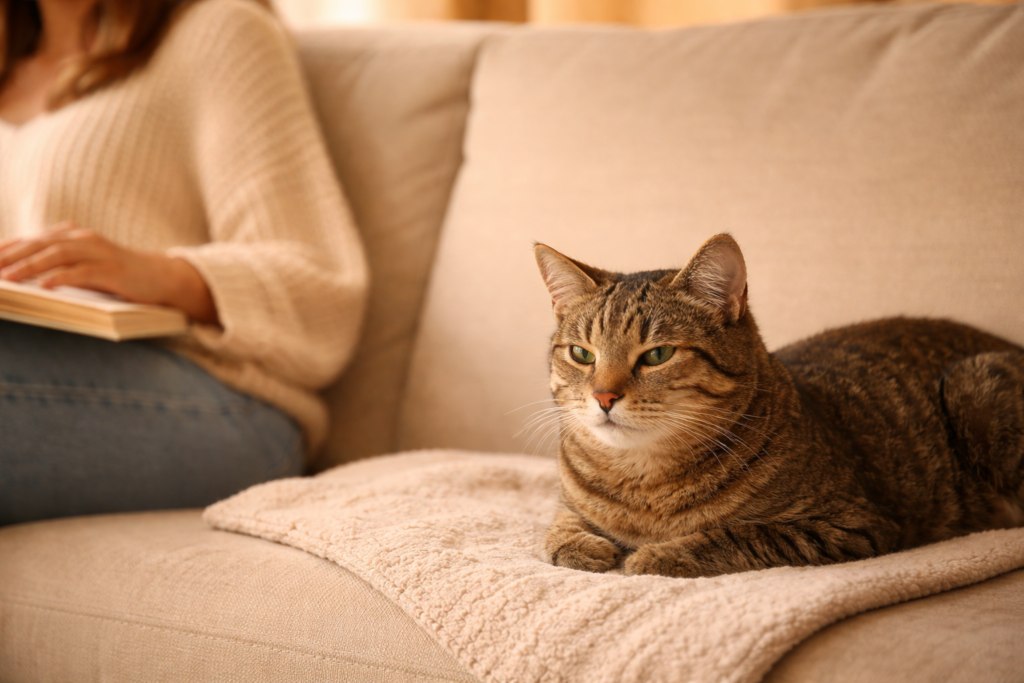
- Sitting nearby without touching = trust
- Choosing the same room repeatedly = bonding
- Sleeping close but not touching = comfort without vulnerability
A cat does not need to sit on a lap to show affection. Presence alone is meaningful.
😼 Why Cats Sometimes Ignore Their Name
Cats recognize their names. Research confirms it.
But recognition doesn’t equal obligation.
Cats decide whether responding is worth the effort. If there’s no perceived benefit — food, play, or safety — silence often follows.
This isn’t stubbornness. It’s independence.
💤 Sleeping Positions Speak Volumes
Cats sleep up to 16 hours a day, and how they sleep matters.
- Exposed belly: Deep trust
- Curled tightly: Self-protection
- Back turned: Feeling safe enough not to watch surroundings
Cats only sleep deeply when they feel secure.
🐾 Rubbing and Head-Butting Explained
When a cat rubs against legs or gently head-butts, it’s not just affection.
Cats have scent glands in their cheeks and forehead. Rubbing transfers scent — a way of saying, “You belong to me.”
It’s ownership wrapped in affection.
🌿 Final Thoughts
Cats aren’t ignoring humans.
They’re communicating — quietly, constantly, and honestly.
Learning to understand that language changes everything. It builds trust, prevents behavior issues, and deepens the bond between human and cat.
Once you start noticing these signals, it becomes impossible to miss them.
FAQs
Do cats understand human emotions?
Cats read tone, posture, and emotional energy very well.
Why does my cat stare at me?
Staring can mean curiosity, affection, or anticipation — especially when followed by a slow blink.
Are quiet cats normal?
Yes. Some cats communicate mostly through body language.