It started like any other ordinary morning.
A quiet walk.
A familiar trail.
Nothing that hinted at how unforgettable the day was about to become.
As Evan, a local resident on his way to work, followed a wooded path near his home, something small on the edge of the trail caught his eye. At first, he almost didn’t stop. It looked like what you might expect to see near houses and parks — a kitten, curled low to the ground, far too young to be alone.
But something about it didn’t feel right.
So he slowed down.
And that’s when everything changed.
A Closer Look Raised Questions
From a distance, the little animal looked fragile and quiet. But as Evan stepped closer, details began to stand out — details that didn’t belong to a house cat.
The paws were unusually large.
The ears were rounder, thicker.
The fur looked dense, built for cold, not couches.
“I remember thinking, that’s not a kitten,” Evan later recalled. “Not once I really looked.”
What he had stumbled upon wasn’t a lost pet at all.
It was a baby lynx.
Alone.
The Moment Between Instinct and Knowledge
Evan’s first instinct was to help immediately. But just as quickly, he hesitated.
He knew enough about wildlife to understand that young animals are often left alone while their mothers search for food. Stepping in too soon could separate them permanently.
So he made the hardest choice — he walked away.
He left the young lynx exactly where it was, hoping its mother was nearby, watching from a distance, ready to return.
All day long, though, the image stayed with him.
That tiny body on the forest floor.
Those oversized paws.
That quiet stillness that didn’t quite feel right.
The Sound That Changed Everything
The next day, Evan went back.
This time, he didn’t need to search.
He heard the cry before he saw the animal — a sharp, lonely sound that echoed faintly through the trees.
It wasn’t the sound of a baby waiting patiently.
It was the sound of distress.
“I could hear him calling out,” Evan said. “And I knew then — if his mother was coming back, she would have already.”
He waited a little longer, just in case.
But the forest stayed silent.
Sometimes, in the wild, mothers are forced to make impossible decisions. Weak or injured young don’t always survive — not because they aren’t loved, but because survival demands hard choices.
Evan realized this baby lynx had been left behind.
Stepping In When Waiting Was No Longer an Option
Near the base of a tree, the small lynx sat where Evan had last seen him. Cold. Hungry. Too young to fend for himself.
This time, Evan didn’t hesitate.
He gently picked up the kitten-sized wildcat, cradling him carefully. The lynx didn’t struggle. He didn’t hiss or bite.
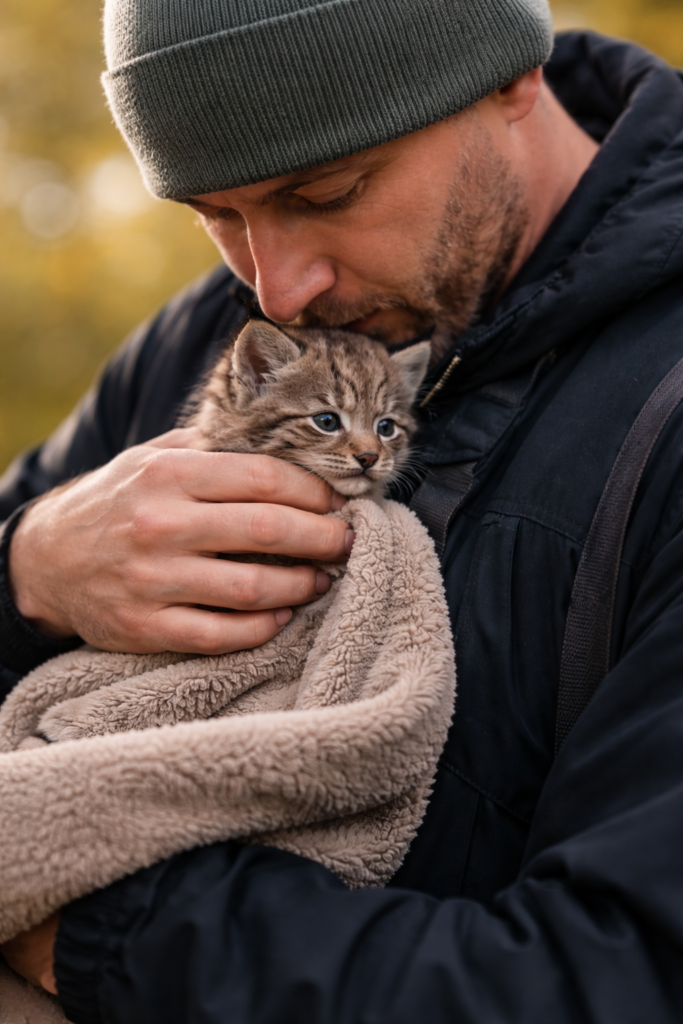
He was simply exhausted.
Evan brought him home and immediately began calling for help, eventually reaching a wildlife rehabilitation center through a nearby zoo.
“I knew I couldn’t keep him,” Evan said. “I just wanted to keep him alive long enough to get him where he needed to be.”
One Long Night of Watching and Waiting
Under the guidance of wildlife professionals, Evan was given temporary instructions — how to keep the lynx warm, how to feed him safely, how to minimize stress.
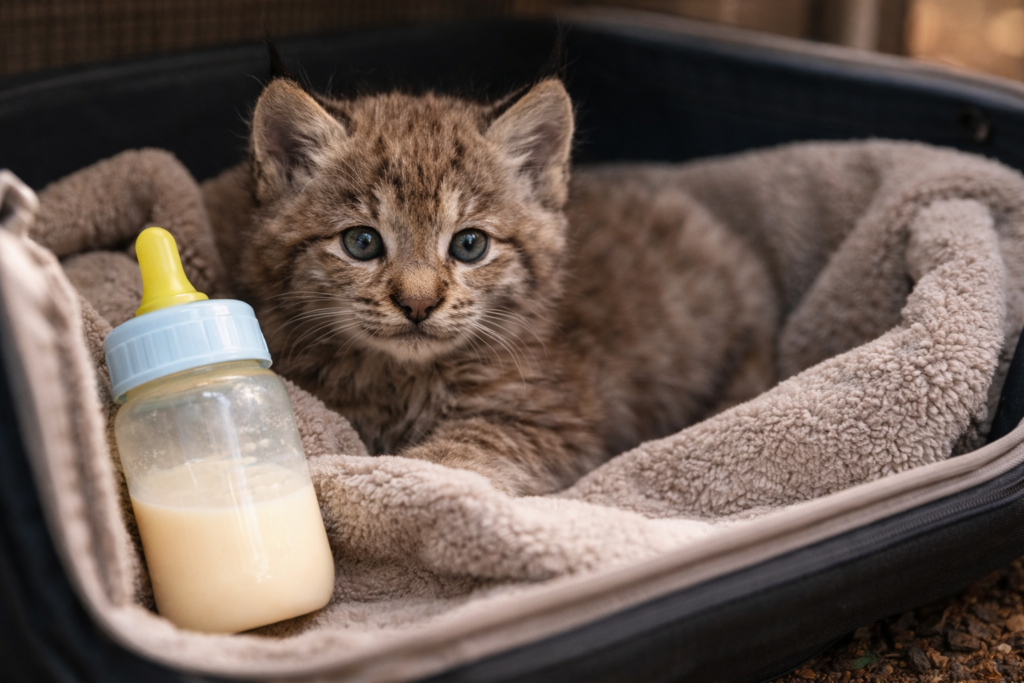
That night was restless.
Evan checked on the little lynx constantly, listening for movement, watching his breathing, making sure he stayed warm.
It wasn’t about bonding.
It wasn’t about attachment.
It was about responsibility.
This was a wild animal who needed just one thing — time.
Help Arrived at the Right Moment
The following day, Evan brought the young lynx to the rehabilitation center.
The professionals confirmed what he already suspected: the lynx was extremely young and would not have survived much longer on his own.
But now, things were different.
With proper care, specialized feeding, and a safe environment, the lynx began to stabilize. Strength returned slowly. The cries faded. Energy came back.
What had been a desperate situation turned into a second chance.
A Life That Will Return to the Wild
The goal of wildlife rehabilitation is simple — recovery without domestication.
The young lynx will stay in care only as long as necessary. Once strong enough, he’ll be reintroduced to the wild, where he belongs — not dependent on humans, not tame, but prepared.
He won’t remember Evan.
He won’t remember the trail.
But his life will continue because someone paused, paid attention, and knew when waiting was no longer enough.
Sometimes the Smallest Details Matter Most
Evan didn’t plan to rescue a wild animal that morning.
He didn’t expect to make a decision that would alter the course of a life.
He simply noticed something that didn’t quite fit — and trusted that instinct.
Big paws.
Round ears.
A cry that wouldn’t stop.
Sometimes, that’s all it takes.