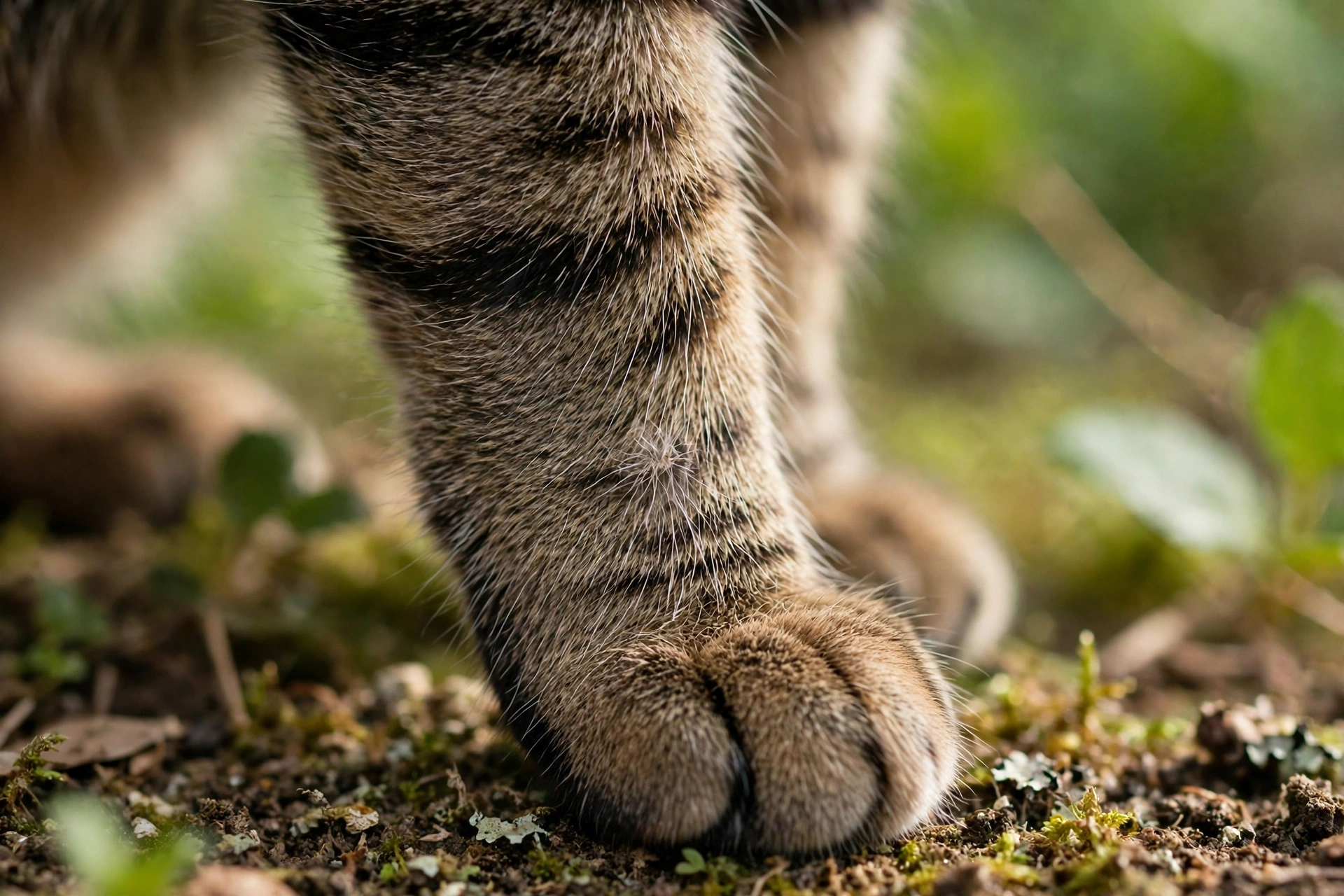
Next time your cat is stretched out asleep, look at its front legs — not the paws, a little higher. On the back of each wrist, just above the paw, sits a small tuft of fine, stiff hairs, sticking out at an angle from the rest of the fur. Most owners have never noticed it, and plenty who have assumed it was just stray hairs.
They are not stray hairs. They are whiskers — the same kind of sensory equipment as the long ones fanning out from your cat’s muzzle — and they sit in one of the most useful places on the whole animal. They are called carpal whiskers, and once you know where to look, you will never unsee them.
Meet the wrist whiskers
Carpal whiskers sit on the front legs only. The name comes from the carpus, the wrist joint, and the tuft grows on the back — or, as Litter-Robot puts it, the inner side — of each wrist, just above the paw. International Cat Care lists them with the better-known sets: about 24 on the cheeks, more above the eyes, and a set on the back of the forelegs.
Every cat has them. Catster answers the question directly: yes, all cats have carpal whiskers on their front legs — if you have not seen them on your cat, you have not looked hard enough. They are usually longer and thicker than the whiskers above the eyebrows, according to Catster, but still short beside the muzzle whiskers, and on a long-haired cat they can vanish into the surrounding fur.
There is nothing on the back legs to match them. The front paws do the close work — catching, holding, testing surfaces — and the wrist whiskers sit exactly where that work happens. Think of them as feelers for the paws, the way the muzzle whiskers are feelers for the face.
What a whisker actually is
A whisker is not a thicker ordinary hair. It is a different structure altogether, called a vibrissa, and it works more like a sensor than like fur.
International Cat Care puts the difference in plain numbers: a cat’s whiskers are twice as thick as the normal hairs on its body and sit three times as deep within the skin. Live Science adds why that depth matters — at the root of each whisker is a follicle loaded with nerves. Catster goes further: whiskers are sensory organs, rooted in follicles filled with nerves and blood vessels, and those nerves connect to the brain’s sensory areas. Touch the tip of a whisker, and the signal travels straight into the part of the brain that maps touch.
That wiring is why whiskers can do things ordinary fur cannot. The base of each whisker is packed with nerve endings, giving the cat what International Cat Care calls a highly sensitive navigational system. Whiskers detect slight changes in air currents, letting a cat sense an object it cannot see, and they report where objects sit relative to the head and legs — the muzzle whiskers are about the same width as the cat’s body, according to WebMD, so they work as a rough measuring device for gaps. The whiskers above the eyes trigger an automatic blink when something approaches the face.
The full set is larger than most people realise: 24 muzzle whiskers, 12 on each cheek, per International Cat Care and Litter-Robot, plus smaller sets above the eyes, on the chin, and on the wrists. The carpal whiskers are the least famous of the set, but they are built from exactly the same hardware.

The blind spot your cat lives with
To understand why a cat would need whiskers on its legs, start with a surprise about cat eyes: they are terrible at close range.
Most cats cannot form a clear, sharp image of anything closer than approximately 25–30 centimetres, according to CatAbroad — and Catster puts the same limit at about 10 inches, or 25 centimetres. Anything inside that range is blurry and indistinct. On top of that, cats have a specific blind spot directly below and in front of the nose, a cone-shaped zone extending roughly 10–15 centimetres from the face, again according to CatAbroad. Put a treat directly under your cat’s chin and it may sniff around in confused circles while standing on top of it — it genuinely cannot see it.
This is not a defect. A cat’s eyes are built for hunting at a distance — spotting movement, judging the leap, tracking prey across a room. The trade-off is that fine detail up close was never the priority: most studies place feline visual acuity between 20/100 and 20/200, according to CatAbroad. What cats gain in return is a wide field of view — around 200 degrees, against about 180 in humans, per both Catster and CatAbroad — and superb motion detection in low light.
So why do cats have whiskers on their front legs? Because there is a gap in the system, exactly where a hunt ends: the last few centimetres, when the prey is caught and under the paws. Vision has gone blurry by then, and smell is slow. Something else has to take over, and that something is touch — the whiskers, and the nerve endings packed into the paw pads. Catster puts it directly: between a cat’s whiskers and its paws, it does just fine when “seeing” its prey up close.
What the wrist whiskers are believed to do
So why do cats have whiskers on their front legs? Here is where honesty matters more than confidence. The jobs below are the leading explanations offered by veterinarians and cat-care writers — not findings proven by experiments designed specifically around carpal whiskers in cats. The anatomy is settled. The exact job list is not. With that said, here is what researchers believe these whiskers do.
Feeling prey that is already caught. This is the explanation given most often, and it makes the most sense from the blind-spot problem. Litter-Robot describes it plainly: because cats cannot see fine detail at close range, the carpal whiskers help the cat situate its prey so it can position it for the fatal blow. The whiskers are sensitive enough to detect the slightest movement, so a mouse twitching between the paws is felt instantly, even though it cannot be seen. Watch a cat with a toy mouse and you can see the logic — the paws hold, the head dips, and the whiskers on the muzzle and the wrists are both in contact with the same small, moving object.

Sensing the ground and the air. Catster says carpal whiskers help a cat get a better sense of the ground it is walking on, and that they can detect minute changes in air pressure and temperature, which helps the cat identify threats or prey nearby. International Cat Care says the same about whiskers in general: they detect air pressure and currents, which lets a cat locate objects even after losing sight of them.
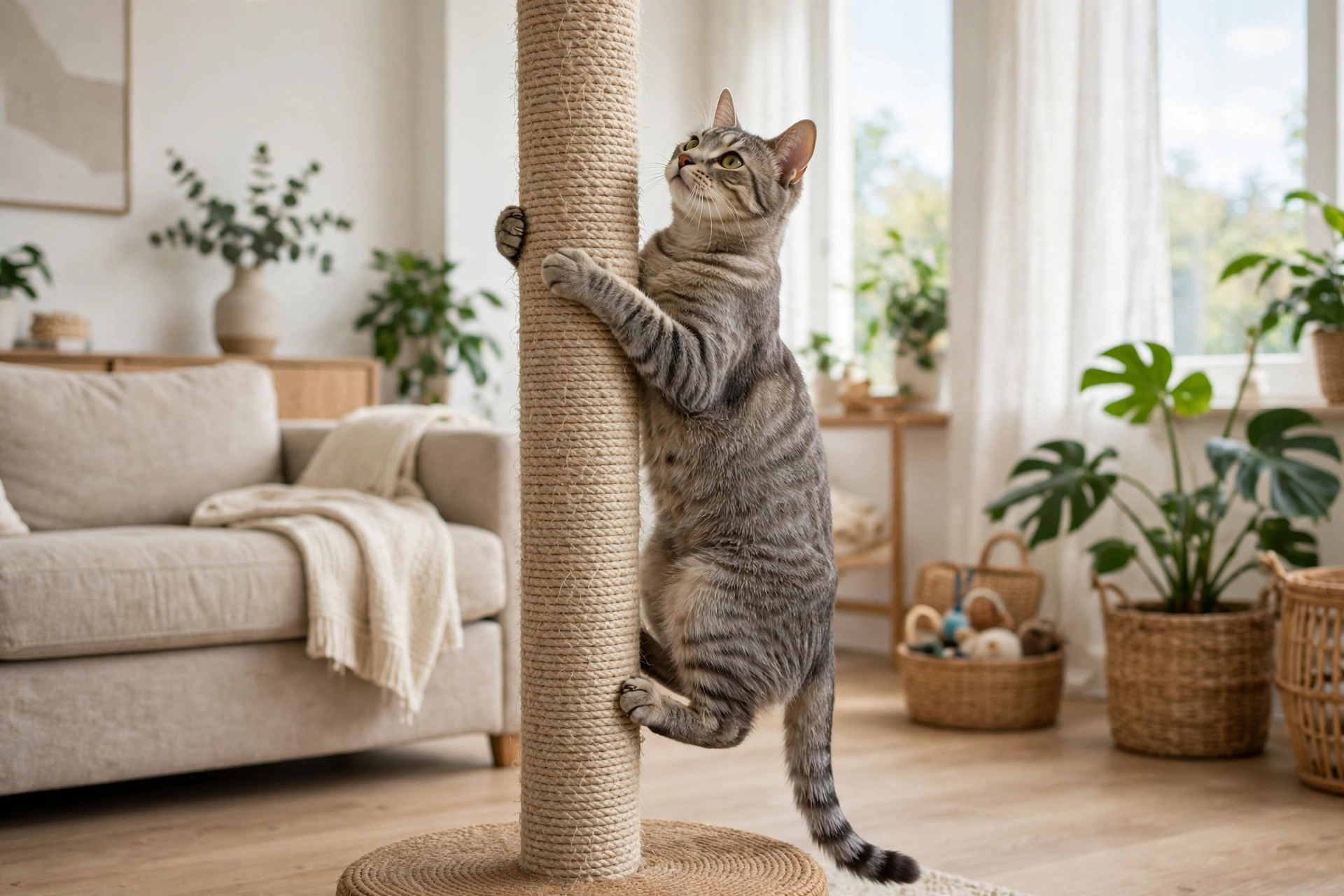
Climbing. WebMD states it simply: “Whiskers on the back of the legs help your cat climb trees.” The reasoning is that a climbing cat needs to know exactly where a branch or a trunk surface is relative to its paws, and the wrist whiskers report on contact and texture a fraction of a second before the paw commits its weight. It fits the placement — but WebMD states it in a single sentence without citing a study, and no carpal-specific climbing experiment is cited by any source used for this article.
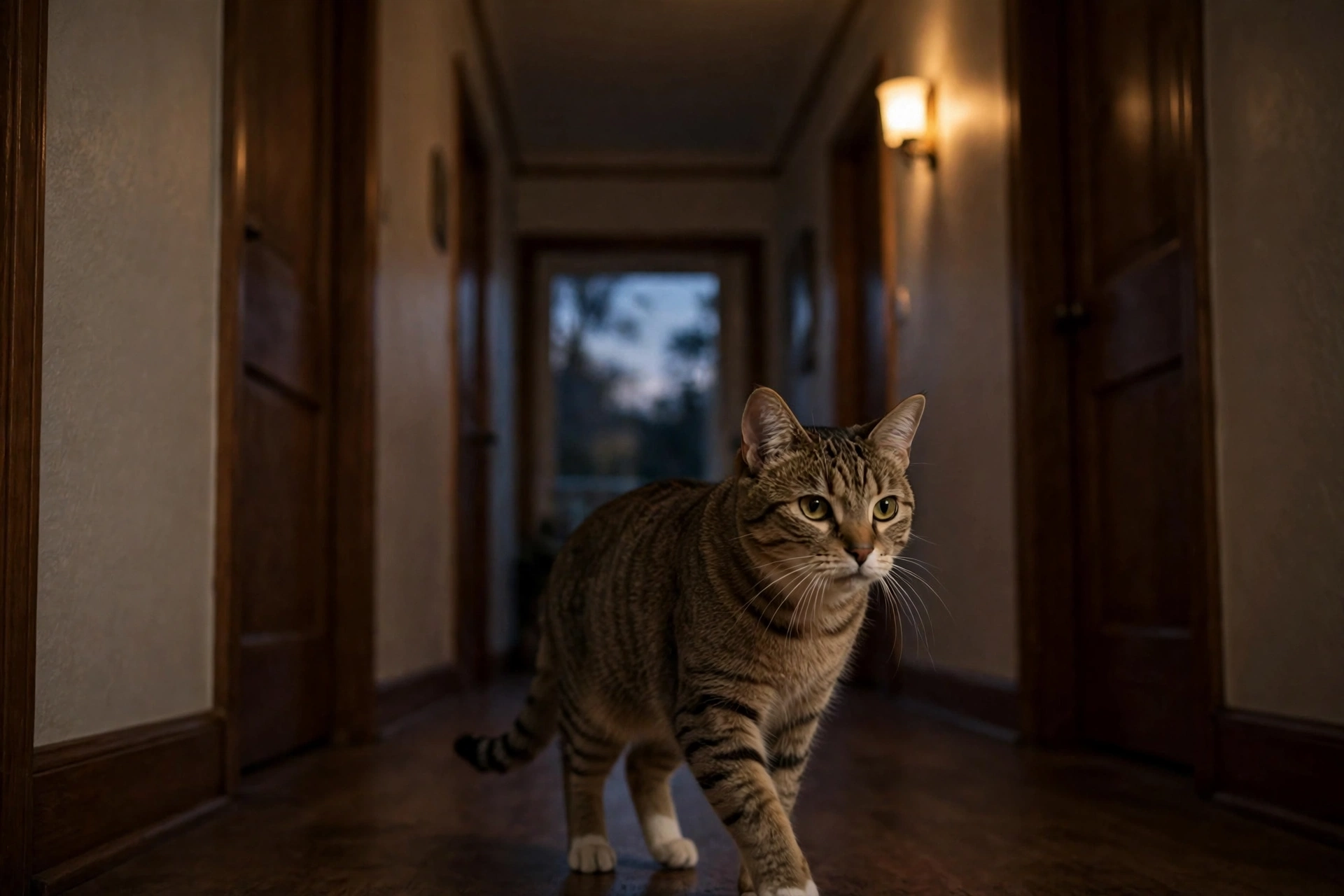
Working in the dark. Cats hunt most at dawn and dusk, and their whiskers are part of why they can do it. Catster lists night hunting among the main functions of whiskers generally: the whiskers help a cat sense its prey and adjust its strike when light is too poor for vision to do the job alone. In a dark hallway, the muzzle whiskers map what is ahead of the face while the carpal whiskers map what is under the paws.
Reading mood — a side job worth knowing. Whiskers also signal how a cat is feeling, and the wrist whiskers are no exception to the general rule, though it is the face whiskers that owners can actually read. When a cat is curious or hunting, it pushes its whiskers slightly forward; when it is nervous or upset, it pins them back toward the face, according to both WebMD and Catster.
What scientists still don’t know
Most of what is written in answer to why do cats have whiskers on their front legs is inferred, not measured. That is the honest position, and it is the reason this article hedges its claims instead of repeating them as facts.
First, most whisker research has focused on the face — and much of it on rodents, not cats. The muzzle whiskers have been studied in detail because they are large, obvious, and easy to test. The small tuft on the wrist has received far less direct attention, and none of the sources used for this article cites an experiment that isolated carpal whiskers in cats to test one function at a time.
Second, the functions overlap. When a cat catches a toy, the muzzle whiskers, the carpal whiskers, the paw pads, and the sense of smell are all reporting at once. Saying which sensor did which part would need an experiment that switches one of them off — and nobody has published that experiment for carpal whiskers in cats.
Third, some claims travel from source to source without getting stronger. A single sentence in a general whisker article gets repeated until it reads like settled science, even though the original carries no study behind it. That does not make the claim wrong. It makes it unproven.
So the fair summary is this: carpal whiskers are real, wired like every other whisker, and the leading explanations — feeling caught prey, sensing the ground and the air, helping with climbing and movement in the dark — all fit the anatomy and the blind-spot problem. What is missing is cat-specific experimental proof that separates one job from the others. Until that work exists, “researchers believe” is the right phrase.
How to find them on your cat — and how to look after them
Finding carpal whiskers takes thirty seconds and a relaxed cat. Wait until your cat is resting, pick up one front paw gently, and look at the back of the wrist, just above the paw. Part the fur lightly with a fingertip: the tuft is a small cluster of fine, stiff hairs sticking out at a different angle from the surrounding coat. They are easiest to see on short-haired cats in good side light; on a long-haired cat, you may need to look twice. Check both front legs — and do not expect anything dramatic. The whole point of these whiskers is that they are small.
Once you have found them, the care advice is simple: leave them alone. Never trim whiskers. WebMD is blunt — a cat with cut whiskers becomes disoriented and scared — and veterinarian Jane Brunt puts it memorably: cutting whiskers is “like blindfolding someone”. Catster warns that clipping whiskers can heavily compromise a cat’s abilities. If whiskers are accidentally cut, they do grow back, but slowly: Catster says several weeks to a few months, and Litter-Robot, citing PetMD, puts it at 6 weeks to 3 months.
A whisker found on the floor is nothing to worry about — International Cat Care notes that shedding a whisker is a perfectly regular body process. Be careful when trimming the fur around the legs, though: Catster warns owners to avoid cutting or damaging the carpal whiskers during grooming.
One exception is worth knowing: many hairless breeds have short, broken whiskers or none at all, according to Litter-Robot. Every other cat has the complete kit, including the small tuft on the wrists.
Frequently asked questions
Do all cats have whiskers on their front legs?
Yes. According to Catster, all cats have carpal whiskers on their front legs. The main exception is some hairless breeds, which may have short, broken whiskers or none at all, according to Litter-Robot.
Do cats have whiskers on their back legs?
No. Carpal whiskers grow only on the forelegs, on the back of the wrists. There is no matching set on the hind legs — the front paws do the catching, holding, and close-range feeling, so that is where the extra sensors sit.
Can I trim my cat’s carpal whiskers?
No — never trim any whiskers, including the carpal ones. WebMD warns that a cat with cut whiskers becomes disoriented and scared, and veterinarian Jane Brunt describes cutting whiskers as “like blindfolding someone”. If they are accidentally damaged, they grow back in several weeks to a few months, but the cat is without that sense in the meantime.
Do carpal whiskers help cats climb?
That is the leading explanation, but it is not proven by a dedicated experiment. WebMD states that “whiskers on the back of the legs help your cat climb trees”, and the reasoning fits: a climbing cat needs to feel where a surface is relative to its paws before committing its weight. Treat it as a plausible, widely repeated explanation rather than a settled scientific finding.
Why can’t my cat see a treat right under its nose?
Because of the close-range blind spot. Most cats cannot form a clear image of anything closer than approximately 25–30 centimetres, according to CatAbroad, and they have a specific blind spot directly below the nose. A treat under the chin sits inside that zone, so the cat genuinely cannot see it and must find it by smell and touch — the range where the whiskers take over.
Next time your cat is batting a toy mouse between its front paws, look at its wrists. The small tuft of hairs there is doing quiet work in a zone the eyes cannot reach — feeling what the paws are holding, in the dark, where vision has already given up. It is a small piece of anatomy, easy to miss for years. Now you know it is there.