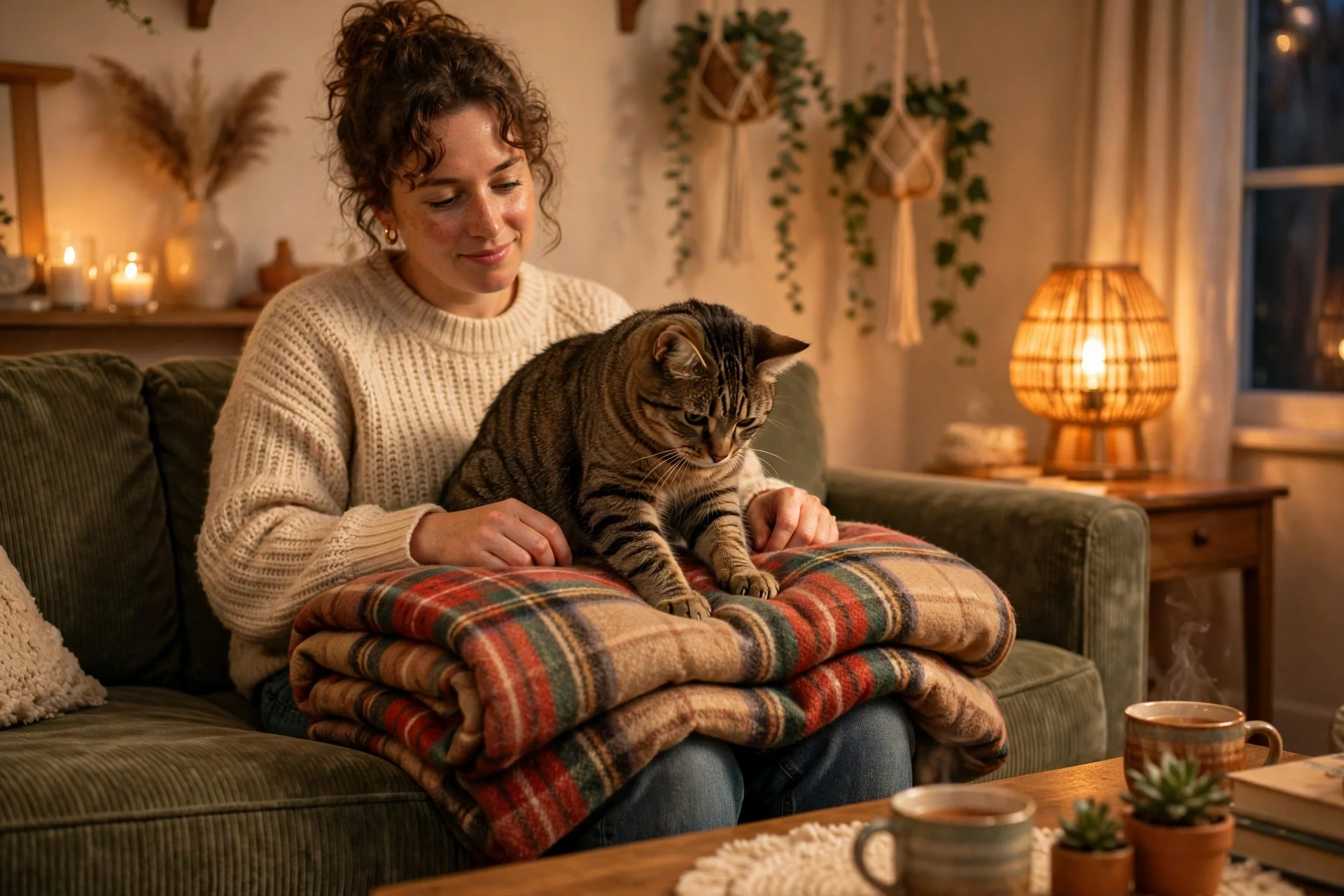
It usually starts the moment you sit down. The cat climbs into your lap, turns a small circle, and begins to press — one front paw, then the other, slow and steady, into your leg or the blanket folded over it. The claws may slide out with each push. The purr may start up. A little drool is not unusual either.
It looks affectionate, and in a loose sense it usually is. But there is not one reason cats knead — and for adult cats, science has not settled on a single one. What looks like a simple habit is a leftover from kittenhood layered with several possible jobs: comfort, scent, stretching, and settling down for sleep. This article sorts out which parts are solid, which are reasonable guesses, and which popular explanations go further than the evidence allows.
“Making biscuits”: what kneading actually looks like
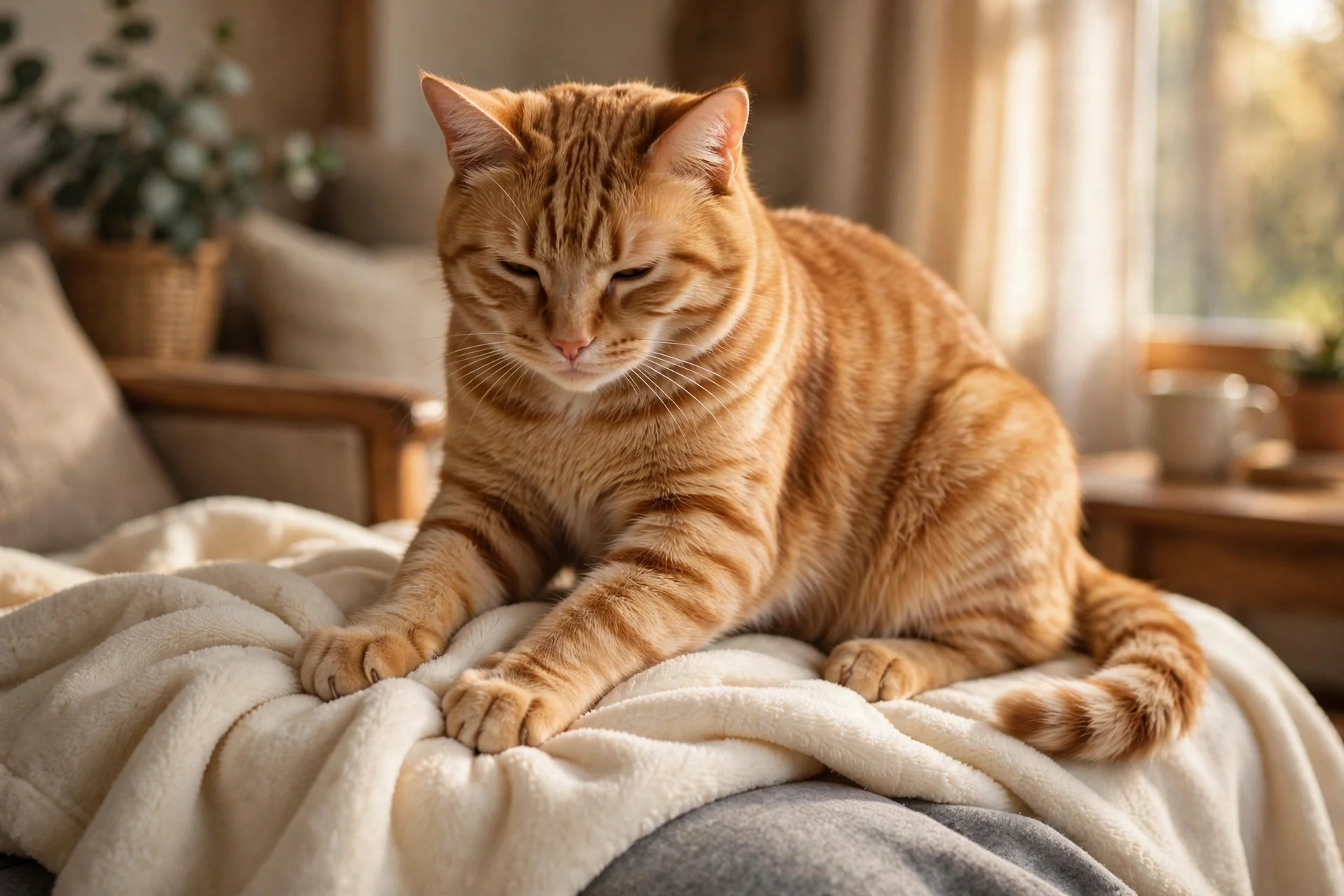
Kneading, often called “making biscuits,” is the rhythmic pushing of the front paws into a soft surface, one paw and then the other, over and over. PetMD describes it as an instinctual behavior, similar to the way a person kneads dough. The usual targets are blankets, bedding, a cushion, or a person’s lap — anything soft enough to give a little under the paws.
It is not the same as scratching or stretching. Scratching is a fast, dragging motion meant to strip the outer husk from the claws. Stretching is a long extension of the body. Kneading is slower and more deliberate, and it often comes with half-closed eyes, a loose body, purring, and sometimes drooling. Some cats keep their claws neatly tucked in. Others knead claws-out, with no apology at all. Most cats knead with the front paws only, though some use all four, and a few knead while sucking or chewing on the fabric beneath them.
It starts with milk
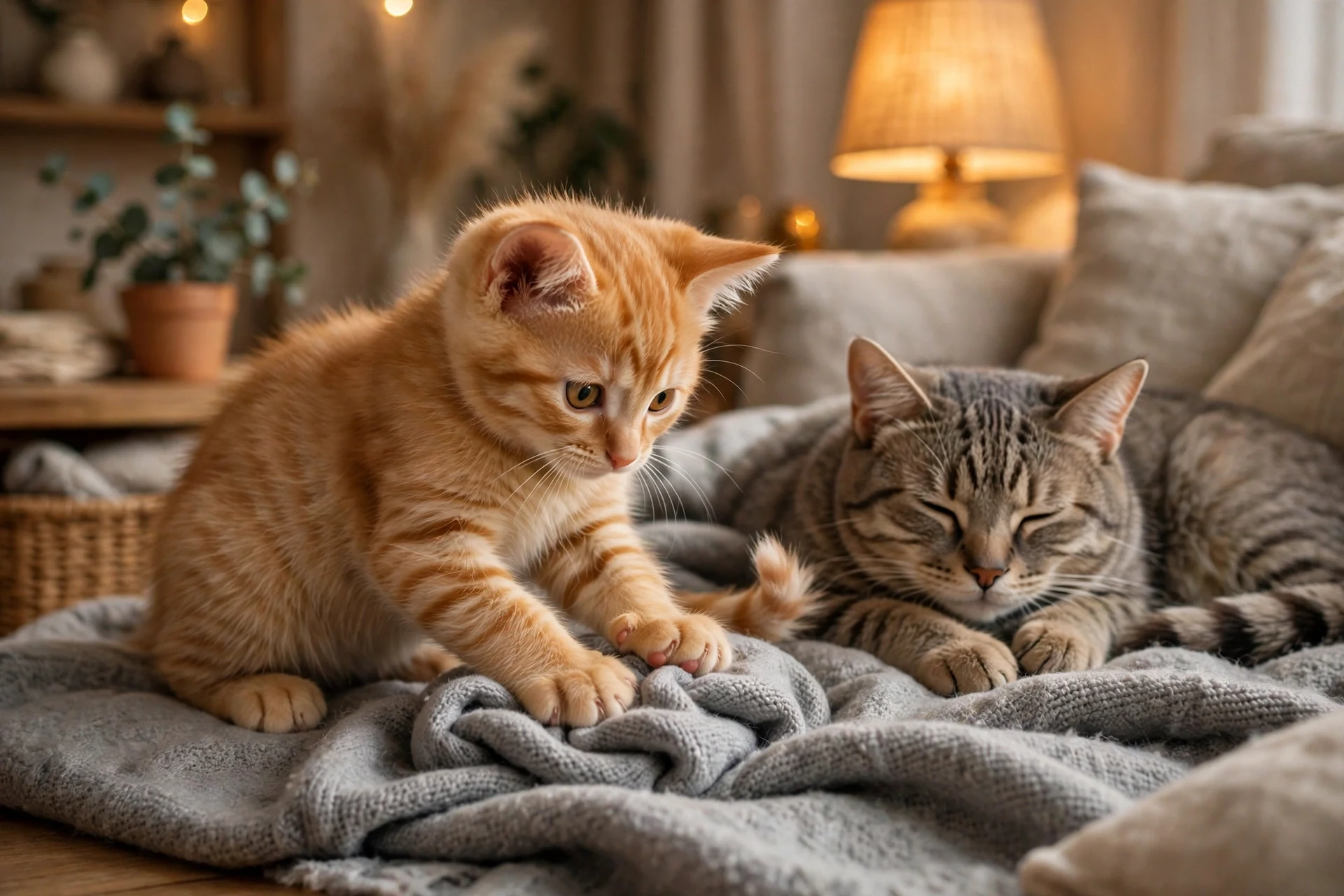
The one part of the story that is solid is where kneading begins. Newborn kittens press their front paws against their mother’s belly while nursing, treading with alternate paws to stimulate the flow of milk. International Cat Care describes it plainly: kittens suckle by treading with alternate front paws on the mother’s abdomen. PetMD and the veterinary behaviorists interviewed by Chewy give the same account.
That early experience ties kneading to warmth, close contact, and food: the kitten that kneads effectively eats better.
Most cats grow out of kneading once it stops being necessary, but a few keep it into adulthood, particularly in the presence of someone they feel safe with or on a soft, familiar surface. That much is agreed on by every credible source. Everything after this point is a matter of degree — which explanations fit adult cats best, and how much weight each one deserves.
Why adults keep doing it
There is no single proven reason adult cats knead. What exists instead is a short list of explanations, each with different levels of support. They are not mutually exclusive. A cat settling down for a nap may be doing several of these at once.
Comfort and settling down
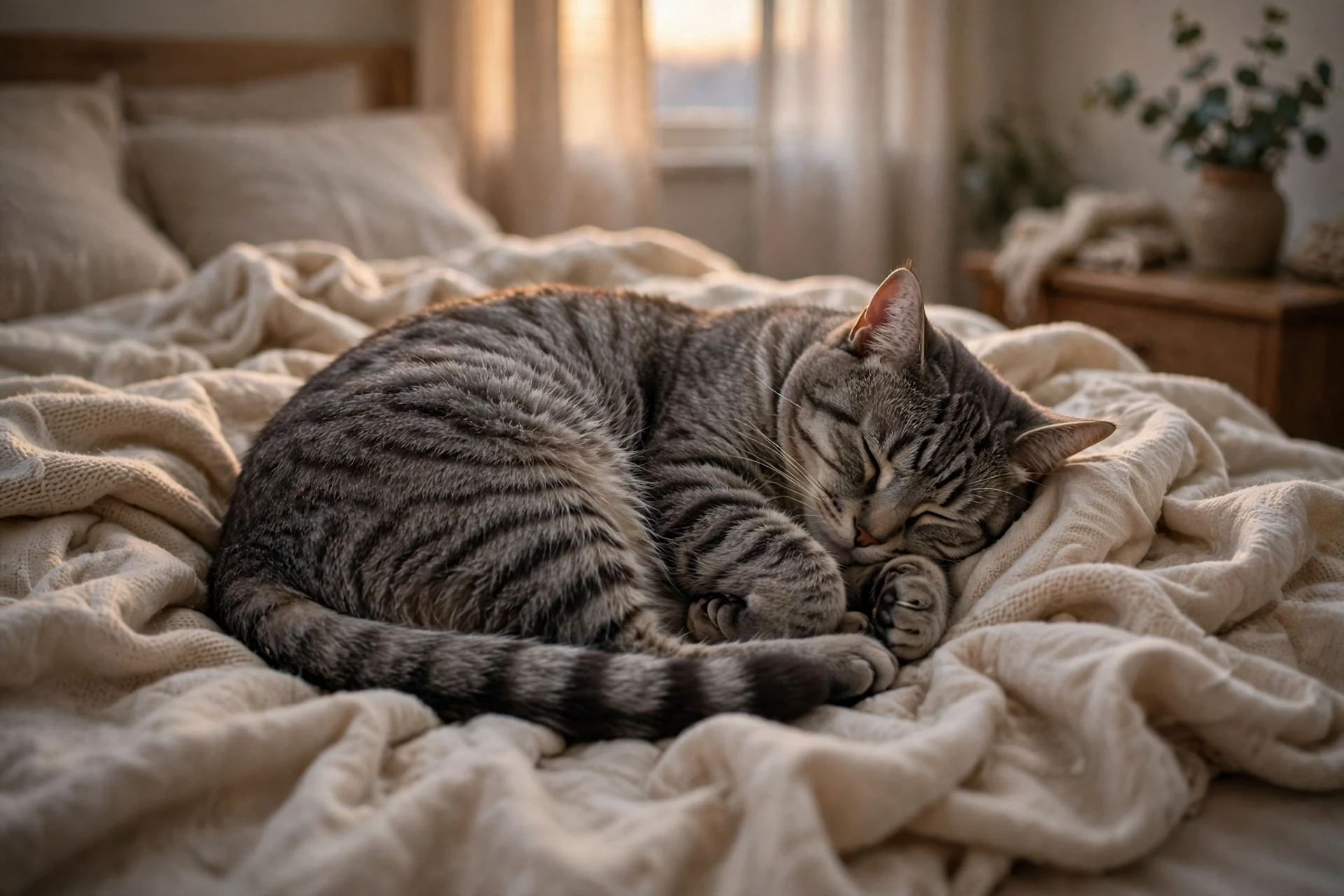
The best-supported explanation is also the simplest: kneading is part of how a cat settles. Adult cats often knead just before lying down, while resting on a familiar person, or on soft material. PetMD notes that wild feline species knead soft grasses and other bedding as they prepare for rest, and domestic cats do the same on beds, blankets, and favorite sleeping spots. It looks like a settling routine — the feline equivalent of circling before sleep — and it usually comes with the body language of a relaxed cat: loose posture, half-closed eyes, slow blinking, and purring.
Chewy’s experts note that nursing causes the release of oxytocin, a hormone involved in maternal bonding, so the movement may remind an adult cat of being near its mother. That is a plausible link, but it is an interpretation: what can be observed is the context — kneading happens most often when the cat is safe, warm, and about to rest.
Scent marking
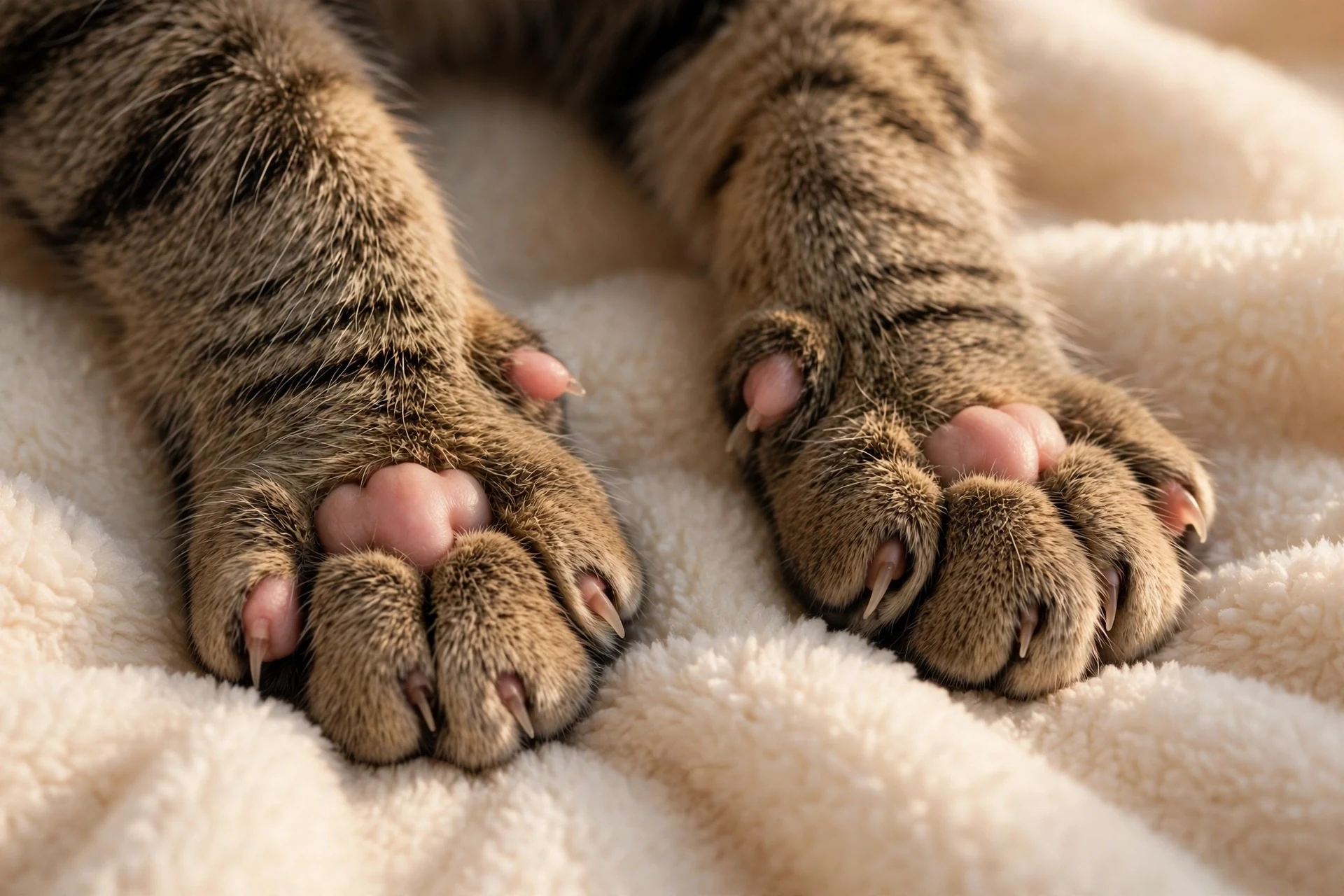
Cats have scent glands between their paw pads. When a cat kneads an object or a person, scent is deposited onto that surface. PetMD states this directly, and Chewy’s behaviorist, Cristy Brusoe, describes kneading as a way of marking territory by releasing pheromones that communicate with other cats. Figo’s veterinary-reviewed guide makes the same point: each push quietly marks territory, and even a person’s lap is fair game.
This explanation is often overstated. Marking a blanket with scent does not mean the cat is trying to dominate or possess a person. Scent is how cats organize familiar spaces: a kneaded blanket smells familiar, and familiar smells are part of what makes a resting place feel safe.
Stretching and tension relief
Some experts theorize that cats knead to stretch their muscles and relieve tension in their limbs. PetMD lists this among the theories, and Chewy’s Brusoe notes that stretching helps maintain muscle and tendon health, promoting flexibility and circulation — something that matters more for an inactive cat, where lack of movement can leave muscles and tendons tight. Figo adds that kneading may help stretch tendons and keep joints flexible, which could be why many cats knead just before settling down for a nap. It fits the timing, but it is still a theory rather than a measured fact: nobody has shown that a cat kneads because a specific muscle is tight.
Preparing a resting place
The oldest-sounding explanation is that kneading comes from wild cats pressing down grass and leaves to make a softer place to rest or give birth. Figo repeats this, and PetMD notes the same behavior in wild felines. But as PurrWise points out, this is difficult to prove as the cause of every episode: several functions can overlap — stretching, testing the surface, scent, and a learned comfort routine.
What kneading does not mean
Kneading attracts confident claims, and several of the most repeated ones are weaker than they sound.
It does not prove a cat was weaned too early. This is one of the most persistent myths about kneading. PurrWise is direct about it: kneading occurs in cats with many different histories, and early weaning should not be inferred from this behavior alone.
It is not proof of love, on its own. Kneading often happens in affectionate moments, and PetMD notes that kneading on a person can convey comfort and security. But a single behavior does not prove a single emotion. A cat that kneads is usually comfortable, and comfort in a person’s presence is a good sign. It is not a declaration of love, and it is not a ranking.
The brain chemistry is not settled. PetMD states that kneading causes the release of dopamine, a feel-good chemical, in the brain. But Figo’s guide, reviewed by veterinarian Jennifer Sperry, carries an important caution: the specific neurochemical pathways involved in kneading “have not been definitively mapped in cats,” and the roles of oxytocin and dopamine are “theoretical, but they’re extrapolated from what we know about other mammalian bonding and reward systems.” The chemistry story is plausible and widely repeated, but it has not been demonstrated in cats.
It is not always happiness. Most of the time, kneading accompanies a relaxed cat. But some cats knead when they are stressed or uncomfortable, using the same rhythmic motion to soothe themselves. PetMD notes that increased kneading can be a sign of discomfort or anxiety, and Chewy’s veterinary behaviorist, Wailani Sung, agrees it can be a self-soothing behavior. The difference is in the context: a loose, purring cat on a blanket is settling; a tense cat kneading hard, with restlessness or vocalizing, is telling a different story.
Why some cats knead and others barely do
If kneading is so natural, why do some cats do it constantly while others almost never do? Individual history, temperament, preferred textures, and reinforcement all matter. A cat that receives warmth and attention every time it kneads a particular blanket is likely to repeat the sequence. Another cat may show comfort through head rubbing, sleeping nearby, or slow blinking instead. Chewy’s experts note that frequency varies greatly and is influenced by individual personalities, past experiences, and levels of comfort, and that some cats are simply more inclined to the behavior than others.
There is no known sex difference, and outdoor cats may knead less because they have fewer safe, soft places to relax and more reason to stay alert.
None of this is a problem to solve. A cat that does not knead can still feel safe and bonded.
Living with a kneader
For most owners, kneading is a pleasure with one drawback: claws. A cat kneading bare skin or a favorite sweater can hurt, and the usual response — pushing the cat away, or worse, punishing it — is the wrong one. International Cat Care is clear that cats should never be punished for kneading, and PetMD warns that punishment may cause fear and anxiety, will not correct the behavior, and can actually make it worse.
What works instead is redirection and padding. Put a thick, folded blanket on your lap before the cat settles, or keep a soft fleece blanket on the couch where the cat likes to knead. PurrWise suggests tightly woven material that does not easily catch claws, and notes that if a cat consistently chooses one blanket, it is worth keeping it available in a washable resting spot — familiar scent may be part of its appeal.
Keep claws trimmed. Short claws make kneading comfortable for everyone. PetMD recommends keeping the cat’s nails trimmed short, and Chewy suggests getting the cat used to nail trims early in life with high-value treats. Introduce paw handling gradually when the cat is relaxed, and if you cannot clearly identify where to cut, ask a veterinary professional or an experienced groomer to demonstrate. Soft claw caps are another option.
If the cat kneads expensive bedding or a leather chair, put an acceptable blanket or bed beside that spot and reward the cat for using it; blocking the favored site first usually just moves the kneading elsewhere.
Never declaw. Declawing is not a solution to a kneading problem. PetMD states that cats should not be declawed for this reason: it is a painful procedure that involves removing the tips of the toes and can cause lameness and permanent nerve damage.
Kneading sometimes comes with sucking or chewing on fabric. Mouthing one safe fabric while relaxed is usually harmless, but loose threads, yarn, and fringe can be swallowing hazards, and persistent chewing or ingestion of non-food items should be discussed with a veterinarian. Never pull string or fabric from a cat’s mouth if it may already be swallowed; seek urgent veterinary guidance.
When kneading is worth a closer look
Kneading is almost always a normal behavioral variant. But a change in the behavior deserves attention, and the change matters more than the kneading itself.
Contact a veterinarian if new or intense kneading appears together with restlessness, hiding, appetite change, unusual vocalization, difficulty settling, mobility changes, paw injury, excessive drooling, or fabric ingestion. Figo’s Dr. Sperry advises that sudden, more intense kneading paired with vocalizing or restlessness can be an early sign of discomfort, anxiety, or medical issues such as osteoarthritis. PetMD adds that cats experiencing soreness from an injury or arthritis may knead to stretch their limbs and relieve muscle tension — and that if a cat is kneading more often than usual, its primary veterinarian should be consulted.
A cat that kneads one area of the body, seems unable to get comfortable, or reacts painfully to touch needs assessment rather than repeated testing at home. Recording when the behavior occurs and what accompanies it gives the veterinary team something useful to work with. An unspayed female in season may also knead more often.
None of this means kneading itself is a warning sign. It means kneading, like any behavior, is most informative when it changes.
Frequently asked questions
Why does my cat knead me but not other people?
Your lap may offer the preferred combination of warmth, texture, position, scent, and history. It can reflect comfort without meaning the cat ranks people in a strict hierarchy. The person the cat kneads is usually the one whose lap is warmest, softest, and most familiar — not necessarily a chosen favorite.
Why do claws come out when my cat kneads?
Claw extension can be part of the alternating paw movement. It is not deliberate and it is not the cat trying to hurt anyone. A thick blanket between the paws and your skin, plus regular claw trims, solves most of the problem without stopping a normal behavior.
Why does my cat drool while kneading?
Some cats drool mildly when deeply relaxed, and kneading is one of the moments when it happens — International Cat Care notes that some cats dribble uncontrollably as they anticipate the milk-feed that kneading usually predicted. Mild drooling in a relaxed cat is usually nothing to worry about. New, heavy, or persistent drooling, especially with mouth odor, eating difficulty, or pawing at the face, should be discussed with a veterinarian.
Can I stop my cat from kneading?
It is better to redirect the location or add padding than to suppress a normal behavior. Provide an acceptable soft surface, keep claws trimmed, and calmly end lap sessions when needed by standing up slowly or luring the cat toward a prepared bed. Never punish a cat for kneading.
Do all cats knead?
No. Some cats knead often, some rarely, and some almost never. Frequency varies with personality, history, texture preference, and how safe and relaxed the cat feels. A cat that does not knead can still feel safe and bonded — kneading is only one way a cat shows comfort.
Kneading begins as a kitten’s nursing behavior and often continues as part of adult comfort, settling, scent, and social routines. The nursing origin is solid; the adult reasons are overlapping theories, and the brain chemistry is still unproven in cats. Offer a safe blanket, protect your lap, keep the claws trimmed, and let the cat choose the moment — and if the rhythm changes, pay attention to what changed with it.